Kay Christina D, Seidenberg Michael, Durgerian Sally, Nielson Kristy A, Smith J Carson, Woodard John L, Rao Stephen M
a Department of Psychology , Rosalind Franklin University of Medicine and Science , North Chicago , IL , USA.
b Department of Neurology and the Center for Imaging Research , Medical College of Wisconsin , Milwaukee , WI , USA.
J Clin Exp Neuropsychol. 2017 Nov;39(9):866-875. doi: 10.1080/13803395.2016.1273321. Epub 2017 Jan 4.
Intraindividual variability (IIV) in motor performance has been shown to predict future cognitive decline. The apolipoprotein E-epsilon 4 (APOE-ε4) allele is also a well-established risk factor for memory decline. Here, we present novel findings examining the influence of the APOE-ε4 allele on the performance of asymptomatic healthy elders in comparison to individuals with amnestic MCI (aMCI) on a fine motor synchronization, paced finger-tapping task (PFTT).
Two Alzheimer's disease (AD) risk groups, individuals with aMCI (n = 24) and cognitively intact APOE-ε4 carriers (n = 41), and a control group consisting of cognitively intact APOE-ε4 noncarriers (n = 65) completed the Rey Auditory Verbal Learning Test and the PFTT, which requires index finger tapping in synchrony with a visual stimulus (interstimulus interval = 333 ms).
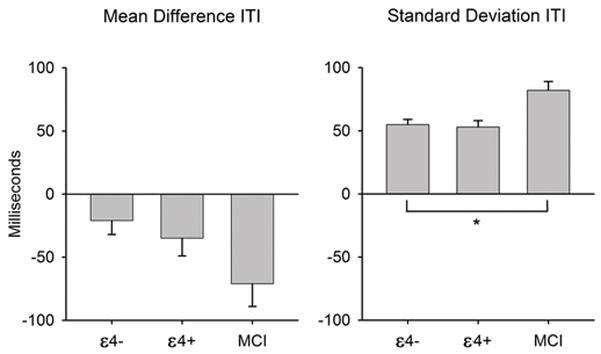
Motor timing IIV, as reflected by the standard deviation of the intertap interval (ITI), was greater in the aMCI group than in the two groups of cognitively intact elders; in contrast, all three groups had statistically equivalent mean ITI. No significant IIV differences were observed between the asymptomatic APOE-ε4 carriers and noncarriers. Poorer episodic memory performance was associated with greater IIV, particularly in the aMCI group.
Results suggest that increased IIV on a fine motor synchronization task is apparent in aMCI. This IIV measure was not sensitive in discriminating older asymptomatic individuals at genetic risk for AD from those without such a genetic risk. In contrast, episodic memory performance, a well-established predictor of cognitive decline in preclinical AD, was able to distinguish between the two cognitively intact groups based on genetic risk.
运动表现的个体内变异性(IIV)已被证明可预测未来的认知衰退。载脂蛋白E-ε4(APOE-ε4)等位基因也是记忆衰退的一个公认风险因素。在此,我们展示了新的研究结果,即与遗忘型轻度认知障碍(aMCI)个体相比,研究APOE-ε4等位基因对无症状健康老年人在精细运动同步、定时手指轻敲任务(PFTT)中的表现的影响。
两个阿尔茨海默病(AD)风险组,aMCI个体(n = 24)和认知功能正常的APOE-ε4携带者(n = 41),以及一个由认知功能正常的APOE-ε4非携带者组成的对照组(n = 65)完成了雷伊听觉词语学习测验和PFTT,该任务要求食指与视觉刺激同步轻敲(刺激间隔 = 333毫秒)。
以轻敲间隔(ITI)的标准差反映的运动定时IIV在aMCI组中比在两组认知功能正常的老年人中更大;相比之下,三组的平均ITI在统计学上相当。在无症状的APOE-ε4携带者和非携带者之间未观察到显著的IIV差异。较差的情景记忆表现与更大的IIV相关,尤其是在aMCI组中。
结果表明,在精细运动同步任务中IIV增加在aMCI中很明显。这种IIV测量方法在区分有AD遗传风险的无症状老年人和无此类遗传风险的老年人方面不敏感。相比之下,情景记忆表现是临床前AD认知衰退的一个公认预测指标,能够根据遗传风险区分这两个认知功能正常的组。