Jung Hyun Jin, Shin Hong Seok
Department of Urology, Catholic University of Daegu School of Medicine, Daegu, Korea.
World J Mens Health. 2016 Dec;34(3):194-199. doi: 10.5534/wjmh.2016.34.3.194. Epub 2017 Jan 23.
We aimed to evaluate the effect of testosterone replacement therapy (TRT) on cognitive function and depression in men with testosterone deficiency syndrome.
We carried out a prospective, placebo-controlled trial involving 106 men with total testosterone levels <3.3 ng/mL and symptoms of hypogonadism. Based on whether the patients received TRT (injection with 1,000 mg testosterone undecanoate) or a placebo (advice to modify lifestyle), the study population was divided into a TRT group (n=54) and a control group (n=52).
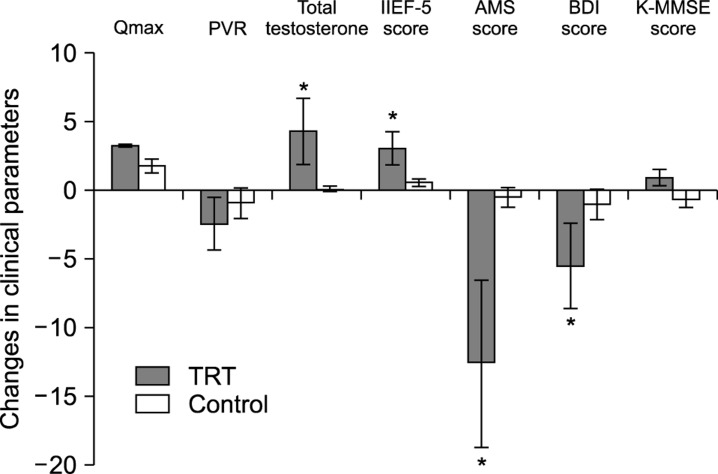
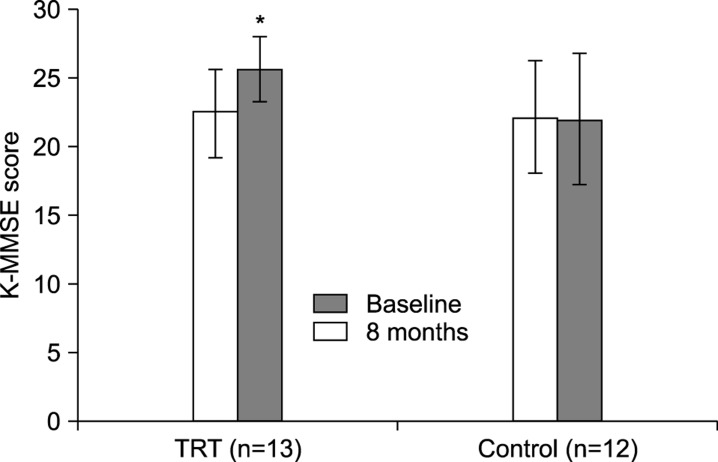
The age among patients in the TRT and control groups was 56.7±12.6 years and 57.8±11.4 years, respectively (p> 0.05). At baseline, no significant differences between the TRT and control groups were noted regarding serum testosterone or prostate-specific antigen levels, or regarding the scores for aging symptoms (Aging Males' Symptoms scale), erectile function (5-item International Index of Erectile Function questionnaire), cognitive function (Korean Mini-Mental State Examination), and depression (Beck Depression Inventory). At 8 months after intervention total serum testosterone levels and erectile function scores had significantly increased (p<0.05), whereas the scores for aging symptoms and depression had significantly decreased (p<0.05) in the TRT group; no significant improvement in any parameters was noted for the control group. Notably, significant improvement in cognitive function was noted among patients with cognitive impairment at baseline (cognitive function score <25) who received TRT.
TRT may be considered in men with testosterone deficiency syndrome if low testosterone levels are associated with depression or cognitive impairment.
我们旨在评估睾酮替代疗法(TRT)对睾酮缺乏综合征男性认知功能和抑郁的影响。
我们进行了一项前瞻性、安慰剂对照试验,纳入了106名总睾酮水平<3.3 ng/mL且有性腺功能减退症状的男性。根据患者是否接受TRT(注射1000 mg十一酸睾酮)或安慰剂(建议改变生活方式),将研究人群分为TRT组(n = 54)和对照组(n = 52)。
TRT组和对照组患者的年龄分别为56.7±12.6岁和57.8±11.4岁(p>0.05)。基线时,TRT组和对照组在血清睾酮或前列腺特异性抗原水平、衰老症状评分(衰老男性症状量表)、勃起功能(5项国际勃起功能指数问卷)、认知功能(韩国简易精神状态检查)和抑郁(贝克抑郁量表)方面均无显著差异。干预8个月后,TRT组的总血清睾酮水平和勃起功能评分显著升高(p<0.05),而衰老症状和抑郁评分显著降低(p<0.05);对照组在任何参数上均无显著改善。值得注意的是,基线时认知功能受损(认知功能评分<25)且接受TRT的患者在认知功能方面有显著改善。
如果低睾酮水平与抑郁或认知障碍相关,睾酮缺乏综合征男性可考虑使用TRT。