Department of Pharmacology and Chemical Biology, University of Pittsburgh, Pittsburgh, PA, 15261, USA.
Fondazione Ri.MED, Palermo, 90133, Italy.
Sci Rep. 2017 Jan 5;7:39900. doi: 10.1038/srep39900.
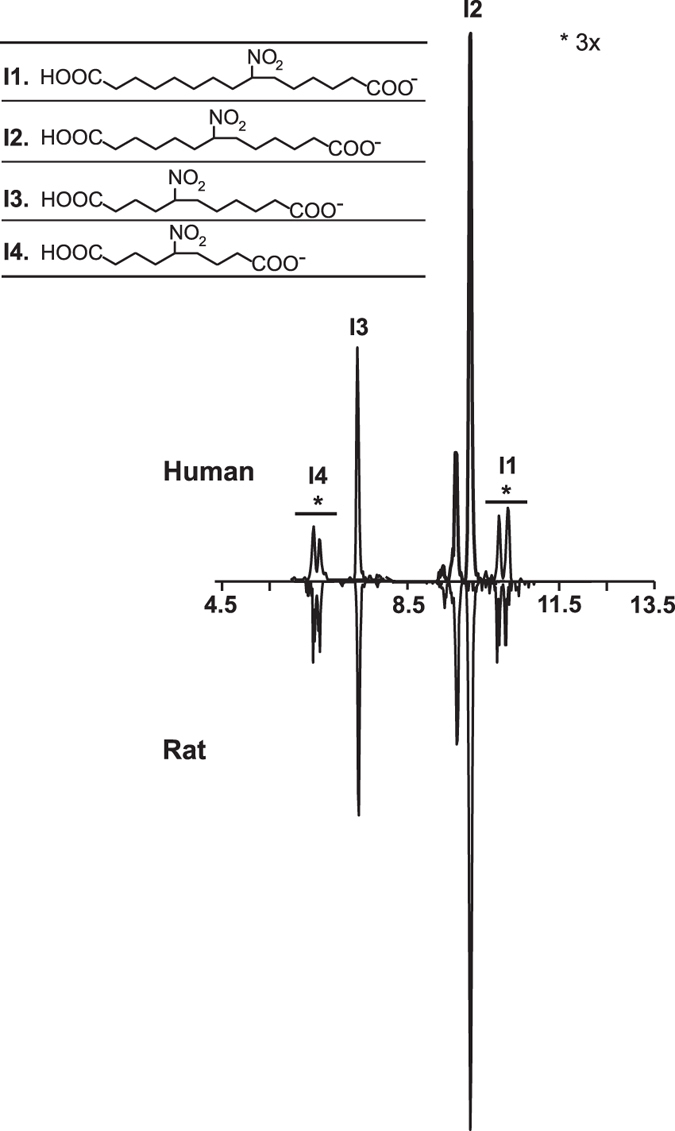
Nitrated fatty acids are endogenously present in human and animal tissues, as well as in plant-derived oils. In particular, 10-nitro oleic acid (10-NO-OA) potently induces Nrf2-dependent antioxidant gene expression and inhibits TLR4/NF-κB signaling, thus promoting an overall cyto-protective and anti-inflammatory response. 10-NO-OA has been extensively tested in animal models and is currently undergoing clinical evaluation in humans. Bio-elimination pathways for 10-NO-OA were evaluated in rats (30 mg/kg·day) and in humans (0.34 mg/kg) using samples obtained from a double-blind, dose-rising clinical trial. Quantitative radiochromatographic/MS analysis indicated that the renal and fecal pathways are the main routes for 10-NO-OA excretion in rats, and allowed the identification of 4-nitro-octanedioic acid (NO-8:0-diCOOH) as the most abundant metabolite in rat urine. In addition, high resolution LC-MS/MS analysis revealed the presence of a novel series of urinary metabolites including ω-carboxylation and β-oxidation products, as well as N-acetylcysteine, taurine and sulfo-conjugates in both rats and humans. Overall, the findings reported herein not only provide valuable tools for the experimental evaluation of 10-NO-OA levels in vivo, but importantly they also set the basis for monitoring its metabolism during potential clinical interventions in humans.
硝态脂肪酸存在于人和动物组织以及植物源性油中。特别是,10-硝基油酸(10-NO-OA)能够强烈诱导 Nrf2 依赖性抗氧化基因表达,抑制 TLR4/NF-κB 信号通路,从而促进整体细胞保护和抗炎反应。10-NO-OA 已在动物模型中进行了广泛测试,目前正在人类中进行临床评估。使用来自双盲、剂量递增临床试验的样本,在大鼠(30mg/kg·天)和人类(0.34mg/kg)中评估了 10-NO-OA 的生物消除途径。定量放射性色谱/MS 分析表明,肾脏和粪便途径是大鼠 10-NO-OA 排泄的主要途径,并确定 4-硝基辛二酸(NO-8:0-diCOOH)为大鼠尿液中含量最丰富的代谢物。此外,高分辨率 LC-MS/MS 分析表明,在大鼠和人类中存在一系列新型尿代谢物,包括 ω-羧化和β-氧化产物,以及 N-乙酰半胱氨酸、牛磺酸和磺基缀合物。总之,本文的研究结果不仅为体内 10-NO-OA 水平的实验评估提供了有价值的工具,而且为监测其在人类潜在临床干预期间的代谢奠定了基础。