Pendharkar Sayali A, Asrani Varsha M, Murphy Rinki, Cutfield Richard, Windsor John A, Petrov Maxim S
Department of Surgery, University of Auckland, Auckland, New Zealand.
Department of Medicine, University of Auckland, Auckland, New Zealand.
Clin Transl Gastroenterol. 2017 Jan 5;8(1):e210. doi: 10.1038/ctg.2016.63.
Diabetes has become an epidemic in developed and developing countries alike, with an increased demand for new efficacious treatments. A large body of pre-clinical evidence suggests that the gut-brain axis may be exploited as a potential therapeutic target for defective glucose homeostasis. This clinical study aimed to investigate a comprehensive panel of glucoregulatory peptides, released by both the gut and brain, in individuals after acute pancreatitis.
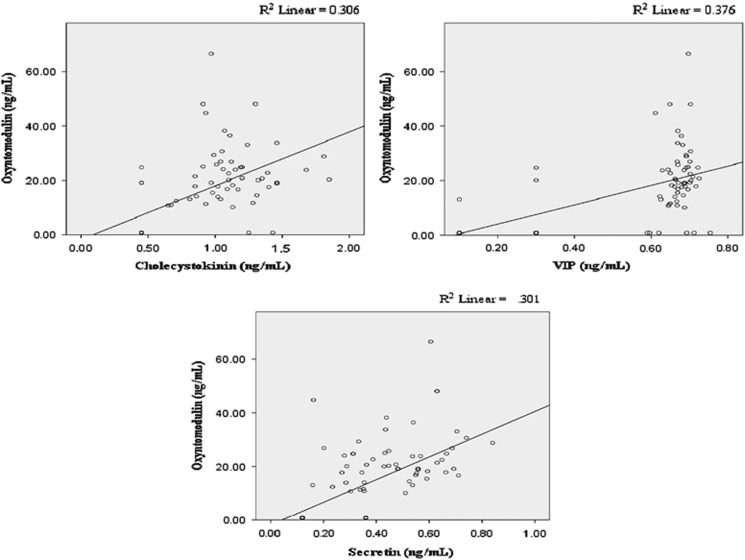
Fasting levels of glucagon-like peptide-1 (GLP-1), glicentin, oxyntomodulin, peptide YY, ghrelin, cholecystokinin, vasoactive intestinal peptide (VIP), and secretin were studied. Modified Poisson and multivariable linear regression analyses were conducted. Pre-determined concentration ranges were used to categorize each peptide into quartiles.
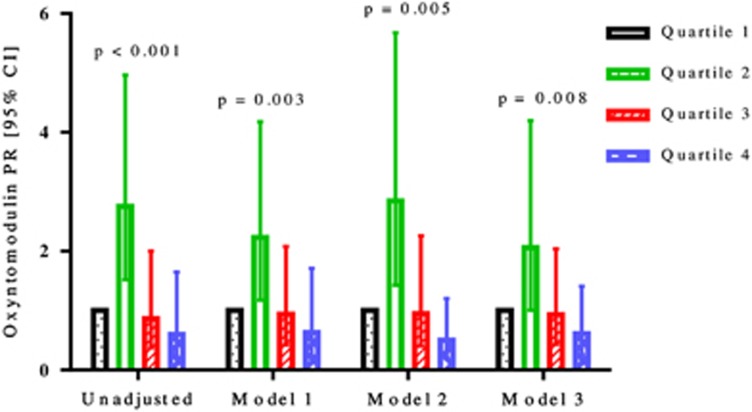
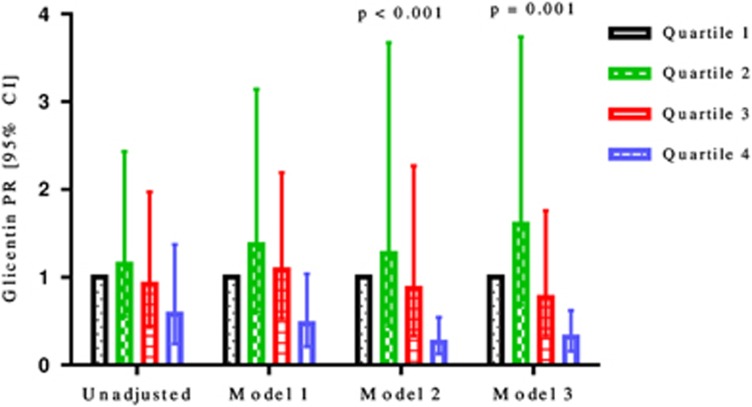
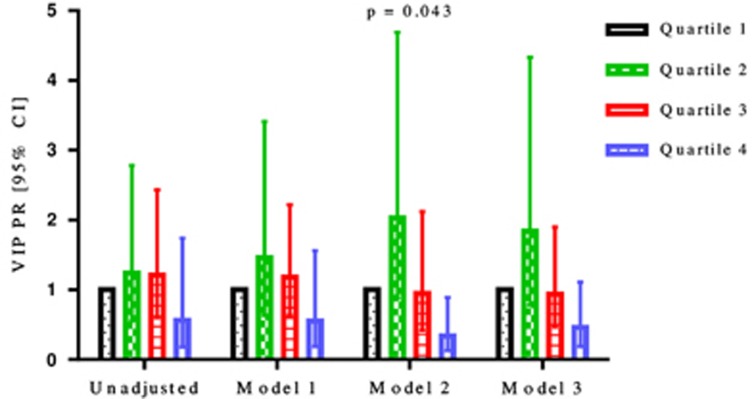
A total of 83 individuals were included, of who 30 (36%) developed abnormal glucose metabolism (AGM) after acute pancreatitis. In individuals with AGM, the highest quartile of oxyntomodulin differed most significantly from the lowest quartile with a prevalence ratio (PR; 95% confidence interval) of 0.50 (0.21, 1.20; P=0.005); of glicentin with a PR of 0.26 (0.13, 0.54; P<0.001); and of VIP with a PR of 0.34 (0.13, 0.89; P=0.043). Peptide YY, GLP-1, cholecystokinin, ghrelin, and secretin were not significantly associated with AGM.
Fasting circulating oxyntomodulin, glicentin, and VIP levels are significantly decreased in patients with defective glucose homeostasis after acute pancreatitis. Oxyntomodulin appears to be a promising therapeutic target for future clinical studies on diabetes associated with diseases of the exocrine pancreas.
糖尿病在发达国家和发展中国家都已成为一种流行病,对新型有效治疗方法的需求不断增加。大量临床前证据表明,肠-脑轴可作为葡萄糖稳态缺陷的潜在治疗靶点。本临床研究旨在调查急性胰腺炎患者肠道和大脑释放的一组全面的葡萄糖调节肽。
研究了胰高血糖素样肽-1(GLP-1)、胃泌酸调节素、胃动素、肽YY、ghrelin、胆囊收缩素、血管活性肠肽(VIP)和促胰液素的空腹水平。进行了修正泊松回归分析和多变量线性回归分析。使用预先确定的浓度范围将每种肽分为四分位数。
共纳入83名个体,其中30名(36%)在急性胰腺炎后出现异常糖代谢(AGM)。在AGM患者中,胃动素最高四分位数与最低四分位数差异最为显著,患病率比(PR;95%置信区间)为0.50(0.21,1.20;P = 0.005);胃泌酸调节素的PR为0.26(0.13,0.54;P < 0.001);VIP的PR为0.34(0.13,0.89;P = 0.043)。肽YY、GLP-1、胆囊收缩素、ghrelin和促胰液素与AGM无显著关联。
急性胰腺炎后糖稳态缺陷患者的空腹循环胃动素、胃泌酸调节素和VIP水平显著降低。胃动素似乎是未来关于外分泌胰腺疾病相关糖尿病临床研究的一个有前景的治疗靶点。