Mofid Layla S, Casapía Martín, Aguilar Eder, Silva Hermánn, Montresor Antonio, Rahme Elham, Fraser William D, Marquis Grace S, Vercruysse Jozef, Allen Lindsay H, Blouin Brittany, Razuri Hugo, Pezo Lidsky, Gyorkos Theresa W
Department of Epidemiology, Biostatistics and Occupational Health, McGill University, Montréal, Québec, Canada.
Division of Clinical Epidemiology, Research Institute of the McGill University Health Centre, Montréal, Québec, Canada.
PLoS Negl Trop Dis. 2017 Jan 5;11(1):e0005098. doi: 10.1371/journal.pntd.0005098. eCollection 2017 Jan.
Nutritional interventions targeting the critical growth and development period before two years of age can have the greatest impact on health trajectories over the life course. Compelling evidence has demonstrated that interventions investing in maternal health in the first 1000 days of life are beneficial for both mothers and their children. One such potential intervention is deworming integrated into maternal postpartum care in areas where soil-transmitted helminth (STH) infections are endemic.
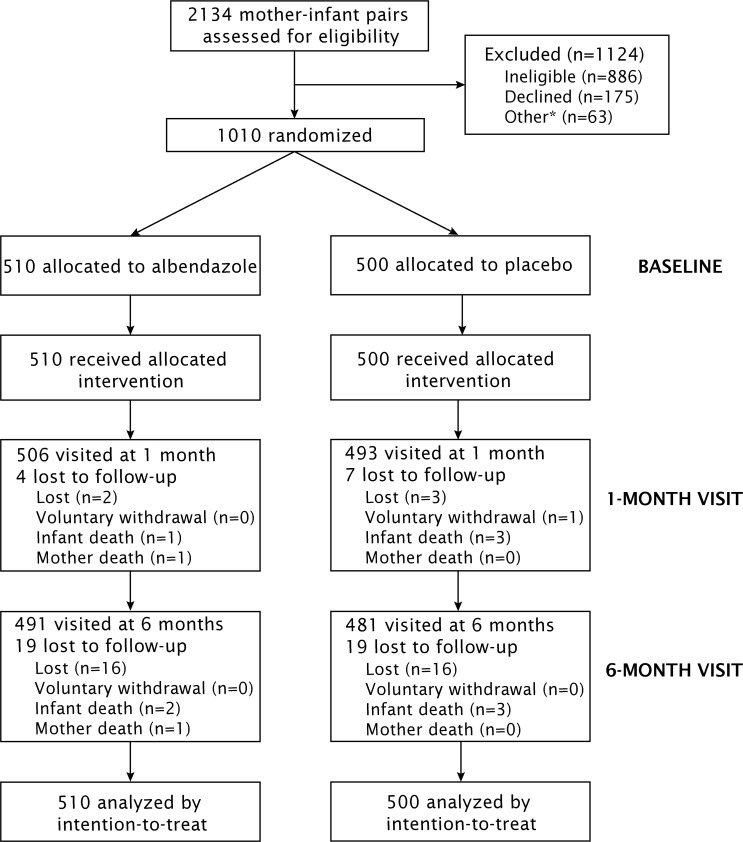
METHODOLOGY/PRINCIPAL FINDINGS: From February to August 2014, 1010 mother-infant pairs were recruited into a trial aimed at assessing the effectiveness of maternal postpartum deworming on infant and maternal health outcomes. Following delivery, mothers were randomly assigned to receive either single-dose 400 mg albendazole or placebo. Participants were followed-up at 1 and 6 months postpartum. There was no statistically significant difference in mean weight gain between infants in the experimental and control groups (mean difference: -0.02; 95% CI: -0.1, 0.08) at 6 months of age. Further, deworming had no effect on measured infant morbidity indicators. However, ad hoc analyses restricted to mothers who tested positive for STHs at baseline suggest that infants of mothers in the experimental group had greater mean length gain in cm (mean difference: 0.8; 95% CI: 0.1, 1.4) and length-for-age z-score (mean difference: 0.5; 95% CI: 0.2, 0.8) at 6 months of age.
CONCLUSIONS/SIGNIFICANCE: In a study population composed of both STH-infected and uninfected mothers, maternal postpartum deworming was insufficient to impact infant growth and morbidity indicators up to 6 months postpartum. Among STH-infected mothers, however, important improvements in infant length gain and length-for-age were observed. The benefits of maternal postpartum deworming should be further investigated in study populations having higher overall prevalences and intensities of STH infections and, in particular, where whipworm and hookworm infections are of public health concern.
ClinicalTrials.gov (NCT01748929).
针对两岁前关键生长发育阶段的营养干预措施,对一生的健康轨迹可能产生最大影响。有力证据表明,在生命最初1000天投资于孕产妇健康的干预措施对母亲及其子女均有益。一种这样的潜在干预措施是在土壤传播蠕虫(STH)感染流行地区,将驱虫纳入产后护理中。
方法/主要发现:2014年2月至8月,招募了1010对母婴参与一项旨在评估产后驱虫对婴儿和母亲健康结局有效性的试验。分娩后,母亲们被随机分配接受单剂量400毫克阿苯达唑或安慰剂。在产后1个月和6个月对参与者进行随访。6个月大时,实验组和对照组婴儿的平均体重增加没有统计学上的显著差异(平均差异:-0.02;95%置信区间:-0.1,0.08)。此外,驱虫对所测量的婴儿发病指标没有影响。然而,仅限于基线时STH检测呈阳性的母亲的临时分析表明,实验组母亲的婴儿在6个月大时平均身长增加更多(厘米)(平均差异:0.8;95%置信区间:0.1,1.4),且年龄别身长Z评分更高(平均差异:0.5;95%置信区间:0.2,0.8)。
结论/意义:在一个由STH感染和未感染母亲组成的研究人群中,产后驱虫不足以影响产后6个月内婴儿的生长和发病指标。然而,在STH感染的母亲中,观察到婴儿身长增加和年龄别身长有重要改善。应在STH感染总体患病率和感染强度更高,特别是鞭虫和钩虫感染成为公共卫生问题的研究人群中,进一步研究产后驱虫的益处。
ClinicalTrials.gov(NCT01748929)。