Kitazawa Masato, Hida Shigeaki, Fujii Chifumi, Taniguchi Shun'ichiro, Ito Kensuke, Matsumura Tomio, Okada Nagisa, Sakaizawa Takashi, Kobayashi Akira, Takeoka Michiko, Miyagawa Shin-Ichi
Department of Surgery, Shinshu University School of Medicine, Matsumoto, Japan.
Department of Molecular Oncology, Shinshu University Graduate School of Medicine, Matsumoto, Japan.
PLoS One. 2017 Jan 5;12(1):e0169340. doi: 10.1371/journal.pone.0169340. eCollection 2017.
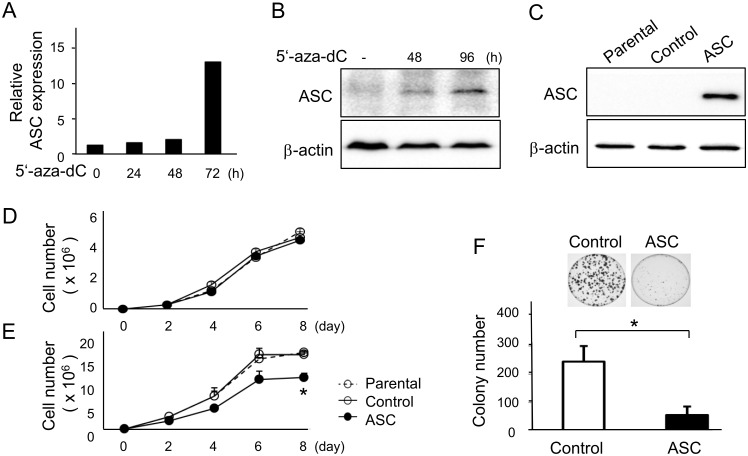
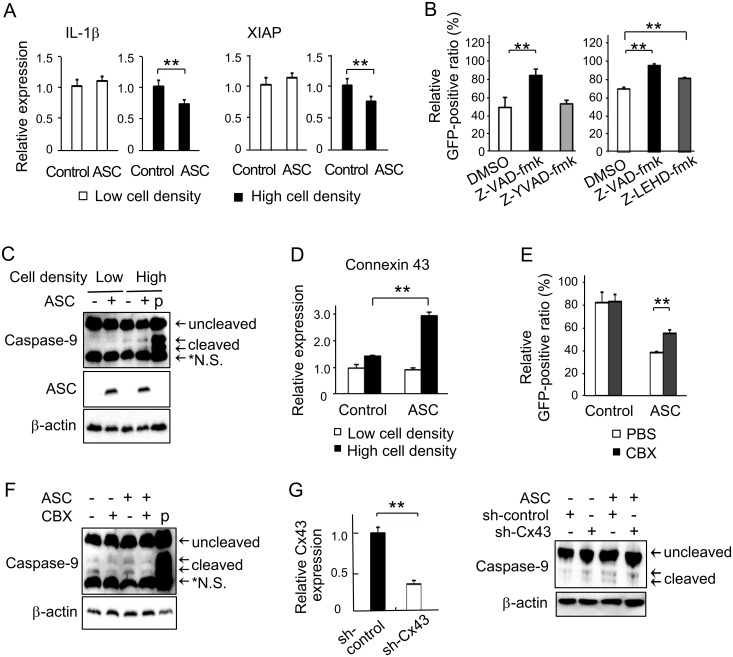
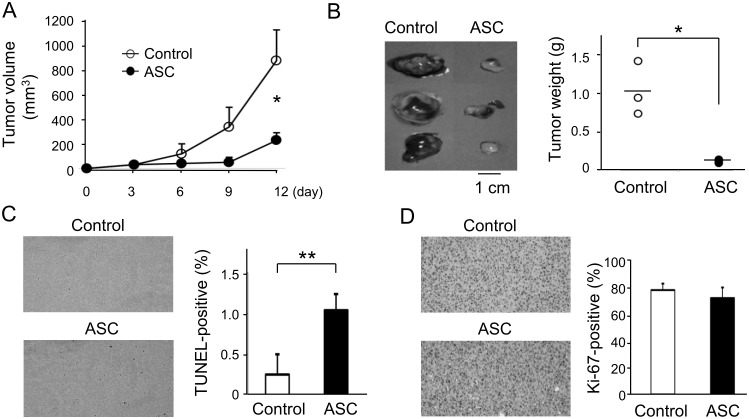
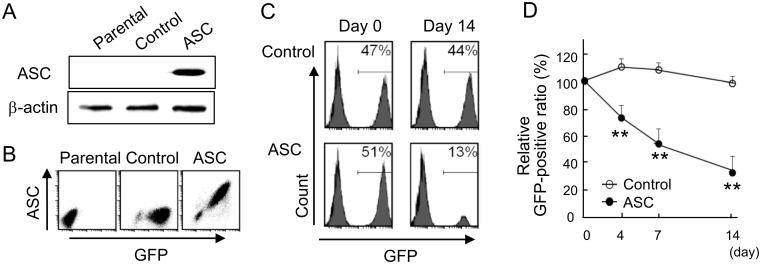
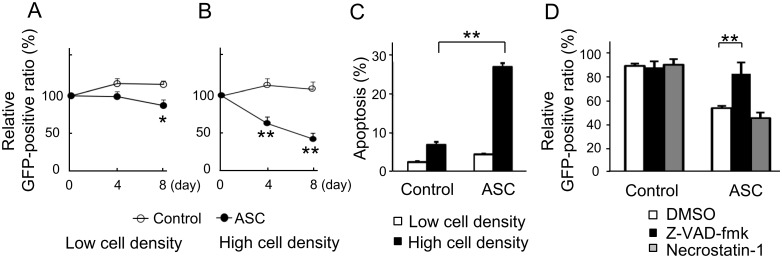
ASC (apoptosis-associated speck-like protein containing a CARD) is a key adaptor molecule of inflammasomes that mediates inflammatory and apoptotic signals. Aberrant methylation-induced silencing of ASC has been observed in a variety of cancer cells, thus implicating ASC in tumor suppression, although this role remains incompletely defined especially in the context of closely neighboring cell proliferation. As ASC has been confirmed to be silenced by abnormal methylation in HT1080 fibrosarcoma cells as well, this cell line was investigated to characterize the precise role and mechanism of ASC in tumor progression. The effects of ASC were examined using in vitro cell cultures based on comparisons between low and high cell density conditions as well as in a xenograft murine model. ASC overexpression was established by insertion of the ASC gene into pcDNA3 and pMX-IRES-GFP vectors, the latter being packed into a retrovirus and subjected to reproducible competitive assays using parental cells as an internal control, for evaluation of cell viability. p21 and p53 were silenced using shRNA. Cell viability was suppressed in ASC-expressing transfectants as compared with control cells at high cell density conditions in in vitro culture and colony formation assays and in in vivo ectopic tumor formation trials. This suppression was not detected in low cell density conditions. Furthermore, remarkable progression of apoptosis was observed in ASC-introduced cells at a high cell density, but not at a low one. ASC-dependent apoptosis was mediated not by p21, p53, or caspase-1, but rather by cleavage of caspase-9 as well as by suppression of the NF-κB-related X-linked inhibitor-of-apoptosis protein. Caspase-9 cleavage was observed to be dependent on gap junction formation. The remarkable effect of ASC on the induction of apoptosis through caspase-9 and gap junctions revealed in this study may lead to promising new approaches in anticancer therapy.
含半胱天冬酶激活和招募结构域的凋亡相关斑点样蛋白(ASC)是炎性小体的关键衔接分子,介导炎症和凋亡信号。在多种癌细胞中已观察到ASC因异常甲基化而沉默,这表明ASC具有肿瘤抑制作用,尽管这一作用尤其是在邻近细胞增殖的背景下仍未完全明确。由于ASC在HT1080纤维肉瘤细胞中也被证实因异常甲基化而沉默,因此对该细胞系进行了研究,以明确ASC在肿瘤进展中的精确作用和机制。基于低细胞密度和高细胞密度条件的比较,在体外细胞培养以及异种移植小鼠模型中检测了ASC的作用。通过将ASC基因插入pcDNA3和pMX-IRES-GFP载体来实现ASC的过表达,后者被包装成逆转录病毒,并使用亲本细胞作为内部对照进行可重复的竞争性试验,以评估细胞活力。使用短发夹RNA(shRNA)使p21和p53沉默。在体外培养和集落形成试验以及体内异位肿瘤形成试验中,与对照细胞相比,在高细胞密度条件下,表达ASC的转染子的细胞活力受到抑制。在低细胞密度条件下未检测到这种抑制作用。此外,在高细胞密度下引入ASC的细胞中观察到凋亡明显进展,而在低细胞密度下则未观察到。ASC依赖性凋亡不是由p21、p53或半胱天冬酶-1介导的,而是由半胱天冬酶-9的切割以及核因子κB相关的X连锁凋亡抑制蛋白的抑制介导的。观察到半胱天冬酶-9的切割依赖于间隙连接的形成。本研究中揭示的ASC通过半胱天冬酶-9和间隙连接诱导凋亡的显著作用可能会为抗癌治疗带来有前景的新方法。