Kitazawa Masato, Miyagawa Yusuke, Koyama Makoto, Nakamura Satoshi, Hondo Nao, Miyazaki Satoru, Muranaka Futoshi, Tokumaru Shigeo, Yamamoto Yuta, Ehara Takehito, Kuroiwa Masatsugu, Tanaka Hirokazu, Komatsu Daisuke, Takeoka Michiko, Soejima Yuji
Department of Surgery, Shinshu University School of Medicine, Matsumoto, Nagano 390-8621, Japan.
Department of Surgery, Jinai Hospital, Ina, Nagano 396-0026, Japan.
Mol Clin Oncol. 2021 Jul;15(1):148. doi: 10.3892/mco.2021.2310. Epub 2021 May 28.
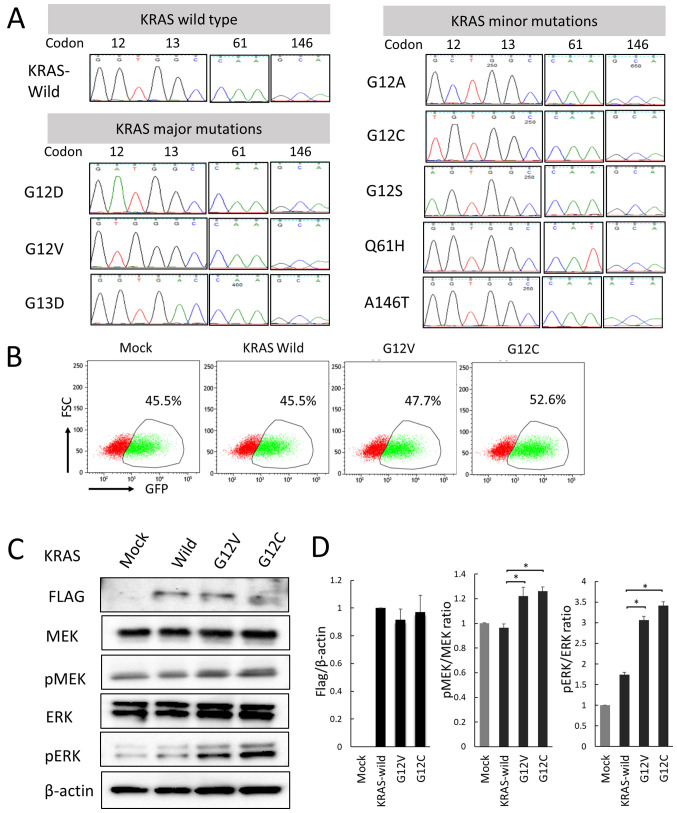
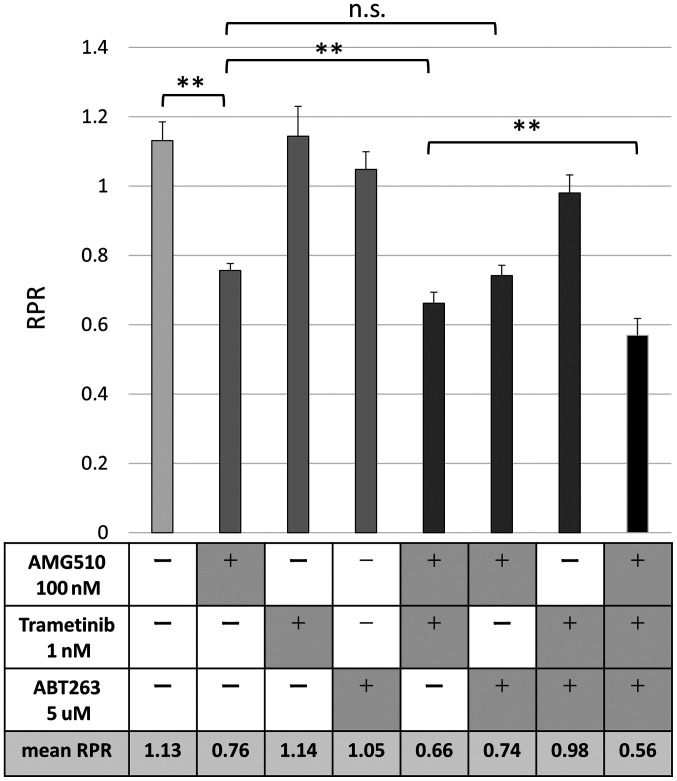
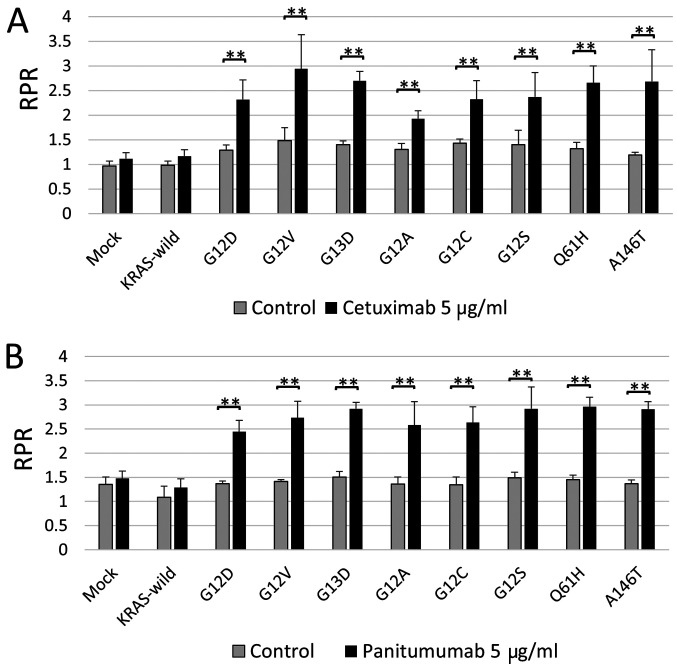
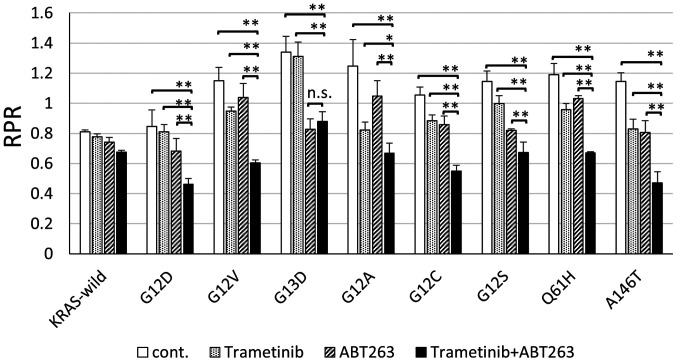
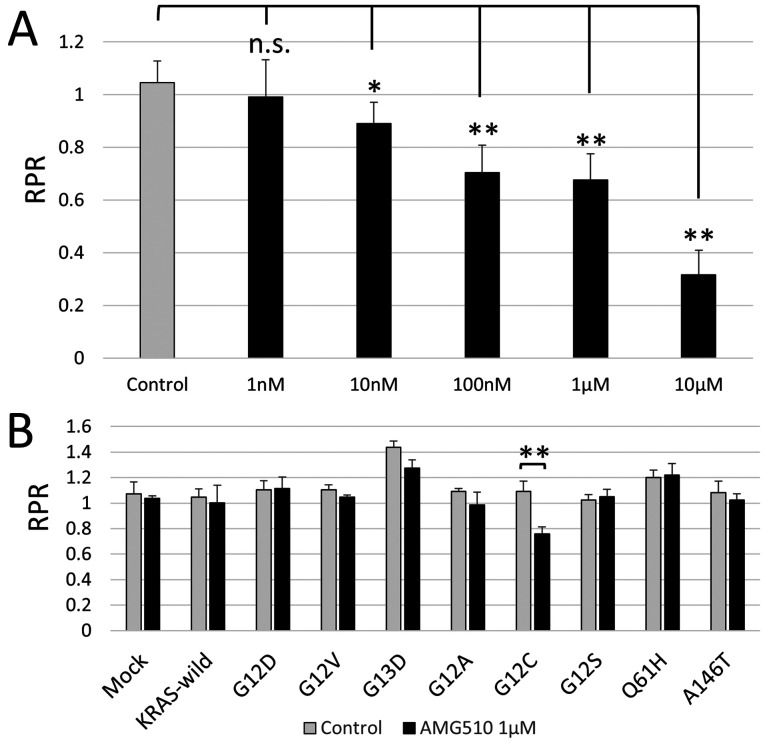
Colorectal cancer with a Kirsten rat sarcoma 2 viral oncogene homolog (KRAS) gene mutation is considered to be resistant to anti-EGFR agents. G12D is the most common KRAS mutation in colorectal cancer, followed by G12V and G13D. According to clinical and basic research data, patients with colorectal cancer exhibiting G12D and G12V KRAS mutations are resistant to anti-EGFR agents; however, this is not true of G13D and other minor mutations, which are still not well understood. The current study focused on minor KRAS mutations (G12A, G12C, G12S, Q61H and A146T) and evaluated whether these were resistant to anti-EGFR antibodies using a mix culture assay. The results demonstrated that all KRAS mutations, including minor mutations, were resistant to two anti-EGFR agents: Cetuximab and panitumumab. The combined effect of MEK and BCL-XL inhibition on colorectal cancer cells with KRAS minor mutations were subsequently evaluated. The combined effect of MEK and BCL-XL inhibitors was confirmed in all KRAS minor mutations. The sensitivity of AMG510, a novel KRAS G12C selective inhibitor, was also assessed. The mix culture assay revealed that AMG510 selectively exerted an antitumor effect on colon cancer cells with a G12C KRAS mutation. The combination of MEK and BCL-XL inhibition markedly enhanced the effect of AMG510 in colon cancer cells. The current study suggested that AMG510 may have potential clinical use in combination with MEK and BCL-XL inhibitors in the treatment of patients with colorectal cancer exhibiting the G12C KRAS mutation.
携带 Kirsten 大鼠肉瘤病毒癌基因同源物(KRAS)基因突变的结直肠癌被认为对抗表皮生长因子受体(EGFR)药物耐药。G12D 是结直肠癌中最常见的 KRAS 突变,其次是 G12V 和 G13D。根据临床和基础研究数据,表现出 G12D 和 G12V KRAS 突变的结直肠癌患者对抗 EGFR 药物耐药;然而,G13D 和其他罕见突变并非如此,目前对这些突变仍了解不足。本研究聚焦于 KRAS 罕见突变(G12A、G12C、G12S、Q61H 和 A146T),并通过混合培养试验评估这些突变是否对抗 EGFR 抗体耐药。结果表明,所有 KRAS 突变,包括罕见突变,均对两种抗 EGFR 药物西妥昔单抗和帕尼单抗耐药。随后评估了 MEK 和 BCL-XL 抑制对具有 KRAS 罕见突变的结直肠癌细胞的联合作用。在所有 KRAS 罕见突变中均证实了 MEK 和 BCL-XL 抑制剂的联合作用。还评估了新型 KRAS G12C 选择性抑制剂 AMG510 的敏感性。混合培养试验显示,AMG510 对具有 G12C KRAS 突变的结肠癌细胞选择性地发挥抗肿瘤作用。MEK 和 BCL-XL 抑制的联合作用显著增强了 AMG510 在结肠癌细胞中的作用。本研究表明,AMG510 与 MEK 和 BCL-XL 抑制剂联合使用可能在治疗具有 G12C KRAS 突变的结直肠癌患者中具有潜在临床应用价值。