Liu Shuhui, Zhao Kaitao, Su Xi, Lu Lu, Zhao He, Zhang Xianwen, Wang Yun, Wu Chunchen, Chen Jizheng, Zhou Yuan, Hu Xue, Wang Yanyi, Lu Mengji, Chen Xinwen, Pei Rongjuan
State Key Laboratory of Virology, Wuhan Institute of Virology, Chinese Academy of Sciences, Wuhan, China.
University of Chinese Academy of Sciences, Beijing, China.
PLoS One. 2017 Jan 5;12(1):e0169701. doi: 10.1371/journal.pone.0169701. eCollection 2017.
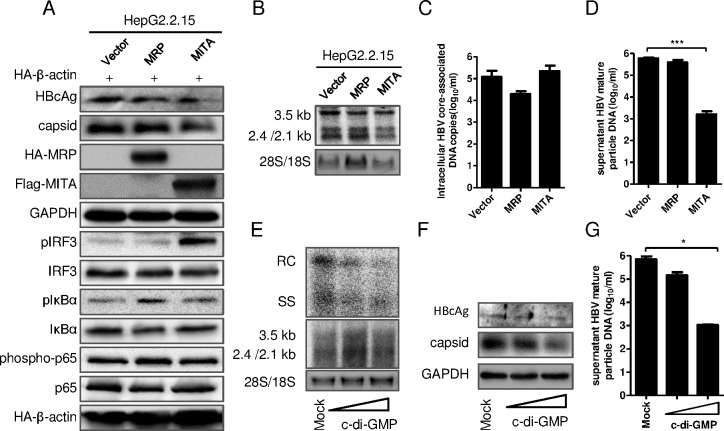
An efficient clearance of hepatitis B virus (HBV) requires the coordinated work of both the innate and adaptive immune responses. MITA/STING, an adapter protein of the innate immune signaling pathways, plays a key role in regulating innate and adaptive immune responses to DNA virus infection. Previously, we identified an alternatively spliced isoform of MITA/STING, called MITA-related protein (MRP), and found that MRP could specifically block MITA-mediated interferon (IFN) induction while retaining the ability to activate NF-κB. Here, we asked whether MITA/STING and MRP were able to control the HBV replication. Both MITA/STING and MRP significantly inhibited HBV replication in vitro. MITA overexpression stimulated IRF3-IFN pathway; while MRP overexpression activated NF-κB pathway, suggesting these two isoforms may inhibit HBV replication through different ways. Using a hydrodynamic injection (HI) mouse model, we found that HBV replication was reduced following MITA/STING and MRP expression vectors in mice and was enhanced by the knockout of MITA/STING (MITA/STING-/-). The HBV specific humoral and CD8+ T cell responses were impaired in MITA/STING deficient mice, suggesting the participation of MITA/STING in the initiation of host adaptive immune responses. In summary, our data suggest that MITA/STING and MRP contribute to HBV control via modulation of the innate and adaptive responses.
高效清除乙型肝炎病毒(HBV)需要先天性免疫反应和适应性免疫反应的协同作用。MITA/STING是先天性免疫信号通路的衔接蛋白,在调节对DNA病毒感染的先天性和适应性免疫反应中起关键作用。此前,我们鉴定出一种MITA/STING的可变剪接异构体,称为MITA相关蛋白(MRP),并发现MRP可以特异性阻断MITA介导的干扰素(IFN)诱导,同时保留激活NF-κB的能力。在此,我们探讨了MITA/STING和MRP是否能够控制HBV复制。MITA/STING和MRP在体外均显著抑制HBV复制。MITA过表达刺激IRF3-IFN通路;而MRP过表达激活NF-κB通路,提示这两种异构体可能通过不同方式抑制HBV复制。利用水动力注射(HI)小鼠模型,我们发现小鼠中表达MITA/STING和MRP表达载体后HBV复制减少,而敲除MITA/STING(MITA/STING-/-)则增强HBV复制。在MITA/STING缺陷小鼠中,HBV特异性体液和CD8+T细胞反应受损,提示MITA/STING参与宿主适应性免疫反应的启动。总之,我们的数据表明,MITA/STING和MRP通过调节先天性和适应性反应来控制HBV。