• 文献检索
  • 文档翻译
  • 深度研究
  • 学术资讯
  • Suppr Zotero 插件Zotero 插件
  • 邀请有礼
  • 套餐&价格
  • 历史记录
应用&插件
Suppr Zotero 插件Zotero 插件浏览器插件Mac 客户端Windows 客户端微信小程序
定价
高级版会员购买积分包购买API积分包
服务
文献检索文档翻译深度研究API 文档MCP 服务
关于我们
关于 Suppr公司介绍联系我们用户协议隐私条款
关注我们

Suppr 超能文献

核心技术专利:CN118964589B侵权必究
粤ICP备2023148730 号-1Suppr @ 2026

文献检索

告别复杂PubMed语法,用中文像聊天一样搜索,搜遍4000万医学文献。AI智能推荐,让科研检索更轻松。

立即免费搜索

文件翻译

保留排版,准确专业,支持PDF/Word/PPT等文件格式,支持 12+语言互译。

免费翻译文档

深度研究

AI帮你快速写综述,25分钟生成高质量综述,智能提取关键信息,辅助科研写作。

立即免费体验

德国三个地区纳氏鼠耳蝠(Myotis nattereri)存在遗传变异的证据,但没有证据表明其与相关星状病毒存在共同变异。

Evidence for genetic variation in Natterer's bats (Myotis nattereri) across three regions in Germany but no evidence for co-variation with their associated astroviruses.

作者信息

Halczok Tanja K, Fischer Kerstin, Gierke Robert, Zeus Veronika, Meier Frauke, Treß Christoph, Balkema-Buschmann Anne, Puechmaille Sébastien J, Kerth Gerald

机构信息

Ernst-Moritz-Arndt Universität Greifswald, Zoological Institute and Museum, Soldmannstr. 14, 17489, Greifswald, Germany.

Friedrich-Loeffler-Institut, Institute of Novel and Emerging Infectious Diseases, Suedufer 10, 17493, Greifswald, Insel Riems, Germany.

出版信息

BMC Evol Biol. 2017 Jan 5;17(1):5. doi: 10.1186/s12862-016-0856-0.

DOI:10.1186/s12862-016-0856-0
PMID:28056776
原文链接:https://pmc.ncbi.nlm.nih.gov/articles/PMC5217449/
Abstract

BACKGROUND

As bats have recently been described to harbor many different viruses, several studies have investigated the genetic co-variation between viruses and different bat species. However, little is known about the genetic co-variation of viruses and different populations of the same bat species, although such information is needed for an understanding of virus transmission dynamics within a given host species. We hypothesized that if virus transmission between host populations depends on events linked to gene flow in the bats, genetic co-variation should exist between host populations and astroviruses.

RESULTS

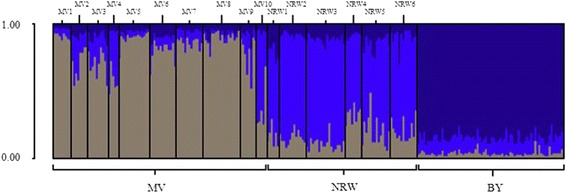
We used 19 nuclear and one mitochondrial microsatellite loci to analyze the genetic population structure of the Natterer's bat (Myotis nattereri) within and among populations at different geographical scales in Germany. Further, we correlated the observed bat population structure to that of partial astrovirus sequences (323-394 nt fragments of the RNA-dependent RNA polymerase gene) obtained from the same bat populations. Our analyses revealed that the studied bat colonies can be grouped into three distinct genetic clusters, corresponding to the three geographic regions sampled. Furthermore, we observed an overall isolation-by-distance pattern, while no significant pattern was observed within a geographic region. Moreover, we found no correlation between the genetic distances among the bat populations and the astrovirus sequences they harbored. Even though high genetic similarity of some of the astrovirus haplotypes found in several different regions was detected, identical astrovirus haplotypes were not shared between different sampled regions.

CONCLUSIONS

The genetic population structure of the bat host suggests that mating sites where several local breeding colonies meet act as stepping-stones for gene flow. Identical astrovirus haplotypes were not shared between different sampled regions suggesting that astroviruses are mostly transmitted among host colonies at the local scale. Nevertheless, high genetic similarity of some of the astrovirus haplotypes found in several different regions implies that occasional transmission across regions with subsequent mutations of the virus haplotypes does occur.

摘要

背景

由于最近发现蝙蝠携带许多不同的病毒,一些研究调查了病毒与不同蝙蝠物种之间的基因共变情况。然而,对于病毒与同一蝙蝠物种的不同种群之间的基因共变情况却知之甚少,尽管了解给定宿主物种内的病毒传播动态需要此类信息。我们推测,如果宿主种群之间的病毒传播取决于与蝙蝠基因流动相关的事件,那么宿主种群与星状病毒之间应该存在基因共变。

结果

我们使用19个核微卫星位点和1个线粒体微卫星位点,分析了德国不同地理尺度的纳氏鼠耳蝠(Myotis nattereri)种群内部和种群之间的遗传种群结构。此外,我们将观察到的蝙蝠种群结构与从同一蝙蝠种群获得的部分星状病毒序列(RNA依赖的RNA聚合酶基因的323 - 394 nt片段)的结构进行了关联。我们的分析表明,所研究的蝙蝠群落可分为三个不同的遗传簇,对应于采样的三个地理区域。此外,我们观察到总体上存在距离隔离模式,而在一个地理区域内未观察到显著模式。此外,我们发现蝙蝠种群之间的遗传距离与其所携带的星状病毒序列之间没有相关性。尽管在几个不同区域发现的一些星状病毒单倍型具有高度的遗传相似性,但不同采样区域之间并未共享相同的星状病毒单倍型。

结论

蝙蝠宿主的遗传种群结构表明,几个当地繁殖群落交汇的交配地点充当了基因流动的踏脚石。不同采样区域之间未共享相同的星状病毒单倍型,这表明星状病毒大多在局部尺度的宿主群落之间传播。然而,在几个不同区域发现的一些星状病毒单倍型具有高度的遗传相似性,这意味着确实偶尔会发生跨区域传播以及随后病毒单倍型的突变。

https://cdn.ncbi.nlm.nih.gov/pmc/blobs/f8ef/5217449/b631f873f9d0/12862_2016_856_Fig4_HTML.jpg
https://cdn.ncbi.nlm.nih.gov/pmc/blobs/f8ef/5217449/7dc63b2575bc/12862_2016_856_Fig1_HTML.jpg
https://cdn.ncbi.nlm.nih.gov/pmc/blobs/f8ef/5217449/a5f6b5a13353/12862_2016_856_Fig2_HTML.jpg
https://cdn.ncbi.nlm.nih.gov/pmc/blobs/f8ef/5217449/66ea3873b63d/12862_2016_856_Fig3_HTML.jpg
https://cdn.ncbi.nlm.nih.gov/pmc/blobs/f8ef/5217449/b631f873f9d0/12862_2016_856_Fig4_HTML.jpg
https://cdn.ncbi.nlm.nih.gov/pmc/blobs/f8ef/5217449/7dc63b2575bc/12862_2016_856_Fig1_HTML.jpg
https://cdn.ncbi.nlm.nih.gov/pmc/blobs/f8ef/5217449/a5f6b5a13353/12862_2016_856_Fig2_HTML.jpg
https://cdn.ncbi.nlm.nih.gov/pmc/blobs/f8ef/5217449/66ea3873b63d/12862_2016_856_Fig3_HTML.jpg
https://cdn.ncbi.nlm.nih.gov/pmc/blobs/f8ef/5217449/b631f873f9d0/12862_2016_856_Fig4_HTML.jpg

相似文献

1
Evidence for genetic variation in Natterer's bats (Myotis nattereri) across three regions in Germany but no evidence for co-variation with their associated astroviruses.德国三个地区纳氏鼠耳蝠(Myotis nattereri)存在遗传变异的证据,但没有证据表明其与相关星状病毒存在共同变异。
BMC Evol Biol. 2017 Jan 5;17(1):5. doi: 10.1186/s12862-016-0856-0.
2
Genetic diversity and phylogenetic analysis of newly discovered bat astroviruses in Korea.韩国新发现的蝙蝠星状病毒的遗传多样性和系统发育分析。
Arch Virol. 2018 Nov;163(11):3065-3072. doi: 10.1007/s00705-018-3992-6. Epub 2018 Aug 10.
3
The Recently Discovered Bokeloh Bat Lyssavirus: Insights Into Its Genetic Heterogeneity and Spatial Distribution in Europe and the Population Genetics of Its Primary Host.新近发现的博克勒狐蝠狂犬病病毒:在欧洲的遗传多样性和空间分布及主要宿主的种群遗传学方面的研究进展
Adv Virus Res. 2017;99:199-232. doi: 10.1016/bs.aivir.2017.07.004. Epub 2017 Sep 9.
4
Detection of Diverse Novel Bat Astrovirus Sequences in the Czech Republic.在捷克共和国检测到多种新型蝙蝠星状病毒序列。
Vector Borne Zoonotic Dis. 2015 Aug;15(8):518-21. doi: 10.1089/vbz.2015.1813.
5
Genetic population structure of Natterer's bats explained by mating at swarming sites and philopatry.纳特勒氏蝠的遗传种群结构可通过在群居地点的交配和留居行为来解释。
Mol Ecol. 2005 Dec;14(14):4299-312. doi: 10.1111/j.1365-294X.2005.02748.x.
6
Diversity of bat astroviruses in Lao PDR and Cambodia.老挝人民民主共和国和柬埔寨蝙蝠星状病毒的多样性。
Infect Genet Evol. 2017 Jan;47:41-50. doi: 10.1016/j.meegid.2016.11.013. Epub 2016 Nov 15.
7
Insectivorous bats carry host specific astroviruses and coronaviruses across different regions in Germany.食虫蝙蝠在德国不同地区携带宿主特异性星状病毒和冠状病毒。
Infect Genet Evol. 2016 Jan;37:108-16. doi: 10.1016/j.meegid.2015.11.010. Epub 2015 Nov 14.
8
Detection and phylogenetic characterization of astroviruses in insectivorous bats from Central-Southern Italy.检测并分析来自意大利中南部食虫蝙蝠的星状病毒。
Zoonoses Public Health. 2018 Sep;65(6):702-710. doi: 10.1111/zph.12484. Epub 2018 Jun 12.
9
Isolation and phylogenetic characterization of bat astroviruses in southern China.中国南方蝙蝠星状病毒的分离与系统进化分析。
Arch Virol. 2011 Aug;156(8):1415-23. doi: 10.1007/s00705-011-1011-2. Epub 2011 May 14.
10
Molecular survey of RNA viruses in Hungarian bats: discovering novel astroviruses, coronaviruses, and caliciviruses.匈牙利蝙蝠中RNA病毒的分子调查:发现新型星状病毒、冠状病毒和杯状病毒。
Vector Borne Zoonotic Dis. 2014 Dec;14(12):846-55. doi: 10.1089/vbz.2014.1637.

引用本文的文献

1
Long-term field studies in bat research: importance for basic and applied research questions in animal behavior.蝙蝠研究中的长期野外研究:对动物行为基础及应用研究问题的重要性。
Behav Ecol Sociobiol. 2022;76(6):75. doi: 10.1007/s00265-022-03180-y. Epub 2022 May 27.
2
Genetic diversity and phylogenetic analysis of newly discovered bat astroviruses in Korea.韩国新发现的蝙蝠星状病毒的遗传多样性和系统发育分析。
Arch Virol. 2018 Nov;163(11):3065-3072. doi: 10.1007/s00705-018-3992-6. Epub 2018 Aug 10.
3
Male-biased dispersal and the potential impact of human-induced habitat modifications on the Neotropical bat .

本文引用的文献

1
CORRELATION OF PAIRWISE GENETIC AND GEOGRAPHIC DISTANCE MEASURES: INFERRING THE RELATIVE INFLUENCES OF GENE FLOW AND DRIFT ON THE DISTRIBUTION OF GENETIC VARIABILITY.成对遗传距离与地理距离测量的相关性:推断基因流和漂变对遗传变异分布的相对影响。
Evolution. 1999 Dec;53(6):1898-1914. doi: 10.1111/j.1558-5646.1999.tb04571.x.
2
The program structure does not reliably recover the correct population structure when sampling is uneven: subsampling and new estimators alleviate the problem.当采样不均匀时,程序结构不能可靠地恢复正确的种群结构:子采样和新的估计器缓解了这个问题。
Mol Ecol Resour. 2016 May;16(3):608-27. doi: 10.1111/1755-0998.12512. Epub 2016 Mar 2.
3
雄性偏向扩散以及人为导致的栖息地改变对新热带蝙蝠的潜在影响。
Ecol Evol. 2018 May 15;8(12):6065-6080. doi: 10.1002/ece3.4161. eCollection 2018 Jun.
4
Host Genetic Variation Does Not Determine Spatio-Temporal Patterns of European Bat 1 Lyssavirus.宿主基因变异并不决定欧洲蝙蝠1型狂犬病病毒的时空模式。
Genome Biol Evol. 2017 Nov 1;9(11):3202-3213. doi: 10.1093/gbe/evx236.
Bat origin of human coronaviruses.
人类冠状病毒的蝙蝠起源
Virol J. 2015 Dec 22;12:221. doi: 10.1186/s12985-015-0422-1.
4
Insectivorous bats carry host specific astroviruses and coronaviruses across different regions in Germany.食虫蝙蝠在德国不同地区携带宿主特异性星状病毒和冠状病毒。
Infect Genet Evol. 2016 Jan;37:108-16. doi: 10.1016/j.meegid.2015.11.010. Epub 2015 Nov 14.
5
Detection of Diverse Novel Bat Astrovirus Sequences in the Czech Republic.在捷克共和国检测到多种新型蝙蝠星状病毒序列。
Vector Borne Zoonotic Dis. 2015 Aug;15(8):518-21. doi: 10.1089/vbz.2015.1813.
6
Lagos bat virus transmission in an Eidolon helvum bat colony, Ghana.加纳 Eidolon helvum 蝙蝠群中的拉各斯蝙蝠病毒传播。
Virus Res. 2015 Dec 2;210:42-5. doi: 10.1016/j.virusres.2015.07.009. Epub 2015 Jul 17.
7
Bats as reservoirs of severe emerging infectious diseases.蝙蝠作为严重新发传染病的宿主
Virus Res. 2015 Jul 2;205:1-6. doi: 10.1016/j.virusres.2015.05.006. Epub 2015 May 18.
8
Ecological Drivers of Virus Evolution: Astrovirus as a Case Study.病毒进化的生态驱动因素:以星状病毒为例的研究
J Virol. 2015 Jul;89(14):6978-81. doi: 10.1128/JVI.02971-14. Epub 2015 May 6.
9
Host and parasite life history interplay to yield divergent population genetic structures in two ectoparasites living on the same bat species.宿主与寄生虫的生活史相互作用,使得寄生于同一蝙蝠物种的两种体外寄生虫呈现出不同的种群遗传结构。
Mol Ecol. 2015 May;24(10):2324-35. doi: 10.1111/mec.13171. Epub 2015 Apr 21.
10
European bats as carriers of viruses with zoonotic potential.作为具有人畜共患病潜力病毒携带者的欧洲蝙蝠。
Viruses. 2014 Aug 13;6(8):3110-28. doi: 10.3390/v6083110.