Huang Chun-Teng, Liu Chia-Jen, Ko Po-Shen, Liu Han-Tsung, Yu Yuan-Bin, Hsiao Liang-Tsai, Gau Jyh-Pyng, Tzeng Cheng-Hwai, Chiou Tzeon-Jye, Liu Jin-Hwang, Yang Muh-Hwa, Huang Ling-Ju, Liu Chun-Yu
Division of Hematology & Oncology, Department of Medicine, Taipei Veterans General Hospital, Taipei, Taiwan.
National Yang-Ming University School of Medicine, Taipei, Taiwan.
BMC Infect Dis. 2017 Jan 6;17(1):33. doi: 10.1186/s12879-016-2155-1.
Patients with multiple myeloma are generally immune-compromised either due to pronounced depression in primary antibody responses or because of anti-myeloma therapy. Infection is a major risk factor for early deaths among these patients. The impact of blood stream infections (BSI) on newly diagnosed myeloma patients has been less studied. We aimed to study the incidence and risk factors of BSI within 3 months after diagnosis of multiple myeloma in a tertiary referral center.
Between November 2002 and December 2008, consecutive patients with multiple myeloma in Taipei Veterans General Hospital were retrospectively enrolled. Characteristics of patients with or without BSI were collected. Possible factors associated with development of BSI were analyzed by Cox regression.
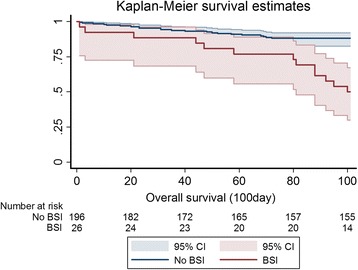
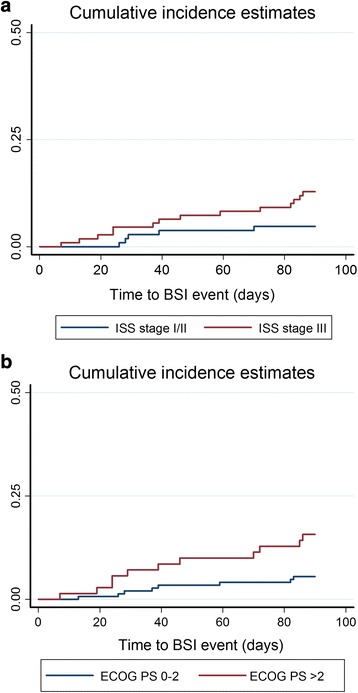
There were a total of 222 patients. The incidence of BSI within 3 months after diagnosis is 11.7%. The patients with BSI had poorer survival outcomes than those without (mortality rate: 50% vs. 20.9%, p < 0.001). Moreover, advanced International Staging System stage (stage III vs. I/II: odds ratio [OR] 2.69, p = 0.049) and poor Eastern Cooperative Oncology Group (ECOG) performance status (ECOG > 2 vs. ≤ 2: OR 3.58, p = 0.005) were the independent risk factors of BSI, whereas immunoglobulin deficiency and low absolute lymphocyte count were not associated with risk of BSI development.
Our study highlights the characteristic of myeloma patients with BSI and the importance of disease and host factors on risk of BSI. Myeloma patients with risks of BSI should be properly managed to reduce early mortality.
多发性骨髓瘤患者通常因原发性抗体反应明显降低或接受抗骨髓瘤治疗而免疫功能受损。感染是这些患者早期死亡的主要危险因素。血流感染(BSI)对新诊断的骨髓瘤患者的影响研究较少。我们旨在研究三级转诊中心多发性骨髓瘤诊断后3个月内BSI的发生率及危险因素。
回顾性纳入2002年11月至2008年12月台北荣民总医院连续收治的多发性骨髓瘤患者。收集有或无BSI患者的特征。通过Cox回归分析与BSI发生相关的可能因素。
共222例患者。诊断后3个月内BSI的发生率为11.7%。发生BSI的患者生存结局较未发生者差(死亡率:50%对20.9%,p<0.001)。此外,国际分期系统晚期(III期对I/II期:比值比[OR]2.69,p=0.049)和东部肿瘤协作组(ECOG)体能状态差(ECOG>2对≤2:OR 3.58,p=0.005)是BSI的独立危险因素,而免疫球蛋白缺乏和绝对淋巴细胞计数低与BSI发生风险无关。
我们的研究突出了发生BSI的骨髓瘤患者的特征以及疾病和宿主因素对BSI风险的重要性。应妥善管理有BSI风险的骨髓瘤患者以降低早期死亡率。