Heinen Ines, Bullinger Monika, Kocalevent Rüya-Daniela
Department of Medical Psychology, University Medical Center Hamburg-Eppendorf, Hamburg, 20246, Germany.
BMC Med Educ. 2017 Jan 6;17(1):4. doi: 10.1186/s12909-016-0841-8.
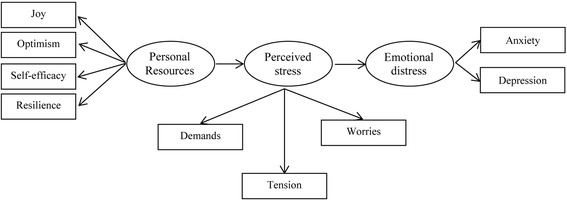
Medical students have been found to report high levels of perceived stress, yet there is a lack of theoretical frameworks examining possible reasons. This cross-sectional study examines correlates of perceived stress in medical students on the basis of a conceptual stress model originally developed for and applied to the general population. The aim was to identify via structural equation modeling the associations between perceived stress and emotional distress (anxiety and depression), taking into account the activation of personal resources (optimism, self-efficacy and resilient coping).
Within this cross-sectional study, 321 first year medical students (age 22 ± 4 years, 39.3% men) completed the Perceived Stress Questionnaire (PSQ-20), the Self-Efficacy Optimism Scale (SWOP) and the Brief Resilient Coping Scale (BRCS) as well as the Patient Health Questionnaire (PHQ-4). The statistical analyses used t-tests, ANOVA, Spearman Rho correlation and multiple regression analysis as well as structural equation modeling.
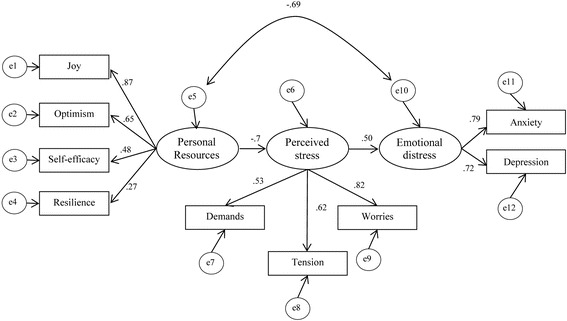
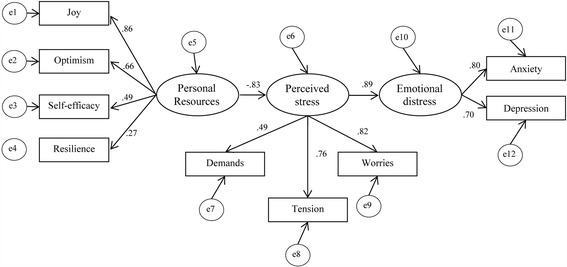
Medical students reported higher levels of perceived stress and higher levels of anxiety and depression than reference samples. No statistically significant differences in stress levels were found within the sample according to gender, migration background or employment status. Students reported more self-efficacy, optimism, and resilient coping and higher emotional distress compared to validation samples and results in other studies. Structural equation analysis revealed a satisfactory fit between empirical data and the proposed stress model indicating that personal resources modulated perceived stress, which in turn had an impact on emotional distress.
Medical students' perceived stress and emotional distress levels are generally high, with personal resources acting as a buffer, thus supporting the population-based general stress model. Results suggest providing individual interventions for those students, who need support in dealing with the challenges of the medical curriculum as well as addressing structural determinants of student stress such as course load and timing of exams.
研究发现医学生报告的感知压力水平较高,但缺乏审视可能原因的理论框架。这项横断面研究基于最初为普通人群开发并应用的概念性压力模型,考察医学生感知压力的相关因素。目的是通过结构方程模型确定感知压力与情绪困扰(焦虑和抑郁)之间的关联,同时考虑个人资源(乐观、自我效能感和韧性应对)的激活情况。
在这项横断面研究中,321名一年级医学生(年龄22±4岁,男性占39.3%)完成了感知压力问卷(PSQ - 20)、自我效能感乐观量表(SWOP)、简短韧性应对量表(BRCS)以及患者健康问卷(PHQ - 4)。统计分析采用t检验、方差分析、Spearman Rho相关性分析、多元回归分析以及结构方程模型。
医学生报告的感知压力水平、焦虑和抑郁水平高于参考样本。根据性别、移民背景或就业状况,样本内压力水平未发现统计学上的显著差异。与验证样本及其他研究结果相比,学生报告了更多的自我效能感、乐观情绪和韧性应对方式,以及更高的情绪困扰。结构方程分析表明,实证数据与所提出的压力模型之间拟合良好,表明个人资源调节了感知压力,进而对情绪困扰产生影响。
医学生的感知压力和情绪困扰水平总体较高,个人资源起到缓冲作用,从而支持了基于人群的一般压力模型。结果表明,对于那些在应对医学课程挑战方面需要支持的学生,以及解决学生压力的结构决定因素(如课程负担和考试时间)而言,应提供个性化干预措施。