Riccetti Laura, De Pascali Francesco, Gilioli Lisa, Potì Francesco, Giva Lavinia Beatrice, Marino Marco, Tagliavini Simonetta, Trenti Tommaso, Fanelli Flaminia, Mezzullo Marco, Pagotto Uberto, Simoni Manuela, Casarini Livio
Unit of Endocrinology, Department of Biomedical, Metabolic and Neural Sciences, University of Modena and Reggio Emilia, NOCSAE, via P. Giardini 1355, 41126, Modena, Italy.
Center for Genomic Research, University of Modena and Reggio Emilia, via G. Campi 287, 41125, Modena, Italy.
Reprod Biol Endocrinol. 2017 Jan 5;15(1):2. doi: 10.1186/s12958-016-0224-3.
Human luteinizing hormone (LH) and chorionic gonadotropin (hCG) are glycoprotein hormones regulating development and reproductive functions by acting on the same receptor (LHCGR). We compared the LH and hCG activity in gonadal cells from male mouse in vitro, i.e. primary Leydig cells, which is a common tool used for gonadotropin bioassay. Murine Leydig cells are naturally expressing the murine LH receptor (mLhr), which binds human LH/hCG.
Cultured Leydig cells were treated by increasing doses of recombinant LH and hCG, and cell signaling, gene expression and steroid synthesis were evaluated.
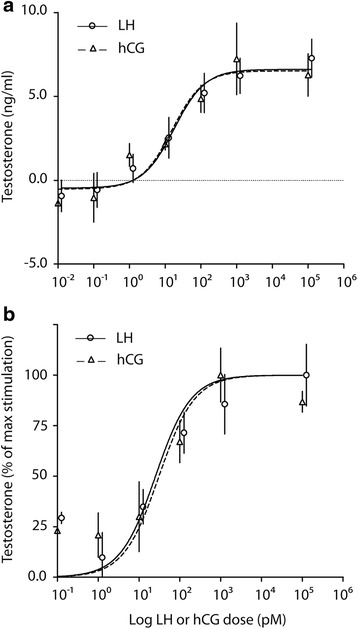
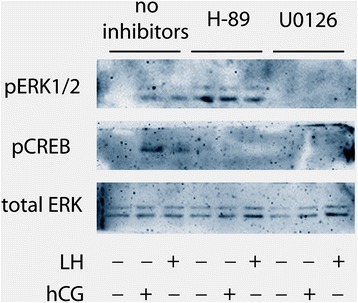
We found that hCG is about 10-fold more potent than LH in cAMP recruitment, and slightly but significantly more potent on cAMP-dependent Erk1/2 phosphorylation. However, no significant differences occur between LH and hCG treatments, measured as activation of downstream signals, such as Creb phosphorylation, Stard1 gene expression and testosterone synthesis.
These data demonstrate that the responses to human LH/hCG are only quantitatively and not qualitatively different in murine cells, at least in terms of cAMP and Erk1/2 activation, and equal in activating downstream steroidogenic events. This is at odds with what we previously described in human primary granulosa cells, where LHCGR mediates a different pattern of signaling cascades, depending on the natural ligand. This finding is relevant for gonadotropin quantification used in the official pharmacopoeia, which are based on murine, in vivo bioassay and rely on the evaluation of long-term, testosterone-dependent effects mediated by rodent receptor.
人促黄体生成素(LH)和绒毛膜促性腺激素(hCG)是通过作用于同一受体(LHCGR)来调节发育和生殖功能的糖蛋白激素。我们在体外比较了雄性小鼠性腺细胞(即原代睾丸间质细胞,这是促性腺激素生物测定常用的工具)中LH和hCG的活性。小鼠睾丸间质细胞天然表达能结合人LH/hCG的小鼠LH受体(mLhr)。
用递增剂量的重组LH和hCG处理培养的睾丸间质细胞,并评估细胞信号传导、基因表达和类固醇合成。
我们发现,在募集cAMP方面,hCG的效力比LH高约10倍,在依赖cAMP的Erk1/2磷酸化方面,hCG的效力略高但显著更高。然而,以Creb磷酸化、Stard1基因表达和睾酮合成等下游信号的激活来衡量,LH和hCG处理之间没有显著差异。
这些数据表明,至少在cAMP和Erk1/2激活方面,小鼠细胞对人LH/hCG的反应仅在数量上而非质量上有所不同,并且在激活下游类固醇生成事件方面是相等的。这与我们之前在人原代颗粒细胞中所描述的情况不同,在人原代颗粒细胞中,LHCGR根据天然配体介导不同的信号级联模式。这一发现与官方药典中使用的促性腺激素定量方法相关,这些方法基于小鼠体内生物测定,并依赖于对由啮齿动物受体介导的长期、睾酮依赖性效应的评估。