Bigalke J M, Heldwein E E
Tufts University School of Medicine, Boston, MA, United States.
Tufts University School of Medicine, Boston, MA, United States.
Adv Virus Res. 2017;97:107-141. doi: 10.1016/bs.aivir.2016.07.002. Epub 2016 Sep 1.
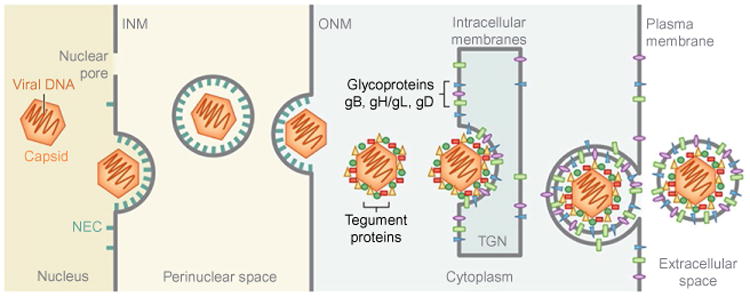
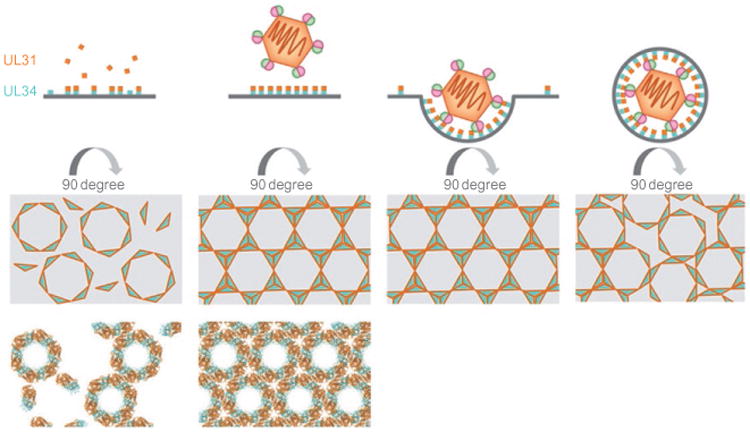
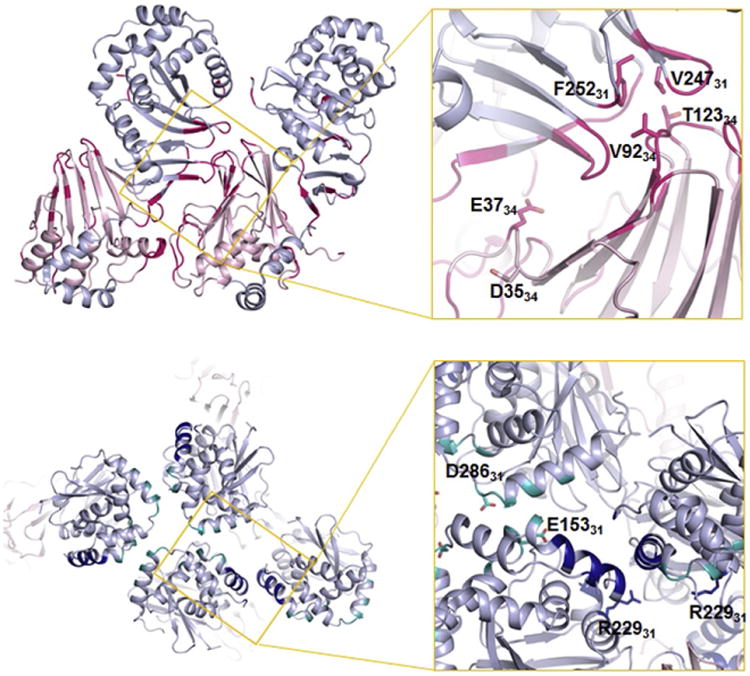
Herpesviruses are unusual among enveloped viruses because they bud twice yet acquire a single envelope. Furthermore, unlike other DNA viruses that replicate in the nucleus, herpesviruses do not exit it by passing through the nuclear pores or by rupturing the nuclear envelope. Instead, herpesviruses have a complex mechanism of nuclear escape whereby nascent capsids bud at the inner nuclear membrane to form perinuclear virions that subsequently fuse with the outer nuclear membrane, releasing capsids into the cytosol. This makes them some of the very few known viruses that bud into the nuclear envelope. The envelope acquired during nuclear budding does not end up in the mature viral particle but instead allows the capsid to translocate from the nucleus into the cytosol. The viral nuclear egress complex (NEC) is a critical player in the nuclear egress, yet its function and mechanism have remained enigmatic. Recent studies have demonstrated that the NEC buds membranes without the help of other proteins by forming a honeycomb coat, which established the NEC as the first virally encoded budding machine that operates at the nuclear, as opposed to cytoplasmic, membrane. This review discusses our current understanding of the NEC budding mechanism, with the emphasis on studies that illuminated the structure of the NEC coat and its role in capsid budding during herpesvirus nuclear escape.
疱疹病毒在包膜病毒中较为特殊,因为它们出芽两次却只获得一层包膜。此外,与在细胞核中复制的其他DNA病毒不同,疱疹病毒并非通过核孔或破裂核膜离开细胞核。相反,疱疹病毒有一种复杂的核逃逸机制,新生衣壳在内核膜出芽形成核周病毒粒子,随后与外核膜融合,将衣壳释放到细胞质中。这使它们成为极少数已知的在核膜出芽的病毒。核出芽过程中获得的包膜最终并不存在于成熟病毒颗粒中,而是使衣壳从细胞核转运到细胞质中。病毒核输出复合体(NEC)在核输出过程中起着关键作用,但其功能和机制一直不明。最近的研究表明,NEC通过形成蜂窝状衣壳在没有其他蛋白质帮助的情况下使膜出芽,这确立了NEC作为首个在核膜而非细胞质膜上运行的病毒编码出芽机器。本综述讨论了我们目前对NEC出芽机制的理解,重点是阐明NEC衣壳结构及其在疱疹病毒核逃逸期间衣壳出芽中作用的研究。