Ramamurthy Narayan, Boninsegna Sara, Adams Rebecca, Sahgal Natasha, Lockstone Helen, Baban Dilair, Marchi Emanuele, Klenerman Paul
Peter Medawar Building for Pathogen Research, University of Oxford, Oxford, UK.
Sacrocuore Hospital, University of Padua, Padua, Italy.
Wellcome Open Res. 2016 Nov 17;1:17. doi: 10.12688/wellcomeopenres.9917.1.
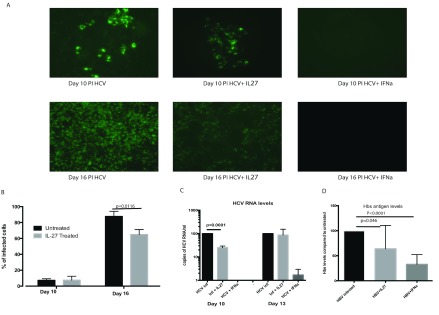
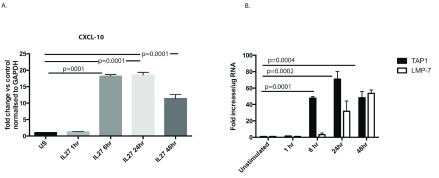
Interleukin (IL)-27 is a member of the IL-6/IL-12 family of cytokines. It is a potent cytokine, with potential antiviral impact, and has been shown to play a role in modulating functions of diverse cell types, including Th1, Th2, and NK and B cells, demonstrating both pro- and anti-inflammatory roles. In hepatocytes, it is capable of inducing signal transducer and activator of transcription (STAT)1, STAT3 and interferon-stimulated genes. To address its role in viral hepatitis, the antiviral activity of IL-27 against hepatitis C virus (HCV) and hepatitis B virus (HBV) was tested using cell-culture-derived infectious HCV (HCVcc) cell culture system and the HepaRG HBV cell culture model. To further investigate the impact of IL-27 on hepatocytes, Huh7.5 cells were treated with IL-27 to analyse the differentially expressed genes by microarray analysis. Furthermore, by quantitative PCR, we analyzed the up-regulation of chemokine in response to IL-27. In both HCV and HBV infection models, we observed only a modest direct antiviral effect. Microarray analysis showed that the up-regulated genes mostly belonged to antigen presentation and DNA replication pathways, and involved strong up-regulation of , a gene associated with liver inflammation. Overall, gene set enrichment analysis showed a striking correlation of these genes with those up-regulated in response to related cytokines in diverse cell populations. Our data indicate that IL-27 can have a significant pro-inflammatory impact , although the direct antiviral effect is modest. It may have a potential impact on hepatocyte function, especially chemokine expression and antigen presentation.
白细胞介素(IL)-27是细胞因子IL-6/IL-12家族的成员。它是一种强效细胞因子,具有潜在的抗病毒作用,并且已被证明在调节多种细胞类型(包括Th1、Th2、NK和B细胞)的功能中发挥作用,显示出促炎和抗炎双重作用。在肝细胞中,它能够诱导信号转导和转录激活因子(STAT)1、STAT3以及干扰素刺激基因。为了研究其在病毒性肝炎中的作用,利用细胞培养衍生的感染性丙型肝炎病毒(HCV)细胞培养系统和HepaRG乙型肝炎病毒(HBV)细胞培养模型,检测了IL-27对HCV和HBV的抗病毒活性。为了进一步研究IL-27对肝细胞的影响,用IL-27处理Huh7.5细胞,通过微阵列分析来分析差异表达基因。此外,通过定量PCR,我们分析了趋化因子对IL-27的上调反应。在HCV和HBV感染模型中,我们仅观察到适度的直接抗病毒作用。微阵列分析表明,上调的基因大多属于抗原呈递和DNA复制途径,并且涉及与肝脏炎症相关的基因的强烈上调。总体而言,基因集富集分析表明这些基因与不同细胞群体中对相关细胞因子反应上调的基因具有显著相关性。我们的数据表明,尽管直接抗病毒作用适度,但IL-27可产生显著的促炎作用。它可能对肝细胞功能有潜在影响,尤其是趋化因子表达和抗原呈递。