Chen Yan, Wang Jing, Hong Duan-Yang, Chen Lin, Zhang Yan-Yan, Xu Yi-Ni, Pan Di, Fu Ling-Yun, Tao Ling, Luo Hong, Shen Xiang-Chun
The High Educational Key Laboratory of Guizhou Province for Natural Medicinal Pharmacology and Druggability, Guizhou Medical University, Huaxi university town, Guian new district 550025, Guizhou, People's Republic of China.
Department of Pharmacology of Chinese Material Medica, Guizhou Medical University, Huaxi university town, Guian new district 550025, Guizhou, People's Republic of China.
Oncotarget. 2017 Feb 7;8(6):10470-10484. doi: 10.18632/oncotarget.14433.
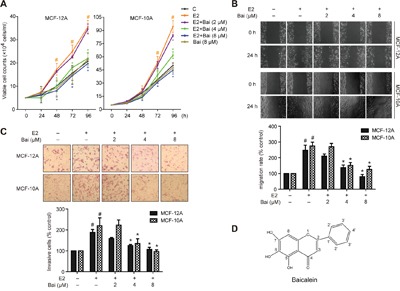
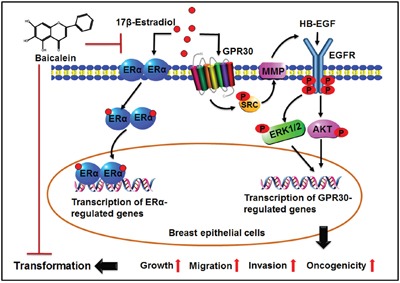
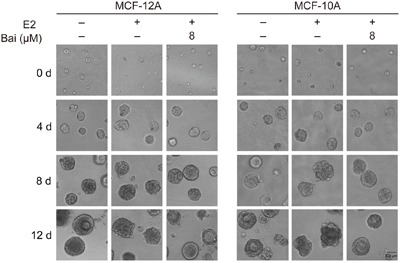
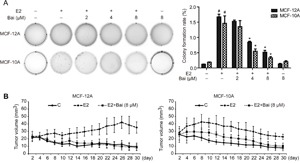
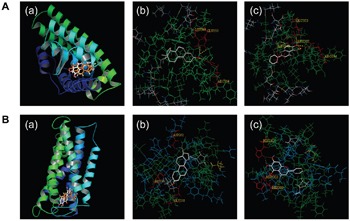
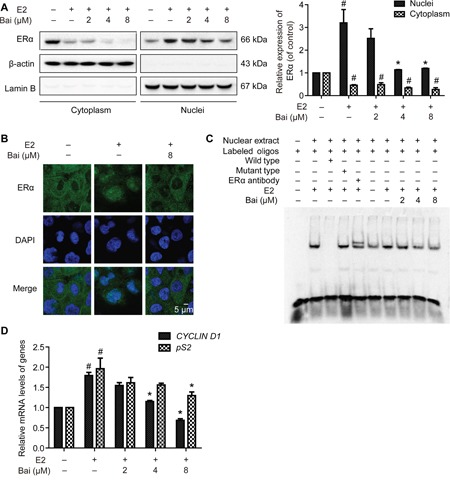
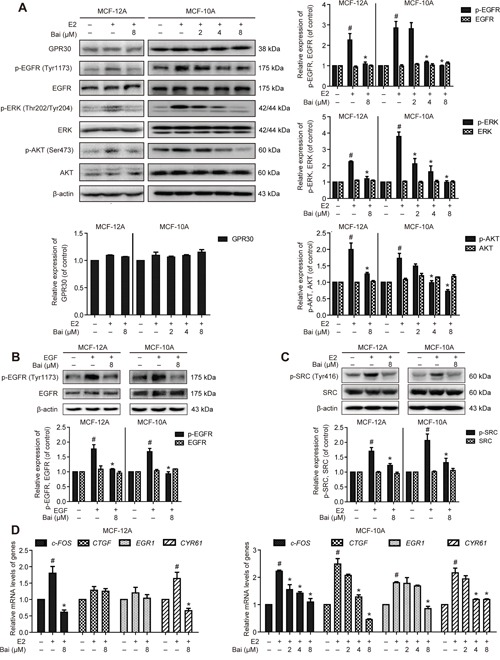
Epidemiologic and systematic studies have indicated that flavonoid consumption is associated with a lower incidence of breast cancer. Baicalein is the primary flavonoid derived from the roots of Scutellaria baicalensis Georgi. In the current study, the long-term exposure of breast epithelial cells to 17β-estradiol (E2) was used to investigate the chemopreventive potential of baicalein on neoplastic transformation. The results demonstrated that baicalein significantly inhibited E2-induced cell growth, motility, and invasiveness, and suppressed E2-induced misshapen acini formation in 3D cultures. Furthermore, it inhibited the ability of E2-induced cells to form clones in agarose and tumors in NOD/SCID immunodeficient mice. Docking studies using Sybyl-X 1.2 software showed that baicalein could bind to both estrogen receptor-α (ERa) and G-protein coupled estrogen receptor 30 (GPR30), which are two critical E2-mediated pathways. Baicalein prevented the E2-induced ERa-mediated activation of nuclear transcriptional signaling by interfering with the trafficking of ERa into the nucleus and subsequent binding to estrogen response elements, thereby decreasing the mRNA levels of ERa target genes. It also inhibited E2-induced GPR30-mediated signal transduction, as well as the transcription of GPR30-regulated genes. Therefore, these results suggest that baicalein is a potential drug for reducing the risk of estrogen-dependent breast cancer.
流行病学和系统性研究表明,食用黄酮类化合物与降低乳腺癌发病率相关。黄芩素是从黄芩根中提取的主要黄酮类化合物。在本研究中,采用乳腺上皮细胞长期暴露于17β-雌二醇(E2)的方法,来研究黄芩素对肿瘤转化的化学预防潜力。结果表明,黄芩素显著抑制E2诱导的细胞生长、运动和侵袭,并抑制E2诱导的三维培养中畸形腺泡形成。此外,它还抑制E2诱导的细胞在琼脂糖中形成克隆以及在NOD/SCID免疫缺陷小鼠中形成肿瘤的能力。使用Sybyl-X 1.2软件进行的对接研究表明,黄芩素可以与雌激素受体-α(ERα)和G蛋白偶联雌激素受体30(GPR30)结合,这是两条关键的E2介导途径。黄芩素通过干扰ERα转运至细胞核以及随后与雌激素反应元件的结合,阻止E2诱导的ERα介导的核转录信号激活,从而降低ERα靶基因的mRNA水平。它还抑制E2诱导的GPR30介导的信号转导以及GPR30调控基因的转录。因此,这些结果表明黄芩素是一种降低雌激素依赖性乳腺癌风险的潜在药物。