Puga Marco Antonio Moreira, Bandeira Larissa Melo, Pompilio Mauricio Antonio, Croda Julio, Rezende Grazielli Rocha de, Dorisbor Luiz Fernando Paiva, Tanaka Tayana Serpa Ortiz, Cesar Gabriela Alves, Teles Sheila Araújo, Simionatto Simone, Novais Alisson Richard Teixeira, Nepomuceno Bruna, Castro Lisie Souza, Lago Barbara Vieira do, Motta-Castro Ana Rita Coimbra
Federal University of Mato Grosso do Sul, Campo Grande, MS, Brazil.
Oswaldo Cruz Foundation, Mato Grosso do Sul, MS, Brazil.
PLoS One. 2017 Jan 6;12(1):e0169195. doi: 10.1371/journal.pone.0169195. eCollection 2017.
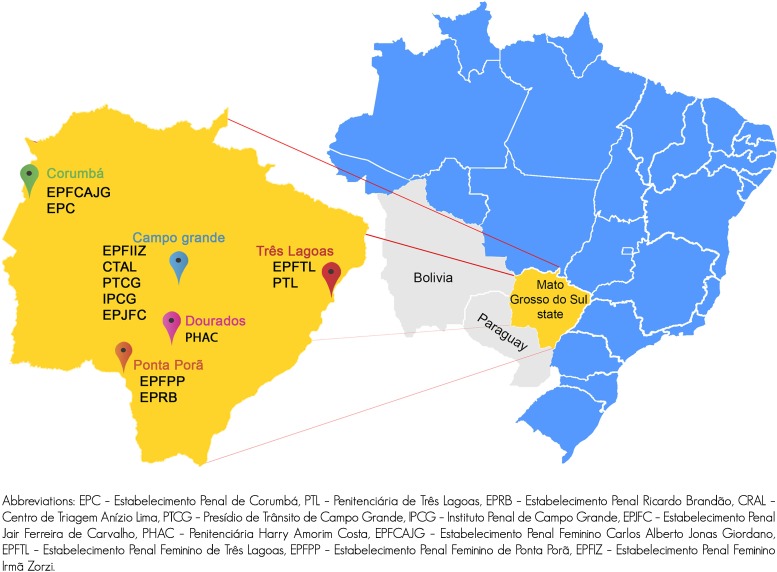
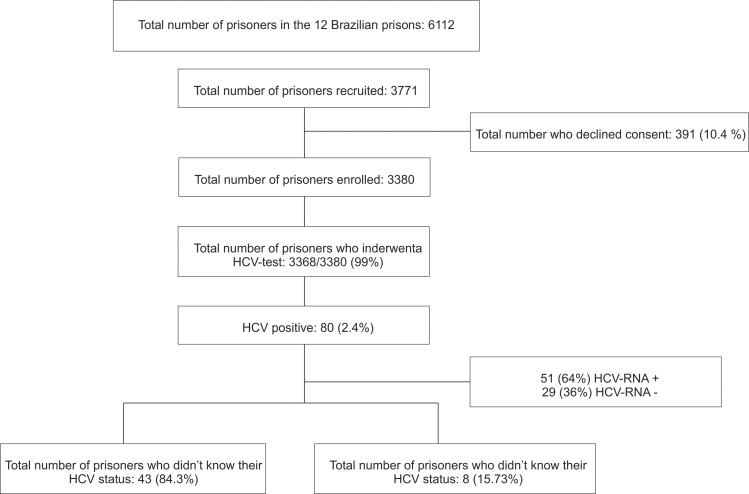
The aim of this multicenter, cross sectional study was to assess the prevalence, incidence and associated risk factors among incarcerated populations from twelve Brazilian prisons. The total of 3,368 individuals from twelve prisons was randomly recruited between March 2013 and March 2014. Participants were interviewed, and provided blood samples which were tested for antibodies to Hepatitis C (HCV ab). One year after the first investigation, a cohort study was conducted with 1,656 inmates who participated the cross sectional study. Positive samples were tested for the presence of HCV RNA. Out of 3,368 inmates, 520 (15.4%) were females, and 2,848 (84.6%) were males. The overall prevalence of HCV was 2.4% (95% CI: 1.9 to 2.9), with 0.6% (95% CI: 0.4 to 0.8) in females, and 2.7% (95% CI: 2.1 to 3.3) in males (p<0.01). HCV RNA was detected in 51/80 (63.7%) samples. Among men prisoners, multivariate analysis of associated factors showed independent associations between HCV exposure and increasing age, inject drug use, length of incarceration, smoking hashish, sharing needle and syringe and HIV positivity. During the cohort study, 7/1,656 new cases of HCV infection were detected, and the incidence rate was 0.4/100 person-year. Once high frequency rates of specific HCV risk behaviors and new HCV infections have been identified inside prisons, effective interventions strategies such as screening, clinical evaluation and treatment to reduce the spread of HCV infection are essential.
这项多中心横断面研究的目的是评估巴西12所监狱在押人员中丙型肝炎病毒(HCV)的流行率、发病率及相关风险因素。2013年3月至2014年3月期间,从12所监狱中随机招募了3368名个体。对参与者进行了访谈,并采集血样检测丙型肝炎病毒抗体(HCV ab)。首次调查一年后,对参与横断面研究的1656名囚犯进行了队列研究。对阳性样本检测HCV RNA的存在情况。在3368名囚犯中,520名(15.4%)为女性,2848名(84.6%)为男性。HCV的总体流行率为2.4%(95%可信区间:1.9%至2.9%),女性为0.6%(95%可信区间:0.4%至0.8%),男性为2.7%(95%可信区间:2.1%至3.3%)(p<0.01)。在80份样本中有51份(63.7%)检测到HCV RNA。在男性囚犯中,相关因素的多变量分析显示,HCV暴露与年龄增长、注射吸毒、监禁时间、吸食大麻、共用针头和注射器以及HIV阳性之间存在独立关联。在队列研究期间,检测到7例新的HCV感染病例,发病率为0.4/100人年。鉴于已确定监狱内特定HCV风险行为的高发生率和新的HCV感染情况,采取筛查、临床评估和治疗等有效干预策略以减少HCV感染传播至关重要。