Lau Andrew, Kong Fabian, Fairley Christopher K, Donovan Basil, Chen Marcus, Bradshaw Catriona, Boyd Mark, Amin Janaki, Timms Peter, Tabrizi Sepehr, Regan David G, Lewis David A, McNulty Anna, Hocking Jane S
Centre for Epidemiology and Biostatistics, Melbourne School of Population and Global Health, University of Melbourne, Carlton, 3053, VIC, Australia.
Melbourne Sexual Health Centre, Alfred Health, 580 Swanston St, Carlton, 3053, VIC, Australia.
BMC Infect Dis. 2017 Jan 6;17(1):35. doi: 10.1186/s12879-016-2125-7.
Rectal infection with Chlamydia trachomatis is one of the most common bacterial sexually transmissible infections among men who have sex with men (MSM) with diagnosis rates continuing to rise. Current treatment guidelines recommend either azithromycin 1 g single dose or doxycycline 100 mg twice daily for 7 days. However, there are increasing concerns about treatment failure with azithromycin. We are conducting the first randomised controlled trial (RCT) to compare treatment efficacy of azithromycin versus doxycycline for the treatment of rectal chlamydia in MSM.
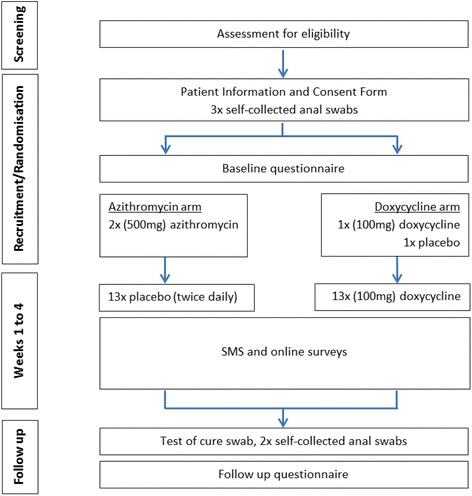
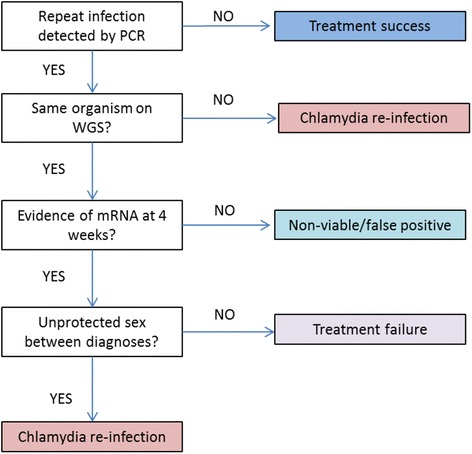
METHODS/DESIGN: The Rectal Treatment Study will recruit 700 MSM attending Australian sexual health clinics for the treatment of rectal chlamydia. Participants will be asked to provide rectal swabs and will be randomised to either azithromycin 1 g single dose or doxycycline 100 mg twice daily for 7 days. Participants will be asked to complete questionnaires about adverse drug reactions, sexual behaviour and drug adherence via short message service and online survey. The primary outcome is the treatment efficacy as determined by a negative chlamydia nucleic acid amplification test at 4 weeks post treatment. Secondary outcomes will utilise whole genome sequencing and mRNA assay to differentiate between treatment failure, reinfection or false positive results.
Rectal chlamydia is an increasing public health concern as use of pre-exposure prophylaxis against HIV becomes commonplace. Optimal, evidence-based treatment is critical to halting ongoing transmission. This study will provide the first RCT evidence comparing azithromycin and doxycycline for the treatment of rectal chlamydia. The results of this trial will establish which treatment is more efficacious and inform international management guidelines.
Australian New Zealand Clinical Trials Registry ACTRN12614001125617.
沙眼衣原体直肠感染是男男性行为者(MSM)中最常见的细菌性性传播感染之一,诊断率持续上升。当前的治疗指南推荐单次口服1克阿奇霉素或每日两次、每次100毫克多西环素,疗程7天。然而,人们越来越担心阿奇霉素治疗失败的问题。我们正在开展第一项随机对照试验(RCT),比较阿奇霉素和多西环素治疗MSM直肠衣原体感染的疗效。
方法/设计:直肠治疗研究将招募700名到澳大利亚性健康诊所治疗直肠衣原体感染的MSM。参与者将被要求提供直肠拭子,并随机分为单次口服1克阿奇霉素组或每日两次、每次100毫克多西环素组,疗程7天。参与者将被要求通过短信服务和在线调查完成关于药物不良反应、性行为和药物依从性的问卷。主要结局是治疗后4周衣原体核酸扩增检测呈阴性所确定的治疗效果。次要结局将利用全基因组测序和mRNA检测来区分治疗失败、再次感染或假阳性结果。
随着暴露前预防艾滋病毒的使用变得普遍,直肠衣原体感染日益成为公共卫生问题。最佳的循证治疗对于阻止持续传播至关重要。本研究将提供第一项比较阿奇霉素和多西环素治疗直肠衣原体感染的RCT证据。该试验的结果将确定哪种治疗更有效,并为国际管理指南提供依据。
澳大利亚新西兰临床试验注册中心ACTRN12614001125617。