Eldh Ann Catrine, Almost Joan, DeCorby-Watson Kara, Gifford Wendy, Harvey Gill, Hasson Henna, Kenny Deborah, Moodie Sheila, Wallin Lars, Yost Jennifer
School of Education, Health and Social Studies, Dalarna University, FALUN, Sweden.
Department of Public Health and Caring Sciences, Uppsala University, UPPSALA, Sweden.
BMC Health Serv Res. 2017 Jan 7;17(1):16. doi: 10.1186/s12913-016-1958-5.
There is increasing awareness that regardless of the proven value of clinical interventions, the use of effective strategies to implement such interventions into clinical practice is necessary to ensure that patients receive the benefits. However, there is often confusion between what is the clinical intervention and what is the implementation intervention. This may be caused by a lack of conceptual clarity between 'intervention' and 'implementation', yet at other times by ambiguity in application. We suggest that both the scientific and the clinical communities would benefit from greater clarity; therefore, in this paper, we address the concepts of intervention and implementation, primarily as in clinical interventions and implementation interventions, and explore the grey area in between.
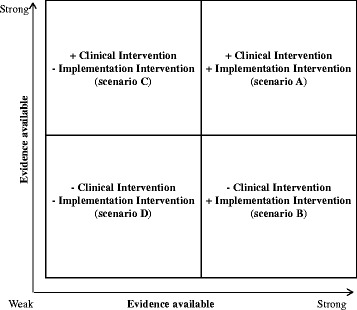
To begin, we consider the similarities, differences and potential greyness between clinical interventions and implementation interventions through an overview of concepts. This is illustrated with reference to two examples of clinical interventions and implementation intervention studies, including the potential ambiguity in between. We then discuss strategies to explore the hybridity of clinical-implementation intervention studies, including the role of theories, frameworks, models, and reporting guidelines that can be applied to help clarify the clinical and implementation intervention, respectively.
Semantics provide opportunities for improved precision in depicting what is 'intervention' and what is 'implementation' in health care research. Further, attention to study design, the use of theory, and adoption of reporting guidelines can assist in distinguishing between the clinical intervention and the implementation intervention. However, certain aspects may remain unclear in analyses of hybrid studies of clinical and implementation interventions. Recognizing this potential greyness can inform further discourse.
人们越来越意识到,尽管临床干预已被证明具有价值,但使用有效的策略将此类干预措施应用于临床实践对于确保患者受益是必要的。然而,临床干预和实施干预之间常常存在混淆。这可能是由于“干预”和“实施”之间缺乏概念清晰度造成的,但有时也可能是由于应用中的模糊性所致。我们认为,科学界和临床界都将从更高的清晰度中受益;因此,在本文中,我们主要探讨临床干预和实施干预中的干预和实施概念,并探索其间的灰色地带。
首先,我们通过概念概述来考虑临床干预和实施干预之间的异同以及潜在的灰色地带。这通过两个临床干预和实施干预研究的例子来说明,包括其间可能存在的模糊性。然后,我们讨论探索临床-实施干预研究混合性的策略,包括可分别用于帮助阐明临床干预和实施干预的理论、框架、模型和报告指南的作用。
语义学为提高在医疗保健研究中描述“干预”和“实施”的精确性提供了机会。此外,关注研究设计、理论的使用以及报告指南的采用有助于区分临床干预和实施干预。然而,在临床和实施干预的混合研究分析中,某些方面可能仍然不清楚。认识到这种潜在的灰色地带可以为进一步的讨论提供参考。