O'Shea Sally J, Robles-Espinoza Carla Daniela, McLellan Lauren, Harrigan Jeanine, Jacq Xavier, Hewinson James, Iyer Vivek, Merchant Will, Elliott Faye, Harland Mark, Bishop D Timothy, Newton-Bishop Julia A, Adams David J
Section of Epidemiology and Biostatistics, Leeds Institute of Cancer and Pathology, University of Leeds, Leeds, UK.
Experimental Cancer Genetics, The Wellcome Trust Sanger Institute, Hinxton, Cambridgeshire, UK.
Hum Mol Genet. 2017 Feb 15;26(4):717-728. doi: 10.1093/hmg/ddw403.
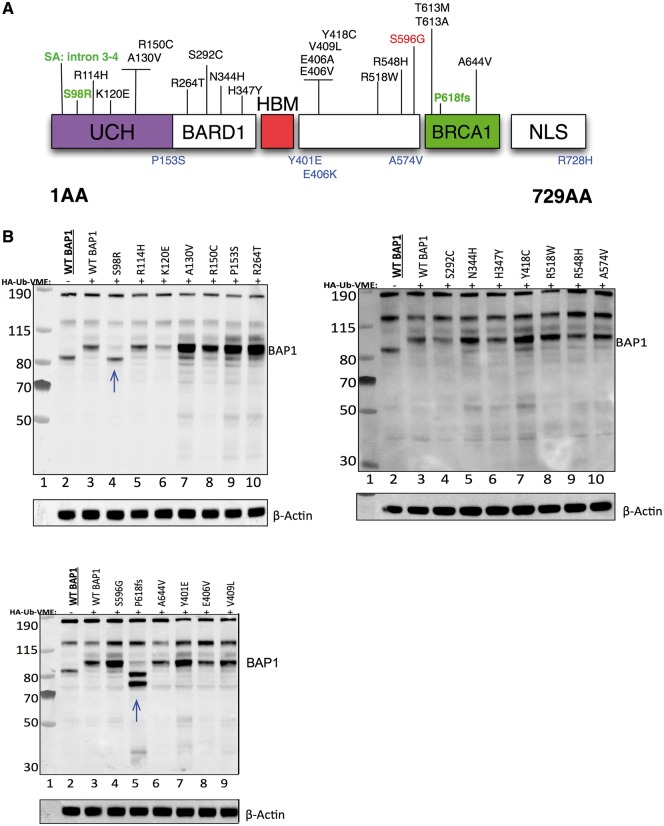
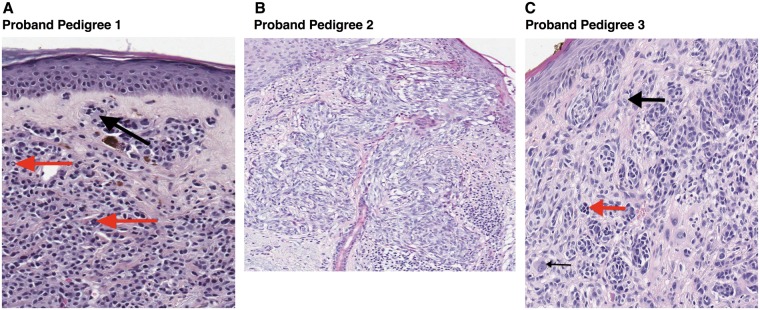
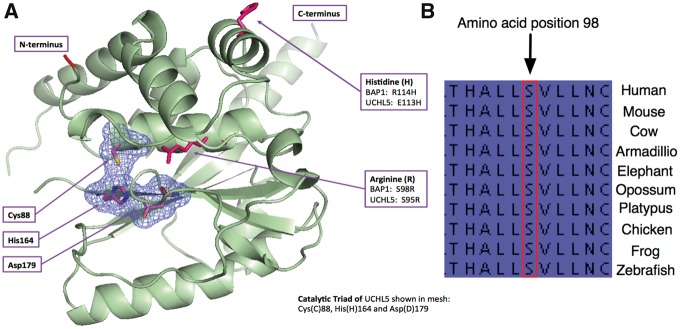
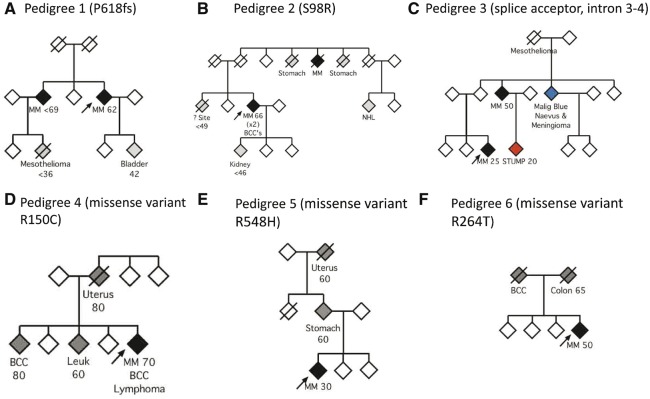
Germline mutation of the BRCA1 associated protein-1 (BAP1) gene has been linked to uveal melanoma, mesothelioma, meningioma, renal cell carcinoma and basal cell carcinoma. Germline variants have also been found in familial cutaneous melanoma pedigrees, but their contribution to sporadic melanoma has not been fully assessed. We sequenced BAP1 in 1,977 melanoma cases and 754 controls and used deubiquitinase assays, a pedigree analysis, and a histopathological review to assess the consequences of the mutations found. Sequencing revealed 30 BAP1 variants in total, of which 27 were rare (ExAc allele frequency <0.002). Of the 27 rare variants, 22 were present in cases (18 missense, one splice acceptor, one frameshift and two near splice regions) and five in controls (all missense). A missense change (S98R) in a case that completely abolished BAP1 deubiquitinase activity was identified. Analysis of cancers in the pedigree of the proband carrying the S98R variant and in two other pedigrees carrying clear loss-of-function alleles showed the presence of BAP1-associated cancers such as renal cell carcinoma, mesothelioma and meningioma, but not uveal melanoma. Two of these three probands carrying BAP1 loss-of-function variants also had melanomas with histopathological features suggestive of a germline BAP1 mutation. The remaining cases with germline mutations, which were predominantly missense mutations, were associated with less typical pedigrees and tumours lacking a characteristic BAP1-associated histopathological appearances, but may still represent less penetrant variants. Germline BAP1 alleles defined as loss-of-function or predicted to be deleterious/damaging are rare in cutaneous melanoma.
BRCA1相关蛋白-1(BAP1)基因的种系突变与葡萄膜黑色素瘤、间皮瘤、脑膜瘤、肾细胞癌和基底细胞癌有关。在家族性皮肤黑色素瘤家系中也发现了种系变异,但它们对散发性黑色素瘤的影响尚未得到充分评估。我们对1977例黑色素瘤病例和754例对照进行了BAP1测序,并使用去泛素酶测定、家系分析和组织病理学检查来评估所发现突变的后果。测序共发现30个BAP1变异,其中27个是罕见的(ExAc等位基因频率<0.002)。在这27个罕见变异中,22个存在于病例中(18个错义突变、1个剪接受体突变、1个移码突变和2个近剪接区域突变),5个存在于对照中(均为错义突变)。在一例病例中鉴定出一个完全消除BAP1去泛素酶活性的错义改变(S98R)。对携带S98R变异的先证者家系以及另外两个携带明确功能丧失等位基因的家系中的癌症分析显示,存在BAP1相关癌症,如肾细胞癌、间皮瘤和脑膜瘤,但没有葡萄膜黑色素瘤。这三个携带BAP1功能丧失变异的先证者中有两个也患有黑色素瘤,其组织病理学特征提示种系BAP1突变。其余携带种系突变的病例主要是错义突变,与不太典型的家系和缺乏特征性BAP1相关组织病理学表现的肿瘤有关,但仍可能代表低外显率变异。在皮肤黑色素瘤中,定义为功能丧失或预测为有害/损伤性的种系BAP1等位基因很少见。