Yang Youqing, Wang Handong, Li Liwen, Li Xiang, Wang Qiang, Ding Hui, Wang Xiaoliang, Ye Zhennan, Wu Lingyun, Zhang Xiangsheng, Zhou Mengliang, Pan Hao
Department of Neurosurgery, Jinling Hospital, Clinical Medical College of Southern Medical University (Guangzhou) Nanjing, China.
Department of Neurosurgery, Jinling Hospital, School of Medicine, Nanjing University Nanjing, China.
Front Neurosci. 2016 Dec 23;10:580. doi: 10.3389/fnins.2016.00580. eCollection 2016.
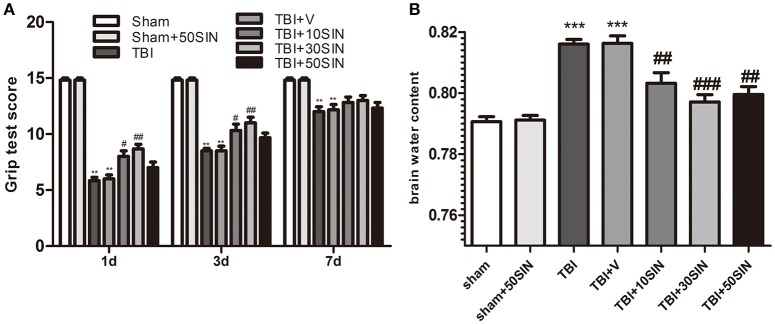
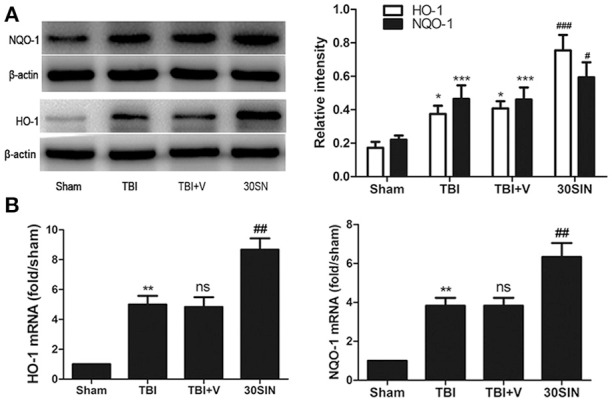
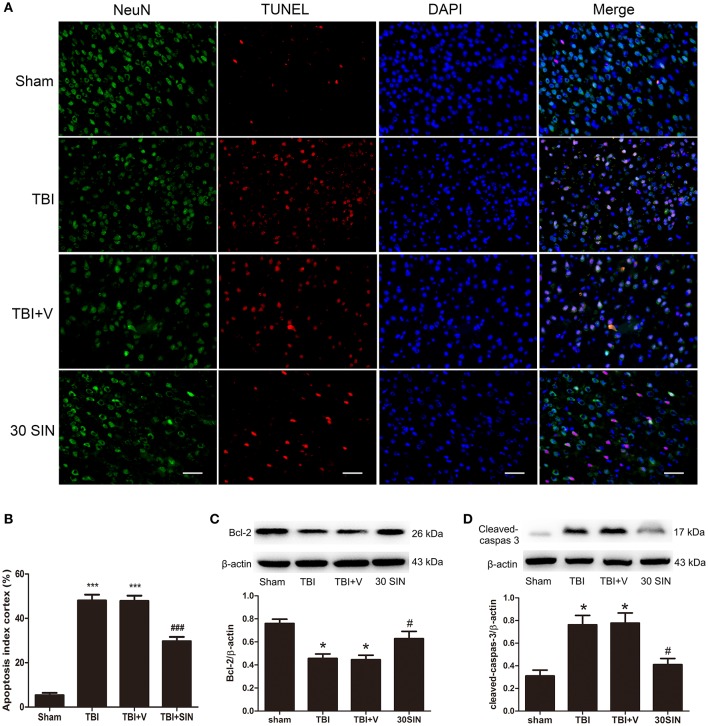
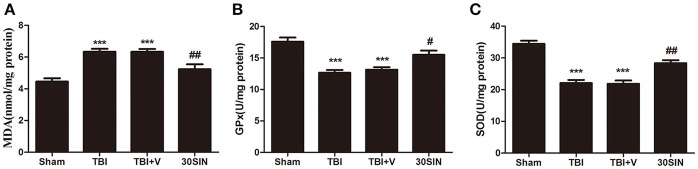
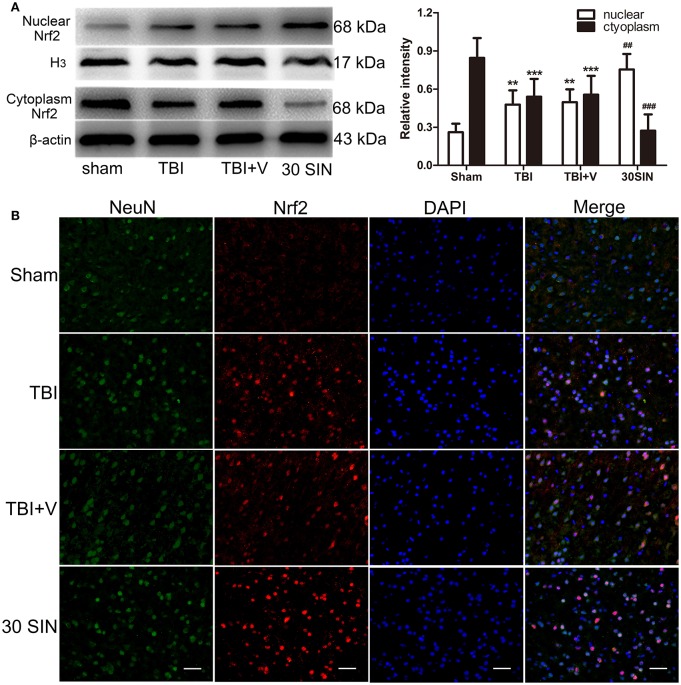
The neuroprotective effect of sinomenine (SIN) has been demonstrated in several brain injury models. However, its role and molecular mechanism in traumatic brain injury (TBI) remain unknown. In this study, we investigated the neuroprotective effects of SIN in the weight-drop model of TBI in male ICR mice. Mice were randomly divided into the sham and TBI groups, SIN (10 mg/kg, 30 mg/kg and 50 mg/kg, administered intraperitoneally) or equal volume of vehicle was given at 30 min after TBI. Treatment with 30 mg/kg SIN significantly improved motor performance and alleviated cerebral edema. However, treatment with 10 mg/kg or 50 mg/kg SIN did not exhibit a better outcome. Therefore, we chose 30 mg/kg SIN for our subsequent experiments. SIN significantly increased the expression of Bcl-2 and decreased that of cleaved caspase-3, indicating that SIN is anti-apoptotic. This was confirmed by the observation that SIN-treated animals had fewer apoptotic neurons. Cortical malondialdehyde content, glutathione peroxidase (GPx) activity and superoxide dismutase (SOD) activity were restored in the group that received SIN. Furthermore, Western blot and immunofluorescence experiments showed that SIN enhanced the translocation of nuclear factor erythroid 2-related factor 2 (Nrf2) to the nucleus. SIN administration also significantly upregulated the expression of the downstream factors heme oxygenase 1 and NAD(P)H:quinone oxidoreductase 1 at pre- and post-transcriptional levels. Together, these data demonstrate that SIN exerts a neuroprotective effect in a model of TBI, possibly by activating the Nrf2-antioxidant response element (ARE) pathway.
青藤碱(SIN)的神经保护作用已在多种脑损伤模型中得到证实。然而,其在创伤性脑损伤(TBI)中的作用及分子机制仍不清楚。在本研究中,我们调查了SIN在雄性ICR小鼠TBI重量下降模型中的神经保护作用。小鼠被随机分为假手术组和TBI组,在TBI后30分钟腹腔注射SIN(10 mg/kg、30 mg/kg和50 mg/kg)或等体积的溶剂。30 mg/kg SIN治疗显著改善了运动性能并减轻了脑水肿。然而,10 mg/kg或50 mg/kg SIN治疗并未显示出更好的效果。因此,我们在后续实验中选择了30 mg/kg SIN。SIN显著增加了Bcl-2的表达并降低了裂解的caspase-3的表达,表明SIN具有抗凋亡作用。接受SIN治疗的动物凋亡神经元较少,这证实了上述结果。接受SIN治疗的组中皮质丙二醛含量、谷胱甘肽过氧化物酶(GPx)活性和超氧化物歧化酶(SOD)活性均得以恢复。此外,蛋白质免疫印迹和免疫荧光实验表明,SIN增强了核因子红细胞2相关因子2(Nrf2)向细胞核的转位。给予SIN还在转录前和转录水平显著上调了下游因子血红素加氧酶1和NAD(P)H:醌氧化还原酶1的表达。总之,这些数据表明SIN在TBI模型中发挥神经保护作用,可能是通过激活Nrf2-抗氧化反应元件(ARE)途径实现的。