Kayser Andrew S, Vega Taylor, Weinstein Dawn, Peters Jan, Mitchell Jennifer M
Department of Neurology, University of California, San Francisco, United States; Department of Neurology, VA Northern California Health Care System, United States.
Department of Neurology, VA Northern California Health Care System, United States.
Neuroimage Clin. 2016 Dec 20;13:339-348. doi: 10.1016/j.nicl.2016.12.022. eCollection 2017.
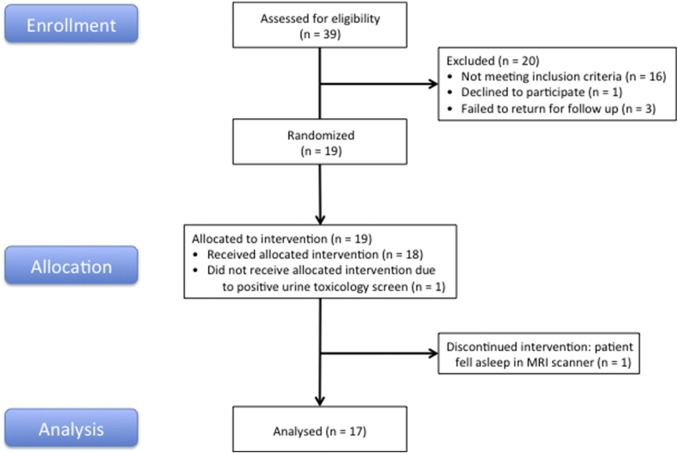
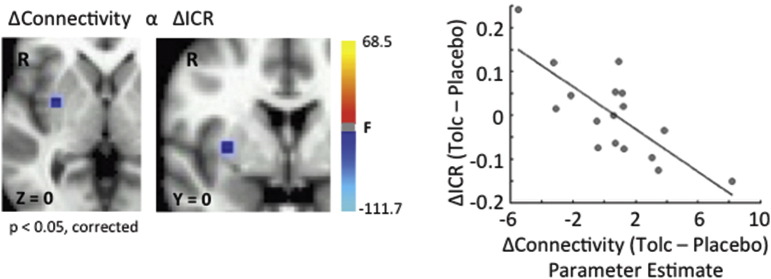
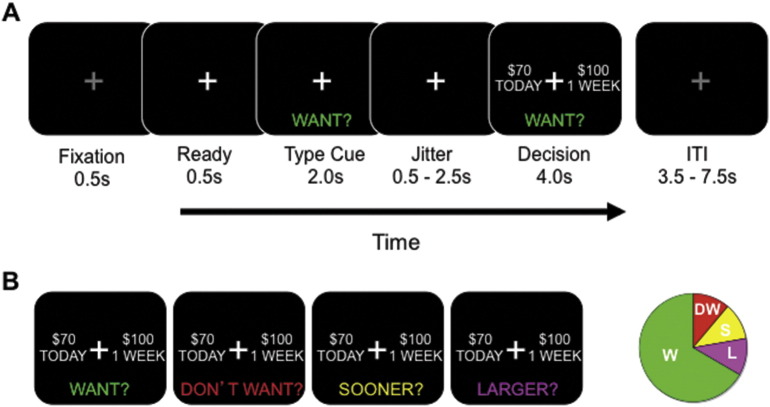
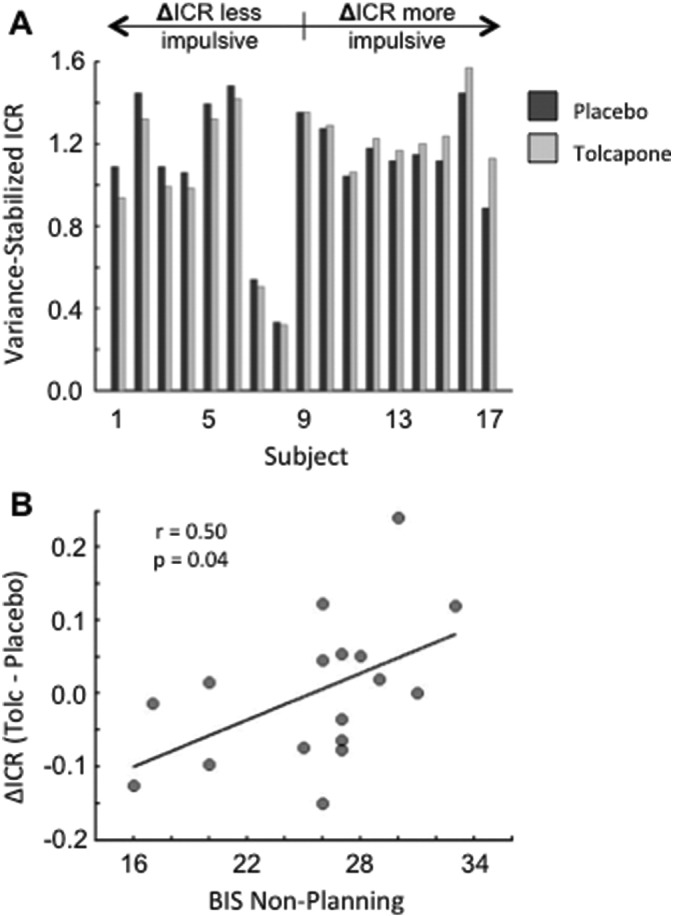
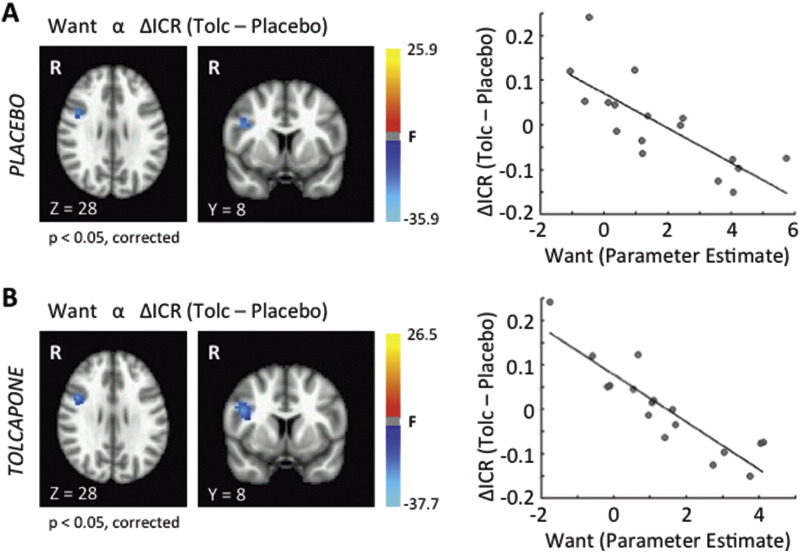
Failures of self-regulation in problem and pathological gambling (PPG) are thought to emerge from failures of top-down control, reflected neurophysiologically in a reduced capacity of prefrontal cortex to influence activity within subcortical structures. In patients with addictions, these impairments have been argued to alter evaluation of reward within dopaminergic neuromodulatory systems. Previously we demonstrated that augmenting dopamine tone in frontal cortex via use of tolcapone, an inhibitor of the dopamine-degrading enzyme catechol-O-methyltransferase (COMT), reduced delay discounting, a measure of impulsivity, in healthy subjects. To evaluate this potentially translational approach to augmenting prefrontal inhibitory control, here we hypothesized that increasing cortical dopamine tone would reduce delay discounting in PPG subjects in proportion to its ability to augment top-down control. To causally test this hypothesis, we administered the COMT inhibitor tolcapone in a randomized, double-blind, placebo-controlled, within-subject study of 17 PPG subjects who performed a delay discounting task while functional MRI images were obtained. In this subject population, we found that greater BOLD activity during the placebo condition within the right inferior frontal cortex (RIFC), a region thought to be important for inhibitory control, correlated with greater declines in impulsivity on tolcapone versus placebo. Intriguingly, connectivity between RIFC and the right striatum, and not the level of activity within RIFC itself, increased on tolcapone versus placebo. Together, these findings support the hypothesis that tolcapone-mediated increases in top-down control may reduce impulsivity in PPG subjects, a finding with potential translational relevance for gambling disorders, and for behavioral addictions in general.
问题性赌博和病理性赌博(PPG)中的自我调节失败被认为源于自上而下控制的失败,在神经生理学上表现为前额叶皮质影响皮质下结构内活动的能力下降。在成瘾患者中,这些损伤被认为会改变多巴胺能神经调节系统内奖励的评估。此前我们证明,通过使用托卡朋(一种多巴胺降解酶儿茶酚-O-甲基转移酶(COMT)的抑制剂)增强额叶皮质中的多巴胺张力,可减少健康受试者的延迟折扣,这是一种冲动性的衡量指标。为了评估这种增强前额叶抑制控制的潜在转化方法,我们在此假设,增加皮质多巴胺张力将按其增强自上而下控制的能力成比例地减少PPG受试者的延迟折扣。为了因果检验这一假设,我们在一项针对17名PPG受试者的随机、双盲、安慰剂对照、受试者内研究中给予COMT抑制剂托卡朋,这些受试者在进行延迟折扣任务时获取功能磁共振成像图像。在这一受试者群体中,我们发现,在右侧下额叶皮质(RIFC)(一个被认为对抑制控制很重要的区域)的安慰剂条件下更大的血氧水平依赖(BOLD)活动,与托卡朋组相对于安慰剂组更大的冲动性下降相关。有趣的是,与RIFC本身的活动水平相比,托卡朋组相对于安慰剂组RIFC与右侧纹状体之间的连接性增加。总之,这些发现支持了以下假设:托卡朋介导的自上而下控制增加可能会降低PPG受试者的冲动性,这一发现对于赌博障碍以及一般行为成瘾具有潜在的转化意义。