Department of Developmental and Preventive Sciences, Faculty of Dentistry, Kuwait University, Kuwait city, Kuwait.
Department of Surgical Sciences, Faculty of Dentistry, Kuwait University, Kuwait city, Kuwait.
Prog Orthod. 2017 Dec;18(1):1. doi: 10.1186/s40510-016-0156-7. Epub 2017 Jan 9.
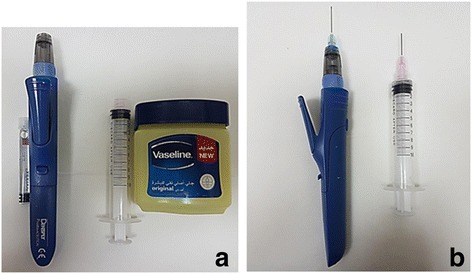
The initial placement of orthodontic elastomeric separators can be uncomfortable and painful. Therefore, it is important to relieve this disturbing sensation to create a discomfort or pain-free orthodontic visit. The purpose of this study was to investigate the effect of a lidocaine/prilocaine topical anesthetic on pain and discomfort associated with the placement of orthodontic elastomeric separators.
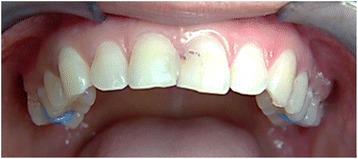
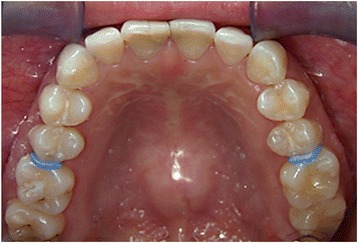
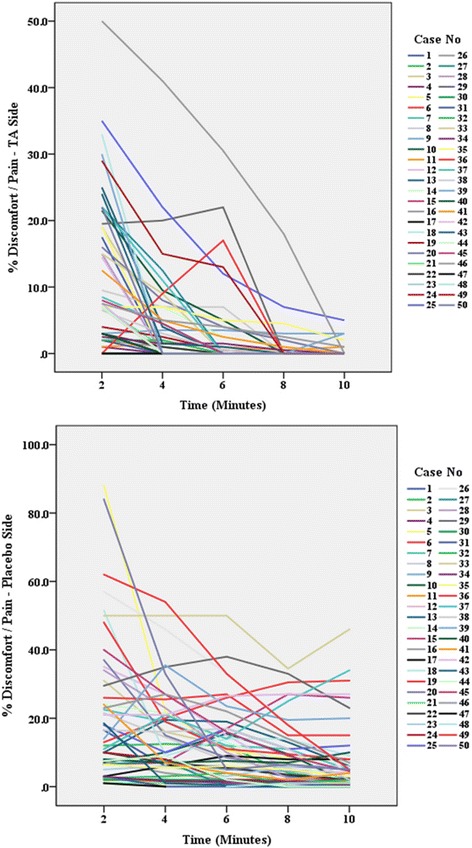
Fifty subjects aging between 20-35 years were included in this study. In the maxillary arch, a lidocaine/prilocaine topical anesthetic was placed around the ginigval margins of the premolar and molar on side. On the other side, a placebo agent was placed around the ginigval margins of the premolar and molar. After two minutes, an elastomeric separator was placed between the premolar and molar on both sides. The subjects were then asked to report their findings on a Verbal Scale and a Visual Analogue Scale every second minute for a period of 10 min. The subjects were also given a questionnaire to evaluate the overall impression on the topical anesthetic use.
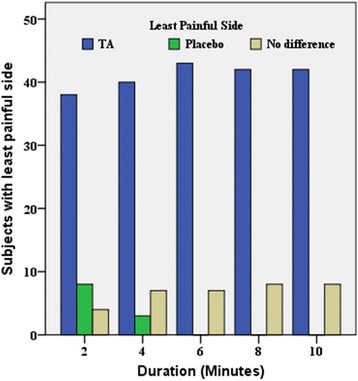
The overall mean discomfort/pain score was found to be significantly lower (p < 0.001) with the topical anesthetic than with the placebo. Repeated measures ANOVA with a Greenhouse-Geisser correction determined that mean pain scores were statistically significantly low with the 10-min time duration (F = 40.7, p = 0.001), with an estimated grand mean (8.37, 95% CI 6.75-9.98). The questionnaire responses revealed that 87% of the subjects reported an overall satisfaction and agreement with the topical anesthetic than with the placebo or no difference (13%) after the initial separator placement.
The discomfort and pain resulting from the initial placement of orthodontic elastomeric separators can be significantly reduced with the lidocaine/prilocaine topical anesthetic.
正畸弹性分离器的初始放置可能会引起不适和疼痛。因此,缓解这种不适感觉对于创造一个无不适或无痛的正畸就诊体验非常重要。本研究旨在探讨利多卡因/丙胺卡因局部麻醉剂对正畸弹性分离器放置相关疼痛和不适的影响。
本研究纳入了 50 名年龄在 20-35 岁之间的受试者。在上颌弓中,利多卡因/丙胺卡因局部麻醉剂被放置在每个前磨牙和磨牙的龈缘周围。在另一侧,将安慰剂制剂放置在每个前磨牙和磨牙的龈缘周围。两分钟后,在两侧的前磨牙和磨牙之间放置一个弹性分离器。然后,受试者每两秒钟使用言语量表和视觉模拟量表报告他们的发现,持续 10 分钟。受试者还被要求填写一份关于局部麻醉剂使用总体印象的问卷。
与安慰剂相比,使用局部麻醉剂时整体不适/疼痛评分明显较低(p<0.001)。经过 Greenhouse-Geisser 校正的重复测量方差分析表明,随着时间的延长(10 分钟),平均疼痛评分具有统计学意义(F=40.7,p=0.001),估计的总平均值(8.37,95%置信区间为 6.75-9.98)较低。问卷回答显示,87%的受试者报告总体满意度和对局部麻醉剂的认同度高于安慰剂(13%)或无差异(13%)。
使用利多卡因/丙胺卡因局部麻醉剂可以显著减轻正畸弹性分离器初始放置引起的不适和疼痛。