Coray Dorien S, Wheeler Nicole E, Heinemann Jack A, Gardner Paul P
a School of Biological Sciences, University of Canterbury, Canterbury , Christchurch , New Zealand.
b Centre for Integrative Ecology, University of Canterbury, Canterbury , Christchurch , New Zealand.
RNA Biol. 2017 Mar 4;14(3):275-280. doi: 10.1080/15476286.2016.1272747. Epub 2017 Jan 9.
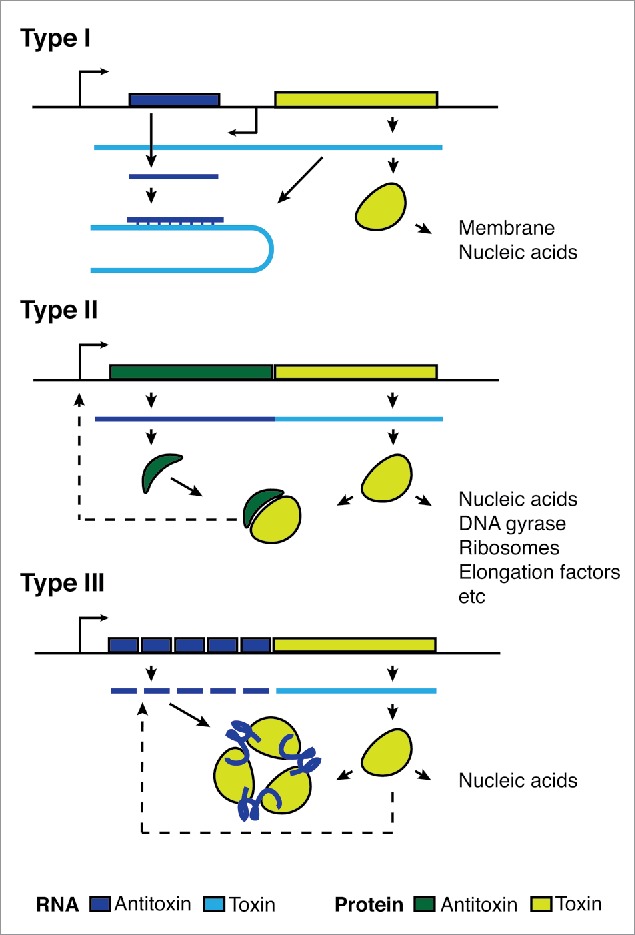
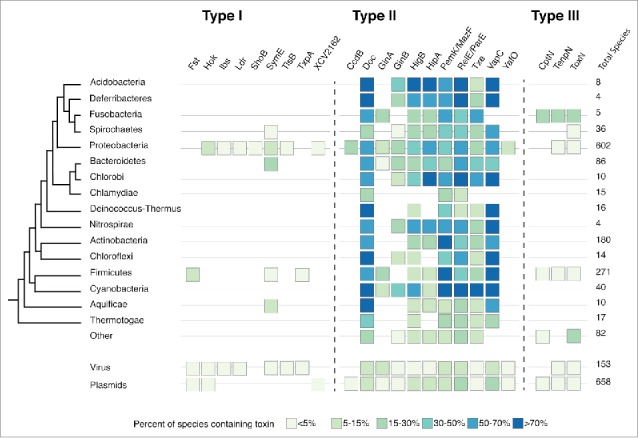
Toxin-antitoxin (TA) systems are gene modules that appear to be horizontally mobile across a wide range of prokaryotes. It has been proposed that type I TA systems, with an antisense RNA-antitoxin, are less mobile than other TAs that rely on direct toxin-antitoxin binding but no direct comparisons have been made. We searched for type I, II and III toxin families using iterative searches with profile hidden Markov models across phyla and replicons. The distribution of type I toxin families were comparatively narrow, but these patterns weakened with recently discovered families. We discuss how the function and phenotypes of TA systems as well as biases in our search methods may account for differences in their distribution.
毒素-抗毒素(TA)系统是一种基因模块,似乎能在广泛的原核生物中水平转移。有人提出,具有反义RNA抗毒素的I型TA系统的移动性低于其他依赖毒素-抗毒素直接结合的TA系统,但尚未进行直接比较。我们使用跨门和复制子的轮廓隐马尔可夫模型进行迭代搜索,以寻找I型、II型和III型毒素家族。I型毒素家族的分布相对较窄,但随着最近发现的家族,这些模式有所减弱。我们讨论了TA系统的功能和表型以及我们搜索方法中的偏差如何解释它们分布上的差异。