Li Yan, Wang Jinghui, Lin Feng, Yang Yinfeng, Chen Su-Shing
Systems Biology Laboratory, Department of Computer Information Science and Engineering, University of Florida, Gainesville, Florida, United States of America.
Key Laboratory of Industrial Ecology and Environmental Engineering (MOE), Faculty of Chemical, Environmental and Biological Science and Technology, Dalian University of Technology, Dalian, Liaoning, P R China.
PLoS One. 2017 Jan 9;12(1):e0169363. doi: 10.1371/journal.pone.0169363. eCollection 2017.
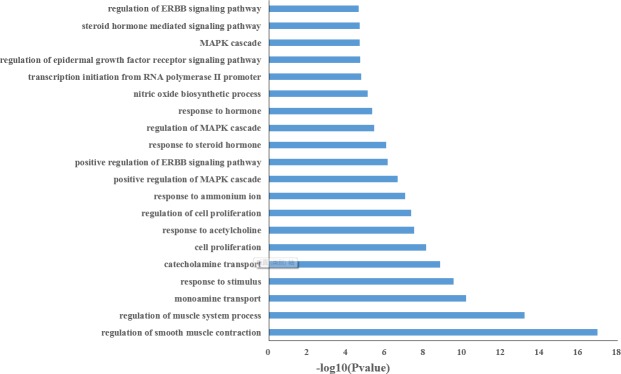
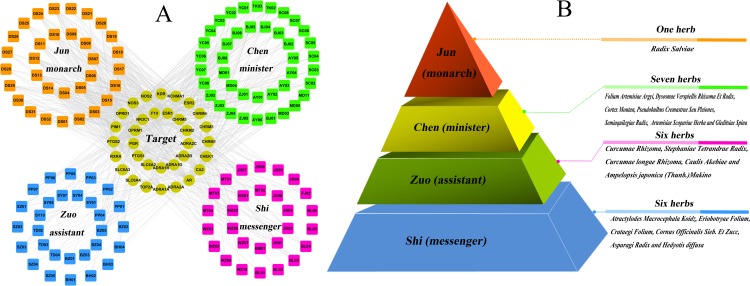
Breast cancer is the most common carcinoma in women. Comprehensive therapy on breast cancer including surgical operation, chemotherapy, radiotherapy, endocrinotherapy, etc. could help, but still has serious side effect and resistance against anticancer drugs. Complementary and alternative medicine (CAM) may avoid these problems, in which traditional Chinese medicine (TCM) has been highlighted. In this section, to analyze the mechanism through which TCM act on breast cancer, we have built a virtual model consisting of the construction of database, oral bioavailability prediction, drug-likeness evaluation, target prediction, network construction. The 20 commonly employed herbs for the treatment of breast cancer were used as a database to carry out research. As a result, 150 ingredient compounds were screened out as active molecules for the herbs, with 33 target proteins predicted. Our analysis indicates that these herbs 1) takes a 'Jun-Chen-Zuo-Shi" as rule of prescription, 2) which function mainly through perturbing three pathways involving the epidermal growth factor receptor, estrogen receptor, and inflammatory pathways, to 3) display the breast cancer-related anti-estrogen, anti-inflammatory, regulation of cell metabolism and proliferation activities. To sum it up, by providing a novel in silico strategy for investigation of the botanical drugs, this work may be of some help for understanding the action mechanisms of herbal medicines and for discovery of new drugs from plants.
乳腺癌是女性中最常见的癌症。乳腺癌的综合治疗包括手术、化疗、放疗、内分泌治疗等,虽有帮助,但仍有严重的副作用且存在抗癌药物耐药性问题。补充和替代医学(CAM)可能避免这些问题,其中传统中医(TCM)备受关注。在本节中,为分析中医作用于乳腺癌的机制,我们构建了一个虚拟模型,包括数据库构建、口服生物利用度预测、类药性评估、靶点预测、网络构建。以20种常用的治疗乳腺癌的草药作为数据库进行研究。结果,筛选出150种成分化合物作为这些草药的活性分子,预测出33种靶蛋白。我们的分析表明,这些草药1)以“君臣佐使”为组方原则,2)主要通过干扰涉及表皮生长因子受体、雌激素受体和炎症途径的三条通路发挥作用,3)展现出与乳腺癌相关的抗雌激素、抗炎、调节细胞代谢和增殖活性。综上所述,通过提供一种新的计算机模拟策略来研究植物药,这项工作可能有助于理解草药的作用机制以及从植物中发现新药。