Peters Claudia, Dulon Madeleine, Kleinmüller Olaf, Nienhaus Albert, Schablon Anja
Institute for Health Services Research in Dermatology and Nursing, CVcare, University Medical Center Hamburg-Eppendorf, Hamburg, Germany.
Department of Occupational Health Research, Institution for Statutory Accident Insurance and Prevention in Healthcare and Welfare, Hamburg, Germany.
PLoS One. 2017 Jan 9;12(1):e0169425. doi: 10.1371/journal.pone.0169425. eCollection 2017.
The increase of multidrug-resistant organisms in hospitals causes problems in nursing homes. Staff in geriatric nursing homes are at greater risk of MRSA colonisation. The aim of the study was to describe the occupational exposure to MRSA among health personnel in geriatric nursing.
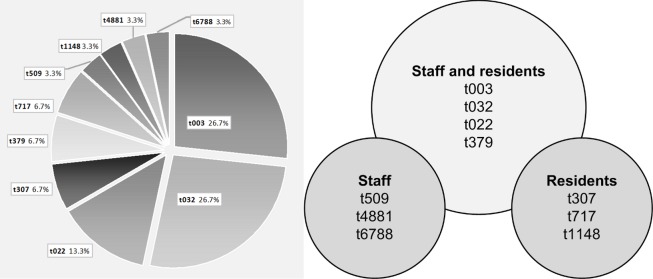
A point prevalence survey was conducted among health personnel and residents of geriatric nursing homes within the greater Hamburg district. Nasal swabs and, where relevant, wound swabs were collected for the screening survey. Risk factors for MRSA colonisation were identified by means of a questionnaire and using the files held on the residents. Where tests on nursing staff were positive, a control swab was taken; when the results were confirmed positive, decolonisation was performed. The responsible general practitioners were notified of positive MRSA findings among residents. A molecular biological examination of the MRSA samples was performed.
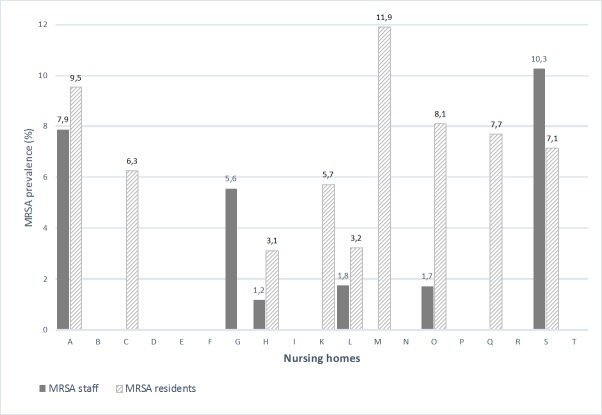
A total of 19 institutions participated in the study. Nasal swabs were taken from 759 nursing staff and 422 residents. Prevalence of MRSA was 1.6% among staff and 5.5% among residents. MRSA colonisation among health personnel indicated a correlation with male gender (OR 4.5, 95% CI 1.4-14.1). Among the residents, chronic skin diseases (OR 3.2, 95% CI 1.0-10.3) and indwelling devices (OR 3.2, 95% CI 1.2-8.1) were identified as risk factors. No link between MRSA in residents and in health personnel could be established.
The number of MRSA colonisations among nursing staff and residents of geriatric nursing homes in Hamburg was rather low at 1.6% and 5.5% respectively and equates to the results of other surveys in non-outbreak scenarios.
医院中多重耐药菌的增加给养老院带来了问题。老年护理院的工作人员感染耐甲氧西林金黄色葡萄球菌(MRSA)的风险更高。本研究的目的是描述老年护理中卫生人员的MRSA职业暴露情况。
在大汉堡地区的老年护理院的卫生人员和居民中进行了一项现况调查。采集鼻拭子,并在相关情况下采集伤口拭子进行筛查调查。通过问卷调查并利用居民的档案确定MRSA定植的危险因素。对护理人员的检测呈阳性时,采集对照拭子;结果确认呈阳性时,进行去定植治疗。向负责的全科医生通报居民中MRSA阳性结果。对MRSA样本进行分子生物学检查。
共有19家机构参与了研究。对759名护理人员和422名居民采集了鼻拭子。工作人员中MRSA的患病率为1.6%,居民中为5.5%。卫生人员中的MRSA定植表明与男性性别相关(比值比4.5,95%置信区间1.4 - 14.1)。在居民中,慢性皮肤病(比值比3.2,95%置信区间1.0 - 10.3)和留置装置(比值比3.2,95%置信区间1.2 - 8.1)被确定为危险因素。居民和卫生人员中的MRSA之间未发现关联。
汉堡老年护理院护理人员和居民中MRSA定植的数量相当低,分别为1.6%和5.5%,与非暴发情况下的其他调查结果相当。