Sellmer Anna, Bech Bodil H, Bjerre Jesper V, Schmidt Michael R, Hjortdal Vibeke E, Esberg Gitte, Rittig Søren, Henriksen Tine B
Department of Pediatrics, Aarhus University Hospital, Palle Juul-Jensens Boulevard 99, DK 8200, Aarhus, Denmark.
Perinatal Epidemiology Research Unit, Department of Pediatrics, Aarhus University Hospital, Palle Juul-Jensens Boulevard 99, DK 8200, Aarhus, Denmark.
BMC Pediatr. 2017 Jan 10;17(1):7. doi: 10.1186/s12887-016-0761-0.
A patent ductus arteriosus (PDA) is frequently found in very preterm neonates and is associated with increased risk of morbidity and mortality. A shunt across a PDA can result in an unfavorable distribution of the cardiac output and may in turn result in poor renal perfusion. Urinary Neutrophil Gelatinase-associated Lipocalin (U-NGAL) is a marker of renal ischemia and may add to the evaluation of PDA. Our primary aim was to investigate if U-NGAL is associated with PDA in very preterm neonates. Secondary, to investigate whether U-NGAL and PDA are associated with AKI and renal dysfunction evaluated by fractional excretion of sodium (FENa) and urine albumin in a cohort of very preterm neonates.
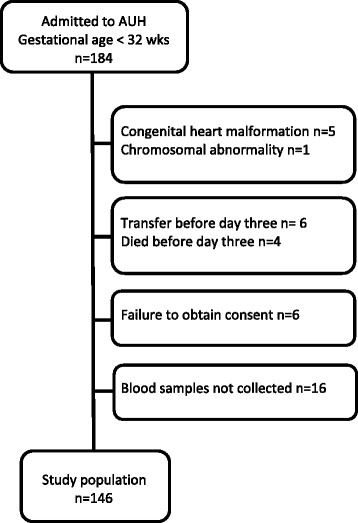
A cohort of 146 neonates born at a gestational age less than 32 weeks were consecutively examined with echocardiography for PDA and serum sodium, and urine albumin and sodium were measured on postnatal day 3 and U-NGAL and serum creatinine day 3 and 6. AKI was defined according to modified neonatal Acute Kidney Injury Network (AKIN) criteria. The association between U-NGAL and PDA was investigated. And secondly we investigated if PDA and U-NGAL was associated with AKI and renal dysfunction.
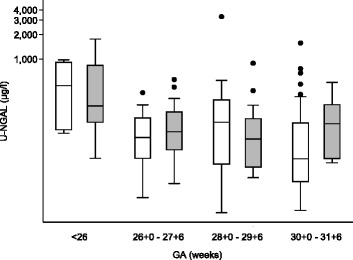
U-NGAL was not associated with a PDA day 3 when adjusted for gestational age and gender. A PDA day 3 was not associated with AKI when adjusted for gestational age and gender; however, it was associated with urine albumin. U-NGAL was not associated with AKI, but was found to be associated with urine albumin and FENa.
Based on our study U-NGAL is not considered useful as a diagnostic marker to identify very preterm neonates with a PDA causing hemodynamic changes resulting in early renal morbidity. The interpretation of NGAL in preterm neonates remains to be fully elucidated.
动脉导管未闭(PDA)在极早产儿中很常见,且与发病率和死亡率增加相关。PDA处的分流可导致心输出量分布不佳,进而可能导致肾灌注不良。尿中性粒细胞明胶酶相关脂质运载蛋白(U-NGAL)是肾缺血的标志物,可能有助于评估PDA。我们的主要目的是研究U-NGAL是否与极早产儿的PDA相关。其次,在一组极早产儿中,研究U-NGAL和PDA是否与急性肾损伤(AKI)及通过尿钠排泄分数(FENa)和尿白蛋白评估的肾功能障碍相关。
对146例孕周小于32周的新生儿进行连续超声心动图检查以评估PDA,并检测血清钠,在出生后第3天测量尿白蛋白和钠,在出生后第3天和第6天测量U-NGAL和血清肌酐。根据改良的新生儿急性肾损伤网络(AKIN)标准定义AKI。研究U-NGAL与PDA之间的关联。其次,我们研究PDA和U-NGAL是否与AKI及肾功能障碍相关。
在根据孕周和性别进行校正后,出生后第3天的U-NGAL与PDA无关。在根据孕周和性别进行校正后,出生后第3天的PDA与AKI无关;然而,它与尿白蛋白相关。U-NGAL与AKI无关,但与尿白蛋白和FENa相关。
基于我们的研究,U-NGAL不被认为是用于识别极早产儿中导致血流动力学改变并引起早期肾脏疾病的PDA的有用诊断标志物。早产儿中NGAL的解读仍有待充分阐明。