Yu Jin, Li Ming-Li, Xu Yu-Yuan, Wu Shi-Wen, Lou Min, Mu Xue-Tao, Feng Feng, Gao Shan, Xu Wei-Hai
Department of Neurology and Radiology, Peking Union Medical College Hospital, Chinese Academy of Medical Sciences, Shuaifuyuan1, Dongcheng District, Beijing, 100730, China.
Department of Neurology and Radiology, General Hospital of Chinese People's Armed Police Force, Beijing, China.
BMC Neurol. 2017 Jan 10;17(1):8. doi: 10.1186/s12883-016-0785-y.
The underlying pathophysiology of BA distribution is unclear and intriguing. Using high-resolution magnetic resonance imaging (HR-MRI), we sought to explore the plaque distribution of low-grade basilar artery (BA) atherosclerosis and its clinical relevance.
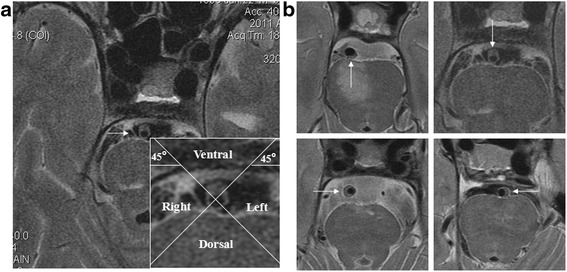
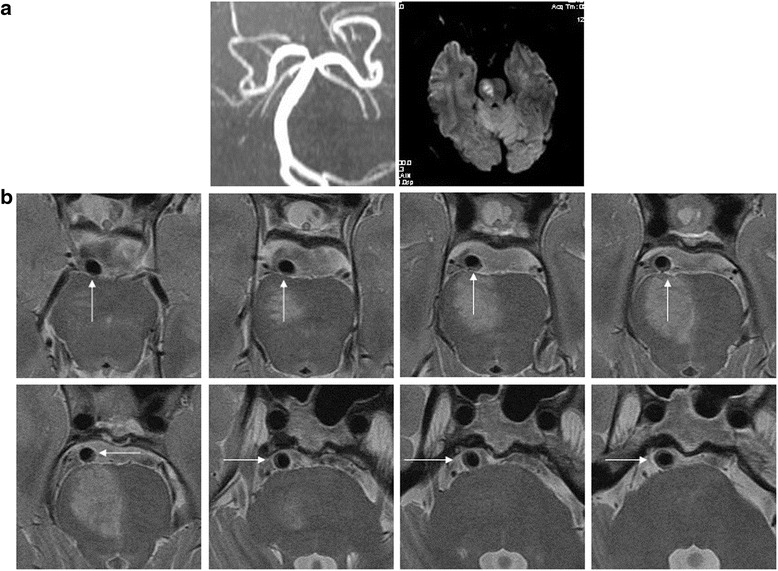
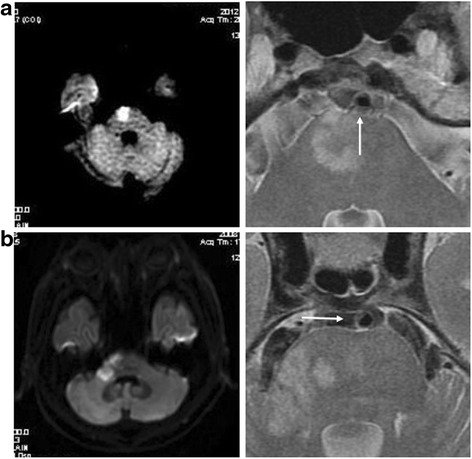
We retrospectively analyzed the imaging and clinical data of 61 patients with low-grade atherosclerotic BA stenosis (<50%). On HR-MRI, the plaques were categorized based on the involvement of the ventral, dorsal, or lateral sides of BA wall. A culprit plaque was defined if it was on the same slice or neighboring slices of symptomatic pontine infarcts and played a probable causal role (dorsal plaques with median pontine infarcts or lateral plaques with ipsilateral pontine infarcts). The relationships between plaque distribution and clinical presentations were analyzed.
Twenty-five symptomatic and thirty-six asymptomatic BAs with 752 HR-MRI image slices were studied. The average length of BA atherosclerosis plaques was 12.16 ± 5.61mm (10.30 ± 6.44mm in symptomatic and 13.46 ± 7.03mm in asymptomatic patients, p = 0.079). The plaque distribution was similar at ventral (29.0%), dorsal (37.6%) and lateral walls (33.1%). The BA plaques in symptomatic patients were more frequently located at the dorsal (42.5%) and lateral (41.2%) walls than at the ventral walls (16.1%; P < 0.05). Compared with symptomatic patients, asymptomatic patients more likely had their plaques distributed at the ventral walls (P = 0.022). Culprit plaques were observed in 85.0% (17/20) pontine infarcts in symptomatic patients and only 14.3% (2/14) silent pontine infarcts in asymptomatic patients (p < 0.001).
Low-grade BA atherosclerosis has a long distribution and evenly involves ventral, dorsal and lateral walls. The plaques at dorsal and lateral walls are associated with symptomatic pontine infarcts but not with silent infarcts.
基底动脉(BA)粥样硬化斑块分布的潜在病理生理学尚不清楚且引人关注。我们使用高分辨率磁共振成像(HR-MRI)来探究轻度基底动脉粥样硬化的斑块分布及其临床相关性。
我们回顾性分析了61例轻度动脉粥样硬化性BA狭窄(<50%)患者的影像学和临床资料。在HR-MRI上,根据斑块累及BA壁的腹侧、背侧或外侧对斑块进行分类。如果斑块位于有症状脑桥梗死的同一层面或相邻层面且可能起因果作用(背侧斑块导致脑桥中部梗死或外侧斑块导致同侧脑桥梗死),则定义为责任斑块。分析斑块分布与临床表现之间的关系。
对25条有症状和36条无症状的BA的752个HR-MRI图像层面进行了研究。BA动脉粥样硬化斑块的平均长度为12.16±5.61mm(有症状患者为10.30±6.44mm,无症状患者为13.46±7.03mm,p = 0.079)。斑块在腹侧(29.0%)、背侧(37.6%)和外侧壁(33.1%)的分布相似。有症状患者的BA斑块更多位于背侧(42.5%)和外侧壁(41.2%),而非腹侧壁(16.1%;P<0.05)。与有症状患者相比,无症状患者的斑块更可能分布在腹侧壁(P = 0.022)。在有症状患者中,85.0%(17/20)的脑桥梗死存在责任斑块,而在无症状患者中,只有14.3%(2/14)的无症状脑桥梗死存在责任斑块(p<0.001)。
轻度BA粥样硬化有较长的分布范围,且腹侧、背侧和外侧壁均有累及。背侧和外侧壁的斑块与有症状的脑桥梗死相关,但与无症状梗死无关。