Li Teng, Ning Xianghui, He Qun, Gong Kan
Department of Urology, Institute of Urology, National Urological Cancer Center, Peking University First Hospital, Peking University, No. 8, Xishiku Street, Xicheng District, Beijing, 100034, P. R. China.
Chin J Cancer. 2017 Jan 9;36(1):4. doi: 10.1186/s40880-016-0172-5.
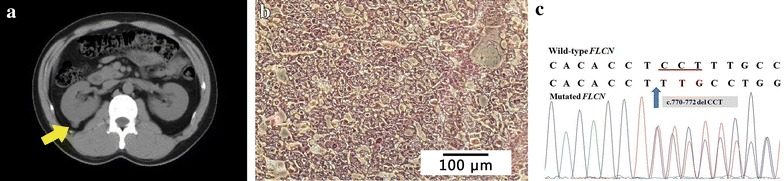
Birt-Hogg-Dubé (BHD) syndrome, a hereditary renal cancer syndrome caused by mutations in the folliculin (FLCN) gene, is characterized by the presence of fibrofolliculomas, pulmonary cysts, spontaneous pneumothorax, and renal cell carcinoma (RCC). Few BHD syndrome cases have been reported in Asian countries, and cutaneous presentations are relatively rare in Asian patients. Asian BHD patients may be misdiagnosed due to their atypical manifestations. Here, we report two Chinese BHD patients with novel FLCN mutations (c.946-947delAG in exon 9 and c.770-772delCCT in exon 7). Both of them had RCC and spontaneous pneumothorax without fibrofolliculomas. In patients with RCC and pulmonary cysts but without cutaneous lesions, screening for mutations in the FLCN gene should be performed, especially for those with a family history of RCC or pulmonary cysts (pneumothorax).
Birt-Hogg-Dubé(BHD)综合征是一种由卵泡抑素(FLCN)基因突变引起的遗传性肾癌综合征,其特征为存在纤维毛囊瘤、肺囊肿、自发性气胸和肾细胞癌(RCC)。亚洲国家报道的BHD综合征病例较少,且亚洲患者的皮肤表现相对罕见。亚洲BHD患者可能因其非典型表现而被误诊。在此,我们报告两名携带新型FLCN突变(外显子9的c.946 - 947delAG和外显子7的c.770 - 772delCCT)的中国BHD患者。他们均患有肾细胞癌和自发性气胸,但无纤维毛囊瘤。对于患有肾细胞癌和肺囊肿但无皮肤病变的患者,应进行FLCN基因突变筛查,尤其是那些有肾细胞癌或肺囊肿(气胸)家族史的患者。