Beyene Misrak Getnet, Geda Nigatu Regassa, Habtewold Tesfa Dejenie, Assen Zuriash Mengistu
Ethiopian Public Health Institute, Addis Ababa, Ethiopia.
Hawassa University, Hawassa, Ethiopia ; University of Saskatchwan, Saskatchwan, Canada.
Int Breastfeed J. 2017 Jan 6;12:1. doi: 10.1186/s13006-016-0096-3. eCollection 2016.
The early initiation of breastfeeding (EIBF), or timely initiation of breastfeeding, is the proportion of children put to the breast within one hour of birth. It is an important strategy for reducing perinatal and infant morbidity and mortality, but it remains under practiced in Ethiopia. The aim of the study was to assess the prevalence and the predicting factors associated with EIBF.
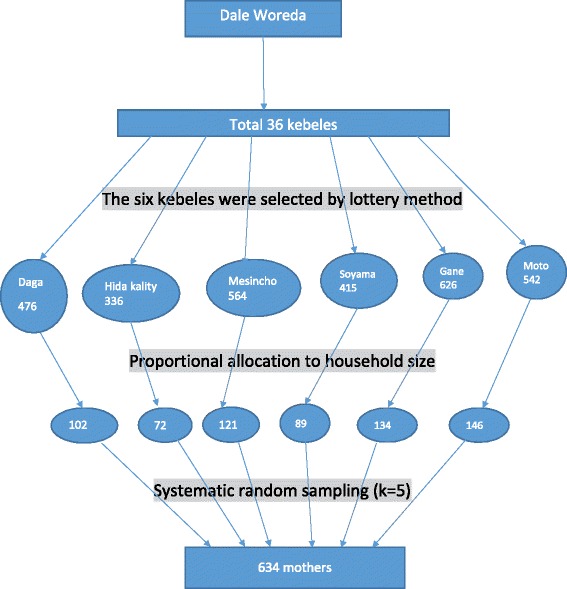
A community based cross-sectional study was conducted in 634 mothers in Dale Woreda, South Ethiopia. Multistage cluster sampling was used to select participating mothers. EIBF was outcome variable whereas sociodemographic characteristics and knowledge and practice of maternal health service were explanatory variables. A face-to-face interview using a pretested semi-structured questionnaire was done from September 2012 to March 2013. To investigate predicting factors, bivariate and multivariate logistic regression analysis was done.
A total of 634 mothers of children under 24 months were interviewed. During the time of data collection, 94.3% of the mothers had breastfed. The prevalence of EIBF was 83.7%. Ownership of the house was a significant predicting factor for EIBF. Mothers who lived in rented houses were significantly less likely (60%) to initiate breastfeeding within one hour of birth compared to mothers who owned their own house: Adjusted odds ratio 0.40 (95% Confidence Interval 0.16, 0.97).
More than three-fourths of mothers initiated breastfeeding within an hour. Findings from our study suggest that improving the mother's socioeconomic status as reflected by house ownership, being a significant predictor of EIBF, would have a central role in improving EIBF.
早期开始母乳喂养(EIBF),即及时开始母乳喂养,是指在出生后一小时内开始哺乳的儿童比例。这是降低围产期和婴儿发病率及死亡率的一项重要策略,但在埃塞俄比亚,这一策略的实施情况仍不容乐观。本研究旨在评估早期开始母乳喂养的患病率及其相关预测因素。
在埃塞俄比亚南部戴尔县对634名母亲进行了一项基于社区的横断面研究。采用多阶段整群抽样方法选取参与研究的母亲。早期开始母乳喂养是结果变量,而社会人口学特征以及孕产妇保健服务的知识和实践是解释变量。2012年9月至2013年3月期间,使用预先测试的半结构化问卷进行了面对面访谈。为了调查预测因素,进行了二元和多元逻辑回归分析。
总共采访了634名24个月以下儿童的母亲。在数据收集期间,94.3%的母亲进行了母乳喂养。早期开始母乳喂养的患病率为83.7%。房屋所有权是早期开始母乳喂养的一个重要预测因素。与拥有自己房屋的母亲相比,居住在出租房屋中的母亲在出生后一小时内开始母乳喂养的可能性显著降低(60%):调整后的优势比为0.40(95%置信区间为0.16,0.97)。
超过四分之三的母亲在一小时内开始母乳喂养。我们的研究结果表明,改善母亲的社会经济地位(以房屋所有权为代表),作为早期开始母乳喂养的一个重要预测因素,将在改善早期开始母乳喂养方面发挥核心作用。