Ofori Benjamin Y, Beaumont Linda J, Stow Adam J
Department of Biological Sciences Macquarie University North Ryde Macquarie Park NSW Australia; Department Animal Biology and Conservation Science University of Ghana Legon-Accra Ghana.
Department of Biological Sciences Macquarie University North Ryde Macquarie Park NSW Australia.
Ecol Evol. 2016 Nov 29;7(1):48-57. doi: 10.1002/ece3.2627. eCollection 2017 Jan.
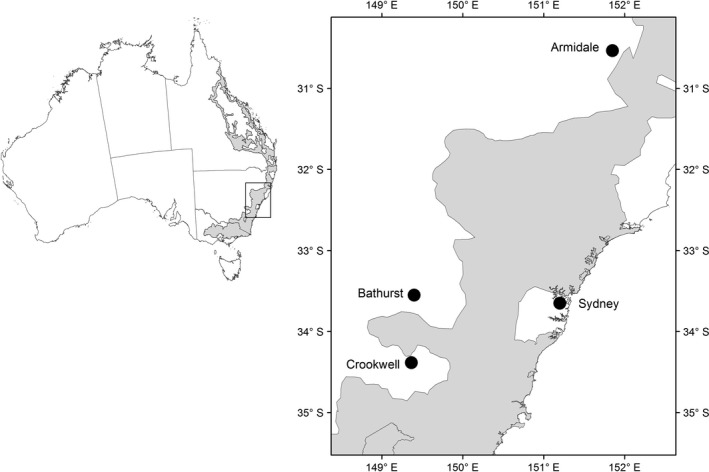
Establishing corridors of connecting habitat has become a mainstay conservation strategy to maintain gene flow and facilitate climate-driven range shifts. Yet, little attention has been given to ascertaining the extent to which corridors will benefit philopatric species, which might exhibit localized adaptation. Measures of genetic connectivity and adaptive genetic variation across species' ranges can help fill this knowledge gap. Here, we characterized the spatial genetic structure of Cunningham's skink (), a philopatric species distributed along Australia's Great Dividing Range, and assessed evidence of localized adaptation. Analysis of 4,274 SNPs from 94 individuals sampled at four localities spanning 500 km and 4° of latitude revealed strong genetic structuring at neutral loci (mean ± = 0.603 ± 0.237) among the localities. Putatively neutral SNPs and those under divergent selection yielded contrasting spatial patterns, with the latter identifying two genetically distinct clusters. Given low genetic connectivity of the four localities, we suggest that the natural movement rate of this species is insufficient to keep pace with spatial shifts to its climate envelope, irrespective of habitat availability. In addition, our finding of localized adaptation highlights the risk of outbreeding depression should the translocation of individuals be adopted as a conservation management strategy.
建立连接栖息地的走廊已成为维持基因流动和促进气候驱动的范围转移的主要保护策略。然而,对于确定走廊将在多大程度上有利于恋巢性物种(可能表现出局部适应性),人们关注甚少。跨物种分布范围的遗传连通性和适应性遗传变异的测量有助于填补这一知识空白。在这里,我们描述了沿澳大利亚大分水岭分布的恋巢性物种坎宁安石龙子(Cunningham's skink)的空间遗传结构,并评估了局部适应性的证据。对来自跨越500公里和4个纬度的四个地点的94个个体的4274个单核苷酸多态性(SNP)进行分析,结果显示各地点之间在中性位点存在强烈的遗传结构(平均±=0.603±0.237)。假定的中性SNP和那些处于分歧选择下的SNP产生了截然不同的空间模式,后者识别出两个遗传上不同的聚类。鉴于这四个地点的遗传连通性较低,我们认为,无论栖息地是否可用,该物种的自然移动速度都不足以跟上其气候适应范围的空间变化。此外,我们关于局部适应性的发现凸显了如果将个体迁移作为保护管理策略,可能会出现远交衰退的风险。