Dröge Egil, Creel Scott, Becker Matthew S, M'soka Jassiel
Department of Ecology Montana State University Bozeman MT USA; Zambian Carnivore Programme Mfuwe Eastern Province Zambia.
Department of National Parks & Wildlife Chilanga, Lusaka Zambia.
Ecol Evol. 2016 Dec 16;7(1):189-199. doi: 10.1002/ece3.2616. eCollection 2017 Jan.
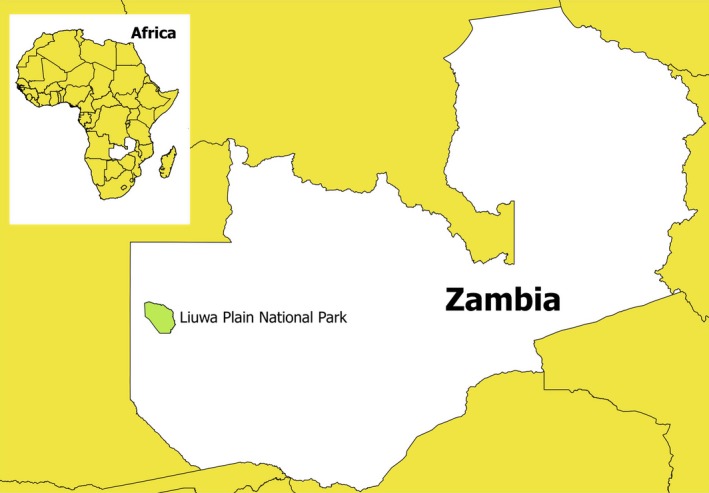
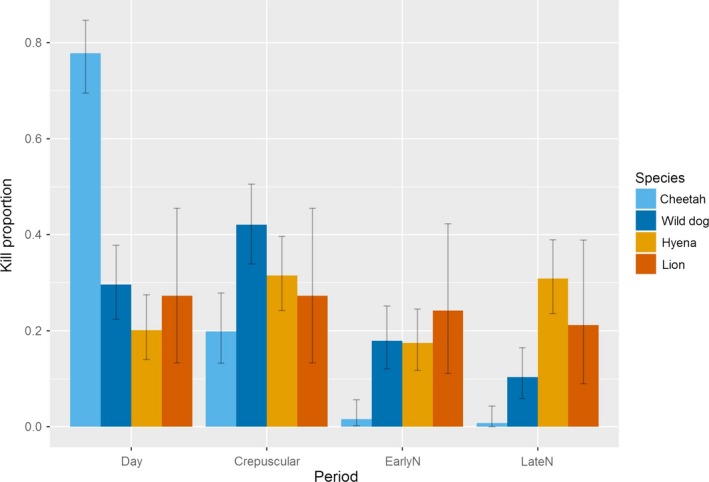
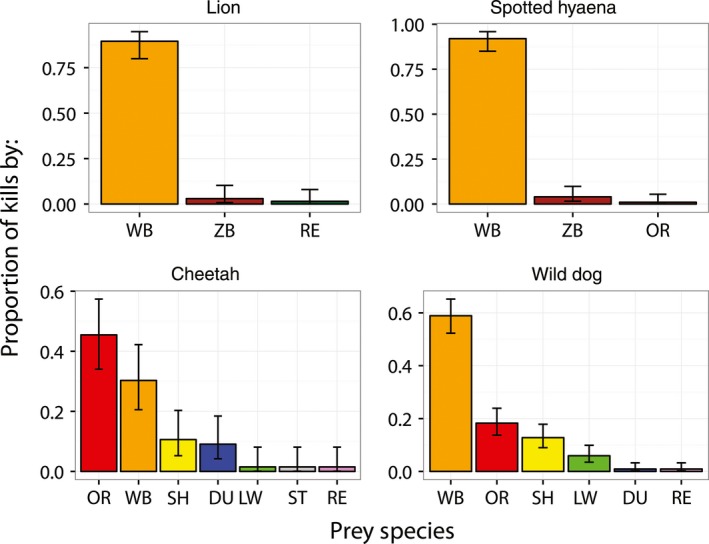
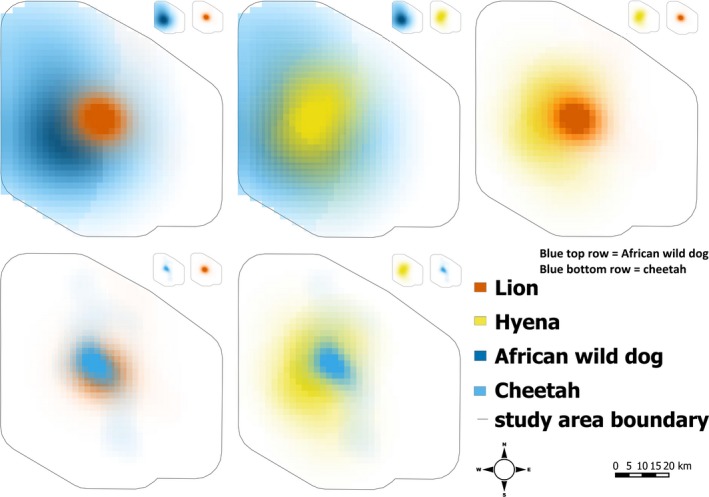
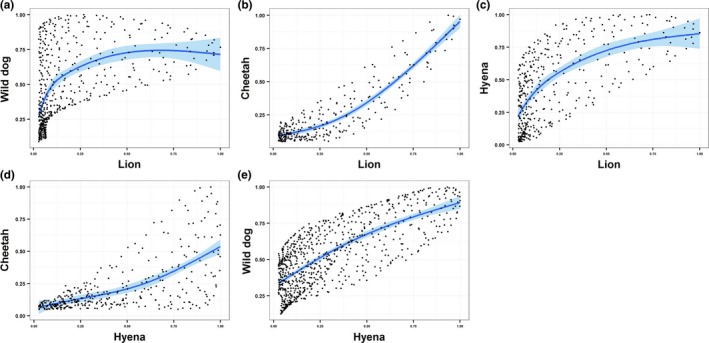
Within a large carnivore guild, subordinate competitors (African wild dog, , and cheetah, ) might reduce the limiting effects of dominant competitors (lion, , and spotted hyena, ) by avoiding them in space, in time, or through patterns of prey selection. Understanding how these competitors cope with one other can inform strategies for their conservation. We tested how mechanisms of niche partitioning promote coexistence by quantifying patterns of prey selection and the use of space and time by all members of the large carnivore guild within Liuwa Plain National Park in western Zambia. Lions and hyenas specialized on wildebeest, whereas wild dogs and cheetahs selected broader diets including smaller and less abundant prey. Spatially, cheetahs showed no detectable avoidance of areas heavily used by dominant competitors, but wild dogs avoided areas heavily used by lions. Temporally, the proportion of kills by lions and hyenas did not detectably differ across four time periods (day, crepuscular, early night, and late night), but wild dogs and especially cheetahs concentrated on time windows that avoided nighttime hunting by lions and hyenas. Our results provide new insight into the conditions under which partitioning may not allow for coexistence for one subordinate species, the African wild dog, while it does for cheetah. Because of differences in responses to dominant competitors, African wild dogs may be more prone to competitive exclusion (local extirpation), particularly in open, uniform ecosystems with simple (often wildebeest dominated) prey communities, where spatial avoidance is difficult.
在一个大型食肉动物群落中,从属竞争者(非洲野犬和猎豹)可能通过在空间、时间上避开优势竞争者(狮子和斑鬣狗),或通过猎物选择模式,来减轻优势竞争者的限制作用。了解这些竞争者如何相互应对,可以为它们的保护策略提供参考。我们通过量化赞比亚西部刘瓦平原国家公园内大型食肉动物群落所有成员的猎物选择模式以及空间和时间利用情况,来测试生态位分化机制如何促进共存。狮子和鬣狗专门捕食角马,而野犬和猎豹则选择更广泛的食物,包括体型较小且数量较少的猎物。在空间上,猎豹没有表现出对优势竞争者大量使用区域的明显回避,但野犬会避开狮子大量使用的区域。在时间上,狮子和鬣狗的捕杀比例在四个时间段(白天、晨昏、深夜和凌晨)没有明显差异,但野犬尤其是猎豹集中在避开狮子和鬣狗夜间捕猎的时间窗口。我们的研究结果为以下情况提供了新的见解:对于一个从属物种非洲野犬来说,生态位分化可能无法使其与其他物种共存,而猎豹则可以。由于对优势竞争者的反应不同,非洲野犬可能更容易受到竞争排斥(局部灭绝),特别是在开阔、单一的生态系统中,那里猎物群落简单(通常以角马为主),空间回避较为困难。