Martin Paul R, Freshwater Cameron, Ghalambor Cameron K
Department of Biology, Queen's University , Kingston , Ontario , Canada.
Department of Biology, University of Victoria , Victoria , British Columbia , Canada.
PeerJ. 2017 Jan 4;5:e2847. doi: 10.7717/peerj.2847. eCollection 2017.
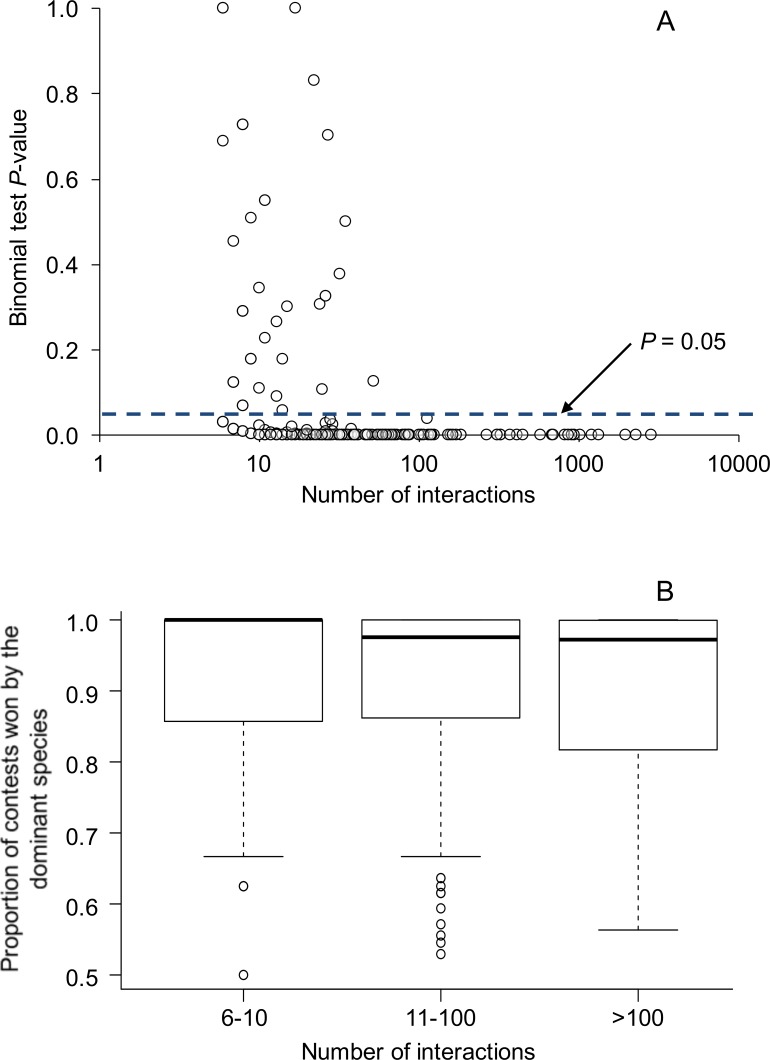
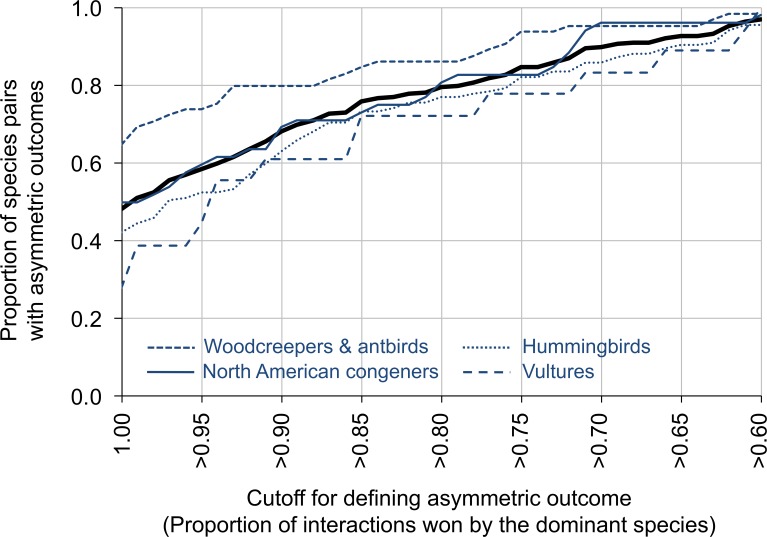
Aggressive interactions among closely related species are common, and can play an important role as a selective pressure shaping species traits and assemblages. The nature of this selective pressure depends on whether the outcomes of aggressive contests are asymmetric between species (i.e., one species is consistently dominant), yet few studies have estimated the prevalence of asymmetric versus symmetric outcomes to aggressive contests. Here we use previously published data involving 26,212 interactions between 270 species pairs of birds from 26 taxonomic families to address the question: How often are aggressive interactions among closely related bird species asymmetric? We define asymmetry using (i) the proportion of contests won by one species, and (ii) statistical tests for asymmetric outcomes of aggressive contests. We calculate these asymmetries using data summed across different sites for each species pair, and compare results to asymmetries calculated using data separated by location. We find that 80% of species pairs had aggressive outcomes where one species won 80% or more of aggressive contests. We also find that the majority of aggressive interactions among closely related species show statistically significant asymmetries, and above a sample size of 52 interactions, all outcomes are asymmetric following binomial tests. Species pairs with dominance data from multiple sites showed the same dominance relationship across locations in 93% of the species pairs. Overall, our results suggest that the outcome of aggressive interactions among closely related species are usually consistent and asymmetric, and should thus favor ecological and evolutionary strategies specific to the position of a species within a dominance hierarchy.
亲缘关系密切的物种之间的激烈互动很常见,并且作为一种塑造物种特征和组合的选择压力,可能发挥重要作用。这种选择压力的性质取决于物种间激烈竞争的结果是否不对称(即一个物种始终占主导地位),然而很少有研究估计激烈竞争中不对称结果与对称结果的普遍程度。在此,我们使用先前发表的涉及来自26个分类科的270对鸟类物种间26212次互动的数据,来解决这个问题:亲缘关系密切的鸟类物种间的激烈互动有多频繁是不对称的?我们使用(i)一个物种赢得竞争的比例,以及(ii)对激烈竞争的不对称结果进行统计检验来定义不对称性。我们使用每个物种对不同地点汇总的数据来计算这些不对称性,并将结果与使用按地点分开的数据计算的不对称性进行比较。我们发现,80%的物种对具有这样的激烈竞争结果,即一个物种赢得80%或更多的激烈竞争。我们还发现,亲缘关系密切的物种间的大多数激烈互动显示出具有统计学意义的不对称性,并且在样本量超过52次互动时,二项式检验后的所有结果都是不对称的。来自多个地点的具有优势数据的物种对中,93%的物种对在不同地点显示出相同的优势关系。总体而言,我们的结果表明,亲缘关系密切的物种间激烈互动的结果通常是一致且不对称的,因此应该有利于特定于一个物种在优势等级体系中位置的生态和进化策略。