Ratneswaran Anusha, Sun Margaret Man-Ger, Dupuis Holly, Sawyez Cynthia, Borradaile Nica, Beier Frank
Department of Physiology and Pharmacology, Schulich School of Medicine & Dentistry, University of Western Ontario, London, ON, N6A 5C1, Canada.
Western Bone & Joint Institute, University of Western Ontario, London, ON, Canada.
J Mol Med (Berl). 2017 Apr;95(4):431-444. doi: 10.1007/s00109-016-1501-5. Epub 2017 Jan 9.
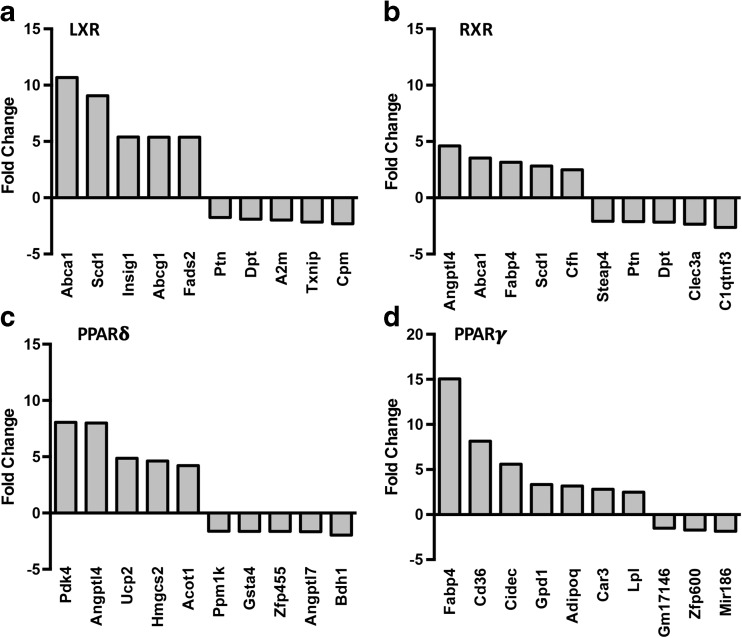
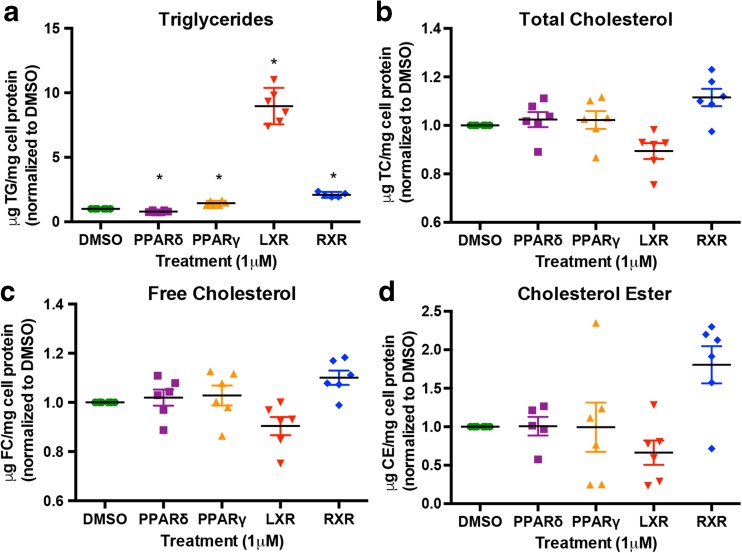
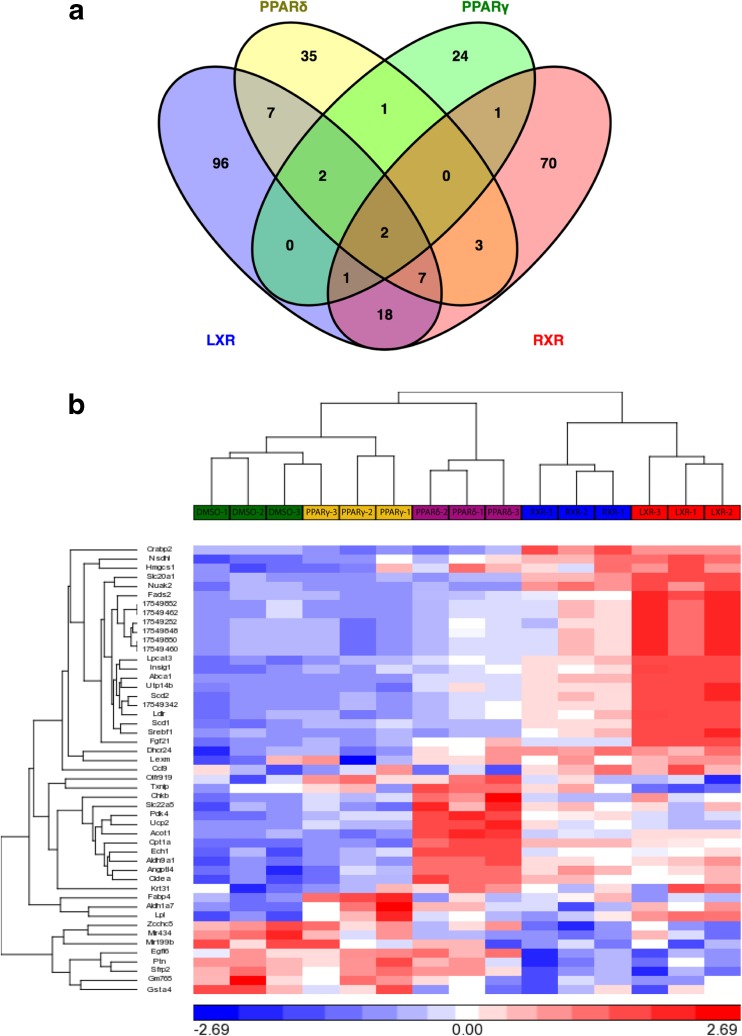
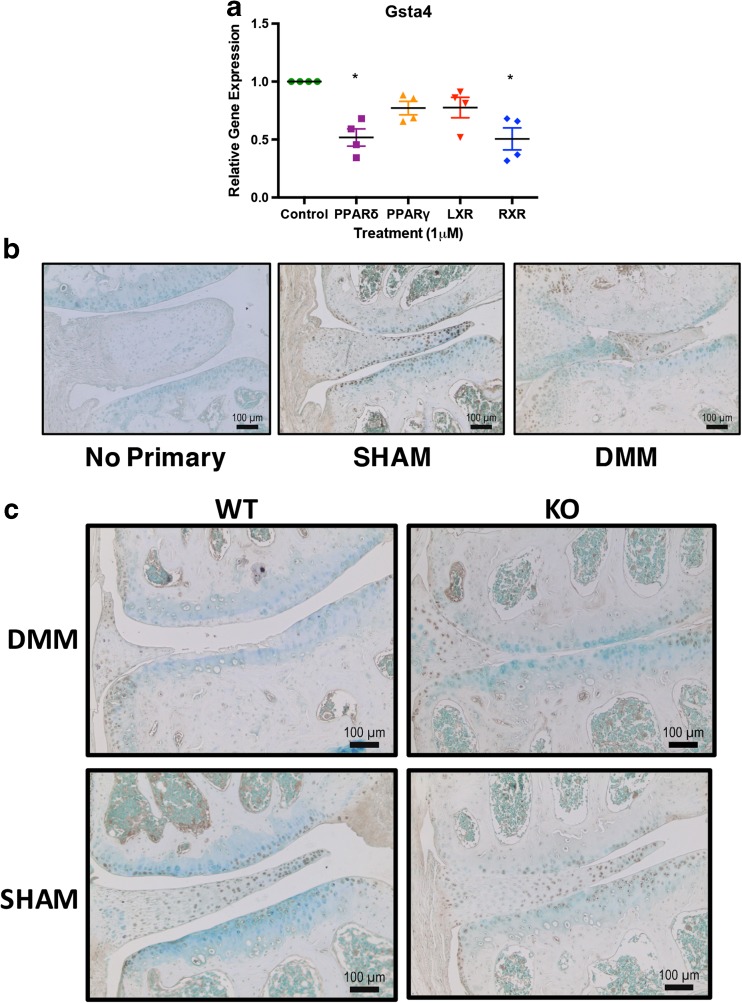
Joint homeostasis failure can result in osteoarthritis (OA). Currently, there are no treatments to alter disease progression in OA, but targeting early changes in cellular behavior has great potential. Recent data show that nuclear receptors contribute to the pathogenesis of OA and could be viable therapeutic targets, but their molecular mechanisms in cartilage are incompletely understood. This study examines global changes in gene expression after treatment with agonists for four nuclear receptor implicated in OA (LXR, PPARδ, PPARγ, and RXR). Murine articular chondrocytes were treated with agonists for LXR, PPARδ, PPARγ, or RXR and underwent microarray, qPCR, and cellular lipid analyses to evaluate changes in gene expression and lipid profile. Immunohistochemistry was conducted to compare two differentially expressed targets (Txnip, Gsta4) in control and cartilage-specific PPARδ knockout mice subjected to surgical destabilization of the medial meniscus (DMM). Nuclear receptor agonists induced different gene expression profiles with many responses affecting lipid metabolism. LXR activation downregulated gene expression of proteases involved in OA, whereas RXR agonism decreased expression of ECM components and increased expression of Mmp13. Functional assays indicate increases in cell triglyceride accumulation after PPARγ, LXR, and RXR agonism but a decrease after PPARδ agonism. PPARδ and RXR downregulate the antioxidant Gsta4, and PPARδ upregulates Txnip. Wild-type, but not PPARδ-deficient mice, display increased staining for Txnip after DMM. Collectively, these data demonstrate that nuclear receptor activation in chondrocytes primarily affects lipid metabolism. In the case of PPARδ, this change might lead to increased oxidative stress, possibly contributing to OA-associated changes.
Nuclear receptors regulate metabolic genes in chondrocytes. Nuclear receptors affect triglyceride levels. PPARδ mediates regulation of oxidative stress markers. Nuclear receptors are promising therapeutic targets for osteoarthritis.
关节稳态失衡可导致骨关节炎(OA)。目前,尚无改变OA疾病进展的治疗方法,但针对细胞行为的早期变化具有巨大潜力。最近的数据表明,核受体参与OA的发病机制,可能是可行的治疗靶点,但其在软骨中的分子机制尚不完全清楚。本研究检测了用与OA相关的四种核受体(LXR、PPARδ、PPARγ和RXR)激动剂处理后基因表达的整体变化。用LXR、PPARδ、PPARγ或RXR激动剂处理小鼠关节软骨细胞,进行微阵列、qPCR和细胞脂质分析,以评估基因表达和脂质谱的变化。进行免疫组织化学以比较对照小鼠和接受内侧半月板手术失稳(DMM)的软骨特异性PPARδ基因敲除小鼠中两个差异表达靶点(Txnip、Gsta4)。核受体激动剂诱导不同的基因表达谱,许多反应影响脂质代谢。LXR激活下调OA相关蛋白酶的基因表达,而RXR激动作用降低细胞外基质成分的表达并增加Mmp13的表达。功能分析表明,PPARγ、LXR和RXR激动后细胞甘油三酯积累增加,而PPARδ激动后减少。PPARδ和RXR下调抗氧化剂Gsta4,PPARδ上调Txnip。野生型小鼠而非PPARδ缺陷小鼠在DMM后Txnip染色增加。总体而言,这些数据表明软骨细胞中核受体激活主要影响脂质代谢。就PPARδ而言,这种变化可能导致氧化应激增加,可能促成与OA相关的变化。
核受体调节软骨细胞中的代谢基因。核受体影响甘油三酯水平。PPARδ介导氧化应激标志物的调节。核受体是骨关节炎有前景的治疗靶点。