Divino Victoria, DeKoven Mitch, Khan Farhad Ali, Boye Kristina S, Sapin Hélène, Norrbacka Kirsi
QuintilesIMS, Fairfax, VA, USA.
QuintilesIMS, Stockholm, Sweden.
Diabetes Ther. 2017 Feb;8(1):115-128. doi: 10.1007/s13300-016-0224-5. Epub 2017 Jan 9.
Glucagon-like peptide-1 receptor agonists (GLP-1 RAs) are a relatively new class of injectable drugs used in the treatment of type 2 diabetes (T2D). This retrospective database study evaluated real-world treatment patterns of T2D patients initiating GLP-1 RAs in Belgium (BE), France (FR), Germany (DE), The Netherlands (NL) and Sweden (SE).
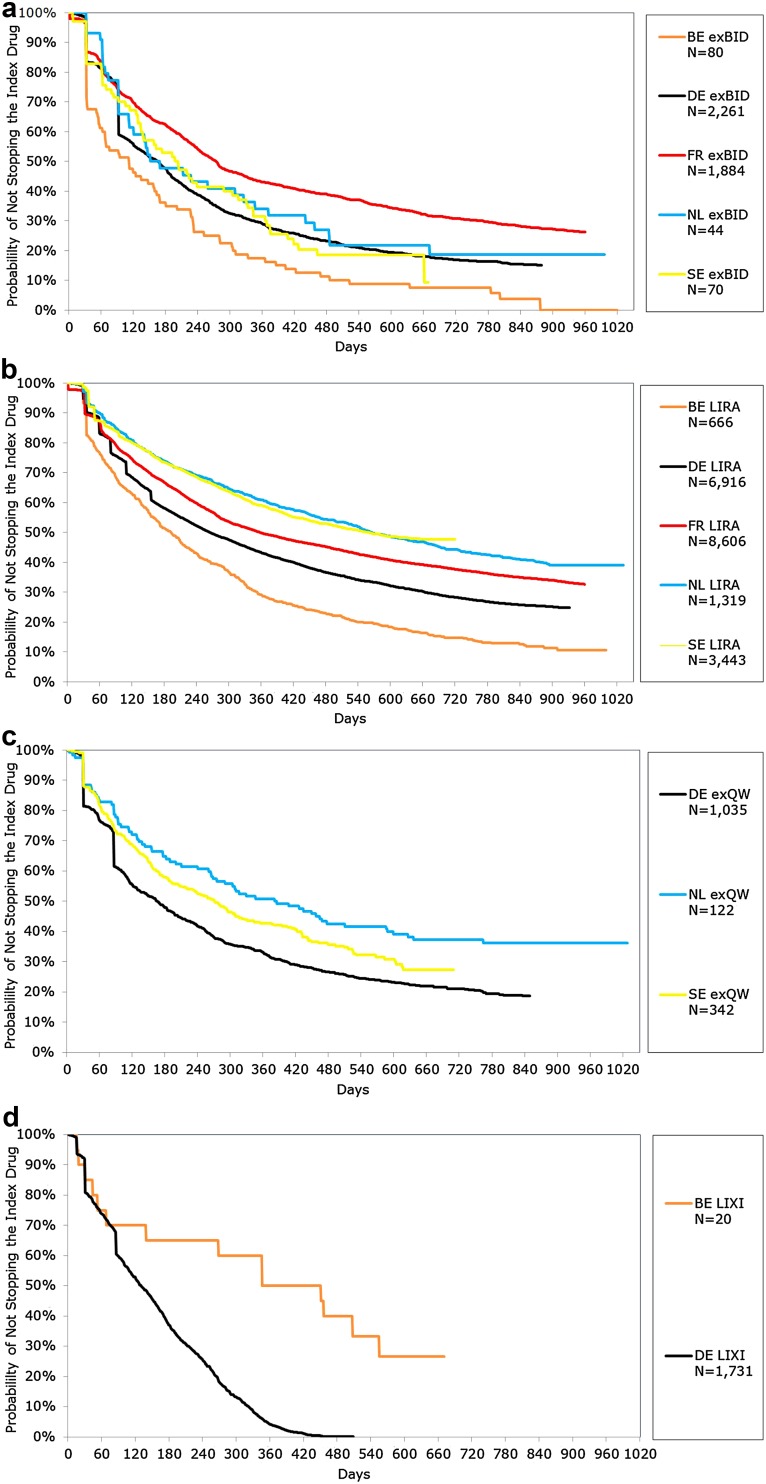
Adult T2D patients initiating exenatide twice daily (exBID), exenatide once weekly (exQW), liraglutide (LIRA) or lixisenatide (LIXI) during 2013 were identified using the QuintilesIMS (QuintilesIMS, Durham, NC, and Danbury, CT, USA) longitudinal retail pharmacy databases (LRx; BE/FR/DE/NL) and national health register data (SE). Therapy initiation date was termed 'index date.' Eligible patients had ≥180-day pre- and variable follow-up (minimum ≥360 days post-index). Baseline patient and treatment characteristics were assessed. Treatment modification and persistence were evaluated over the 1-year follow-up. Kaplan-Meier (KM) survival curves evaluated stopping of the index therapy (first of discontinuation or switch) over the available follow-up.
A total of 4339 exBID, 1499 exQW, 20,955 LIRA and 1751 LIXI patients were included in the analysis (45.1-61.9% female; mean age range 57.1-62.9 years). Mean follow-up ranged from 17.7 to 30.7 months. Across countries/databases, the proportion experiencing a treatment modification at 1-year ranged from 84.1 to 93.8% for exBID, 53.3-73.4% for exQW and 59.5-80.5% for LIRA patients. The proportion of LIXI patients with treatment modification was 55.0% in Belgium (N = 20) and 96.9% in Germany (LIXI taken off the German market in April 2014). In KM analyses, LIRA patients had the lowest proportion stopping therapy, while exBID patients had the highest proportion stopping therapy, across databases, with the exception of LIXI patents.
Treatment patterns varied among GLP-1 RA patients, and persistence was generally highest among LIRA and lowest among exBID across countries. Longer term data would be useful, given the recent approval of several GLP-1 RA therapies.
Eli Lilly and Co., Indianapolis, IN, USA.
胰高血糖素样肽-1受体激动剂(GLP-1 RAs)是一类相对较新的用于治疗2型糖尿病(T2D)的注射药物。这项回顾性数据库研究评估了在比利时(BE)、法国(FR)、德国(DE)、荷兰(NL)和瑞典(SE)开始使用GLP-1 RAs的2型糖尿病患者的真实治疗模式。
使用昆泰IMS(美国北卡罗来纳州达勒姆和康涅狄格州丹伯里的昆泰IMS)纵向零售药房数据库(LRx;BE/FR/DE/NL)和国家健康登记数据(SE),确定2013年期间开始每日两次注射艾塞那肽(exBID)、每周一次注射艾塞那肽(exQW)、利拉鲁肽(LIRA)或利司那肽(LIXI)的成年2型糖尿病患者。治疗开始日期被称为“索引日期”。符合条件的患者有≥180天的基线期和可变的随访期(索引日期后至少≥360天)。评估了患者的基线特征和治疗特征。在1年的随访期间评估治疗调整和持续情况。采用Kaplan-Meier(KM)生存曲线评估在可用随访期内索引治疗的停药情况(首次停药或换药)。
共有4339例exBID患者、1499例exQW患者、20955例LIRA患者和1751例LIXI患者纳入分析(女性占45.1 - 61.9%;平均年龄范围为57.1 - 62.9岁)。平均随访时间为17.7至30.7个月。在各个国家/数据库中,1年时经历治疗调整的比例,exBID患者为84.1%至93.8%,exQW患者为53.3% - 73.4%,LIRA患者为59.5% - 80.5%。LIXI患者中,比利时有55.0%(N = 20)经历了治疗调整,德国有96.9%(LIXI于2014年4月在德国退市)。在KM分析中,除LIXI患者外,在各个数据库中,LIRA患者停药比例最低,而exBID患者停药比例最高。
GLP-1 RA患者的治疗模式各不相同,在各个国家中,LIRA患者的治疗持续率总体最高,exBID患者最低。鉴于最近几种GLP-1 RA疗法获批,长期数据将很有用。
美国印第安纳州印第安纳波利斯的礼来公司。