Department of Epidemiology and Cancer Control, St. Jude Children's Research Hospital, 262 Danny Thomas Place, Mail Stop #735, Memphis, TN, 38105-3678, USA.
Department of Psychology, St. Jude Children's Research Hospital, Memphis, TN, USA.
J Cancer Surviv. 2017 Jun;11(3):309-319. doi: 10.1007/s11764-016-0589-5. Epub 2017 Jan 9.
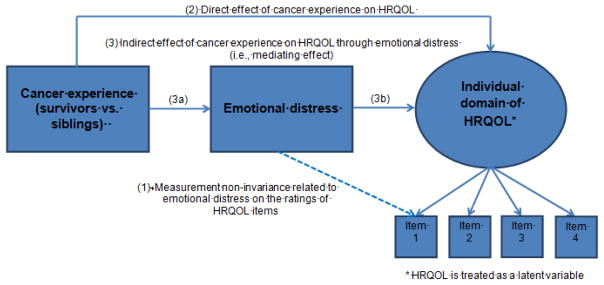
We compared health-related quality of life (HRQOL) between adult survivors of childhood cancer and siblings by investigating the mediating role of emotional distress on HRQOL assessment, and examining the extent to which emotional distress affected the item responses of HRQOL measures given the same underlying HRQOL (i.e., measurement non-invariance).
Cancer survivors (7103) and siblings (390) enrolled in Childhood Cancer Survivor Study who completed the SF-36 measuring HRQOL and the Brief Symptom Inventory-18 measuring anxiety, depression, and somatization were analyzed. Multiple Indicators & Multiple Causes modeling was performed to identify measurement non-invariance related to emotional distress on the responses to HRQOL items. Mediation analysis was performed to test the effects of cancer experience on HRQOL accounting for the mediating role of emotional distress.
Twenty-nine percent, 40%, and 34% of the SF-36 items were identified with measurement non-invariance related to anxiety, depression, and somatization, respectively. Survivors reported poorer HRQOL than siblings in all domains (ps < 0.05), except for pain. Other than physical functioning and general health perceptions, poorer HRQOL was explained by the mediating role of emotional distress (ps < 0.05).
Differences in HRQOL between survivors and siblings appear due, in part, to the mediating effect of emotional distress through which cancer experience influences the responses to HRQOL measures.
Interventions to treat emotional distress may improve cancer survivors' HRQOL.
通过调查情绪困扰对健康相关生活质量(HRQOL)评估的中介作用,并检查情绪困扰在多大程度上影响了相同潜在 HRQOL 下(即测量不变性)HRQOL 测量的项目反应,比较儿童癌症幸存者与同胞的 HRQOL。
对参加儿童癌症幸存者研究的 SF-36 测量 HRQOL 和 Brief Symptom Inventory-18 测量焦虑、抑郁和躯体化的癌症幸存者(7103 名)和同胞(390 名)进行分析。采用多指标多原因模型(Multiple Indicators & Multiple Causes modeling)识别与情绪困扰相关的 HRQOL 项目反应的测量不变性。进行中介分析以检验癌症经历对 HRQOL 的影响,同时考虑情绪困扰的中介作用。
分别有 29%、40%和 34%的 SF-36 项目与焦虑、抑郁和躯体化相关的测量不变性有关。除了疼痛,幸存者在所有领域的 HRQOL 都比同胞差(p<0.05)。除了身体机能和一般健康感知外,情绪困扰的中介作用解释了较差的 HRQOL(p<0.05)。
幸存者和同胞之间的 HRQOL 差异部分归因于情绪困扰的中介作用,即癌症经历通过情绪困扰影响 HRQOL 测量的反应。
治疗情绪困扰的干预措施可能会改善癌症幸存者的 HRQOL。