Wang Peng, Qi Xuan, Zhang Xuemin, Wang Tieqiang, Li Yunong, Zhang Kai, Zhao Shuang, Zhou Jun, Fu Yu
College of Sciences, Northeastern University, Shenyang, 110004, China.
School of Materials Science and Engineering, Key Laboratory for Anisotropy and Texture of Materials, Ministry of Education, Northeastern University, Shenyang, 110004, China.
Nanoscale Res Lett. 2017 Dec;12(1):25. doi: 10.1186/s11671-016-1797-7. Epub 2017 Jan 9.
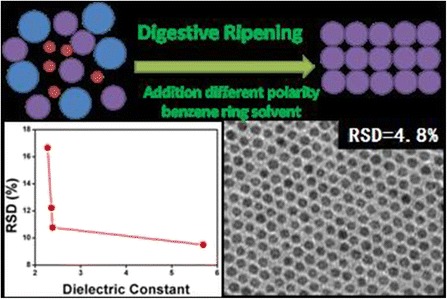
This work has mainly investigated the influence of the solvent on the nanoparticles distribution in digestive ripening. The experiments suggested that the solvents played a key role in digestive ripening of Au nanoparticles (Au NPs). For the benzol solvents, the resulting size distribution of Au NPs was inversely related to the solvent polarity. It may be interpreted by the low Gibbs free energy of nanoparticles in the high polarity medium, which was supposedly in favor of reducing the nanoparticles distribution. Through digestive ripening in the highly polar benzol solvent of p-chlorotoluene, monodisperse Au NPs with relative standard deviation (RSD) of 4.8% were achieved. This indicated that digestive ripening was an effective and practical way to prepare high-quality nanoparticles, which holds great promise for the nanoscience and nanotechnology. Graphical Abstract The polarity of benzol solvent plays significant role in obtaining high-quality monodisperse Au nanoparticles.
这项工作主要研究了溶剂对消化成熟过程中纳米颗粒分布的影响。实验表明,溶剂在金纳米颗粒(Au NPs)的消化成熟过程中起着关键作用。对于苯类溶剂,Au NPs的最终尺寸分布与溶剂极性呈负相关。这可能是由于纳米颗粒在高极性介质中的吉布斯自由能较低,据推测这有利于减少纳米颗粒的分布。通过在对氯甲苯的高极性苯类溶剂中进行消化成熟,获得了相对标准偏差(RSD)为4.8%的单分散Au NPs。这表明消化成熟是制备高质量纳米颗粒的一种有效且实用的方法,对纳米科学和纳米技术具有巨大的前景。图形摘要 苯类溶剂的极性在获得高质量单分散金纳米颗粒方面起着重要作用。