Department of Brain and Cognitive Sciences and McGovern Institute, Massachusetts Institute of Technology, Cambridge, Massachusetts 02139, USA.
Department of Psychology, Emory University, Atlanta, Georgia 30322, USA.
Nat Commun. 2017 Jan 10;8:13995. doi: 10.1038/ncomms13995.
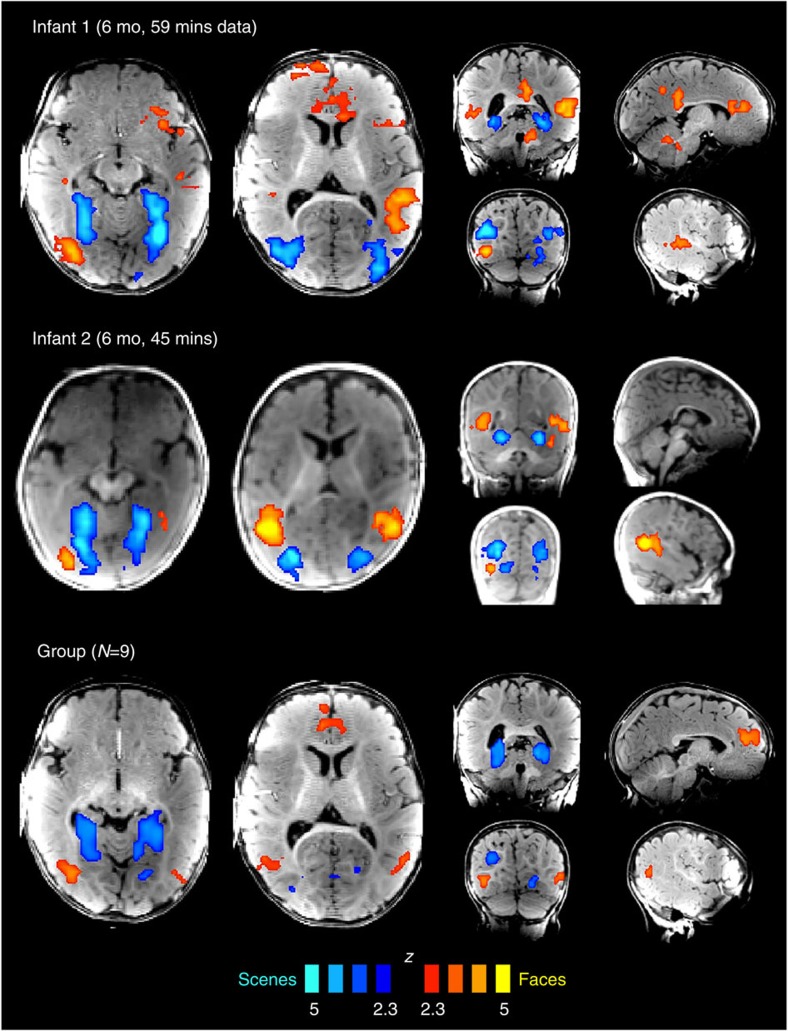
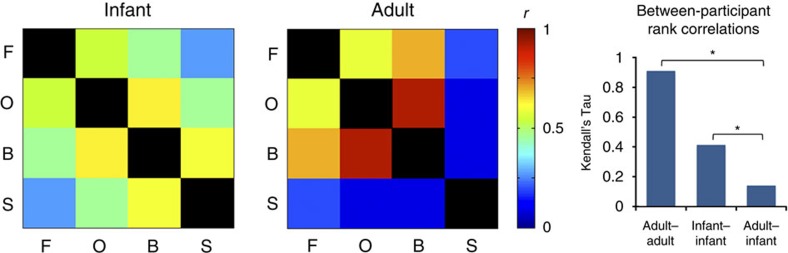
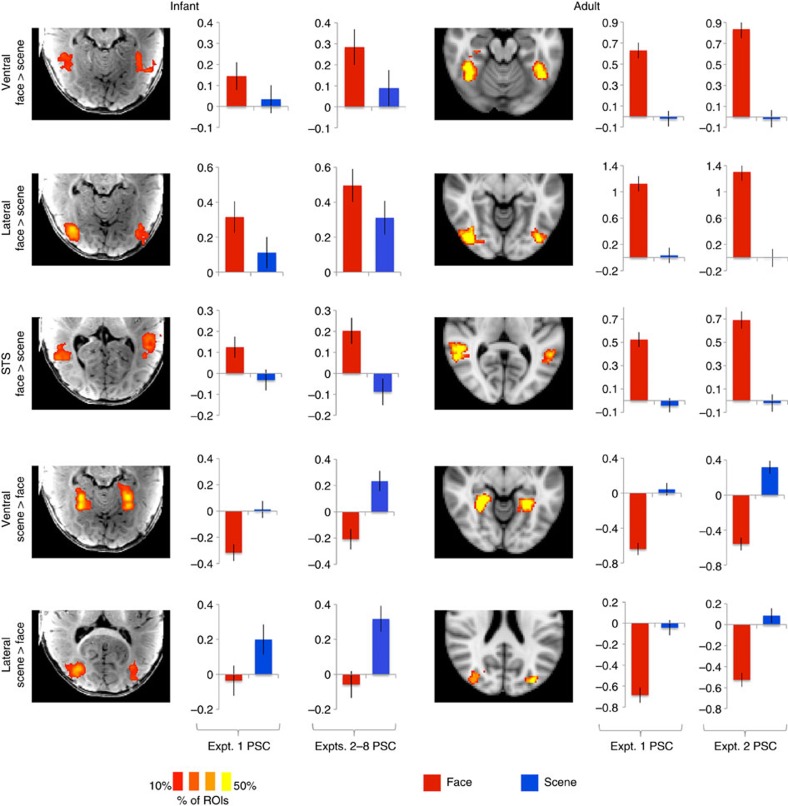
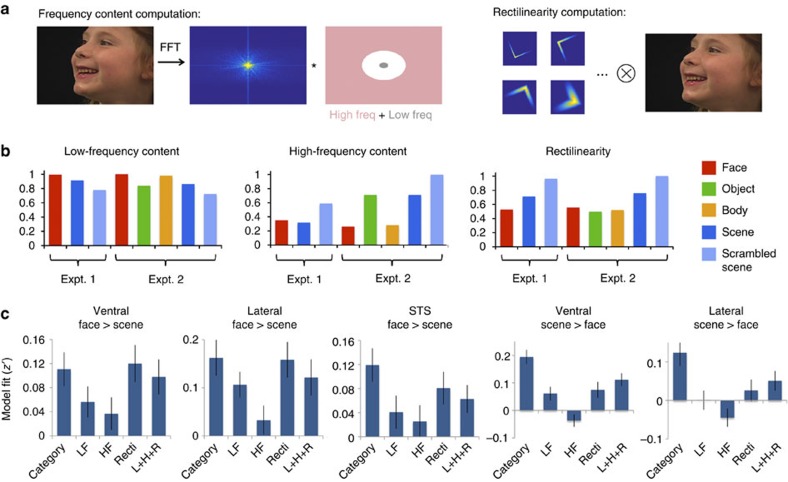
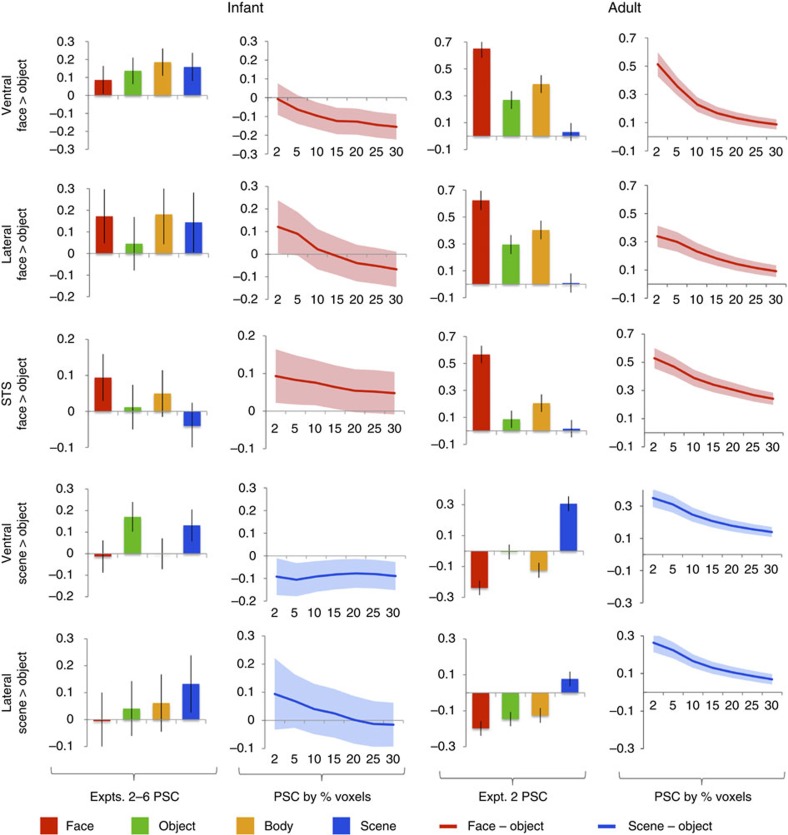
How much of the structure of the human mind and brain is already specified at birth, and how much arises from experience? In this article, we consider the test case of extrastriate visual cortex, where a highly systematic functional organization is present in virtually every normal adult, including regions preferring behaviourally significant stimulus categories, such as faces, bodies, and scenes. Novel methods were developed to scan awake infants with fMRI, while they viewed multiple categories of visual stimuli. Here we report that the visual cortex of 4-6-month-old infants contains regions that respond preferentially to abstract categories (faces and scenes), with a spatial organization similar to adults. However, precise response profiles and patterns of activity across multiple visual categories differ between infants and adults. These results demonstrate that the large-scale organization of category preferences in visual cortex is adult-like within a few months after birth, but is subsequently refined through development.
人类的思维和大脑结构有多少是在出生时就已经确定的,又有多少是由经验产生的?在本文中,我们以视皮层为例来探讨这个问题。在正常成年人中,几乎每个人的视皮层都呈现出高度系统的功能组织,包括对行为上有意义的刺激类别有偏好的区域,如面孔、身体和场景。我们开发了新的方法,用 fMRI 对清醒的婴儿进行扫描,让他们观看多种类别的视觉刺激。我们报告说,4 到 6 个月大的婴儿的视皮层中存在对抽象类别(面孔和场景)有优先反应的区域,其空间组织与成年人相似。然而,婴儿和成年人在多个视觉类别之间的精确反应特征和活动模式存在差异。这些结果表明,出生后几个月内,视觉皮层中类别偏好的大规模组织就已经类似于成年人,但随后会通过发育进一步完善。