Jin Shenhui, Liang Dong Dong, Chen Chengyu, Zhang Minyuan, Wang Junlu
Department of Anesthesiology, The first Affiliated Hospital of Wenzhou Medical University, Wenzhou, China.
Medicine (Baltimore). 2017 Jan;96(1):e5770. doi: 10.1097/MD.0000000000005770.
Postoperative nausea and vomiting (PONV) is a frequent complication in postoperative period. The aim of this article was to evaluate the effect of dexmedetomidine on PONV.
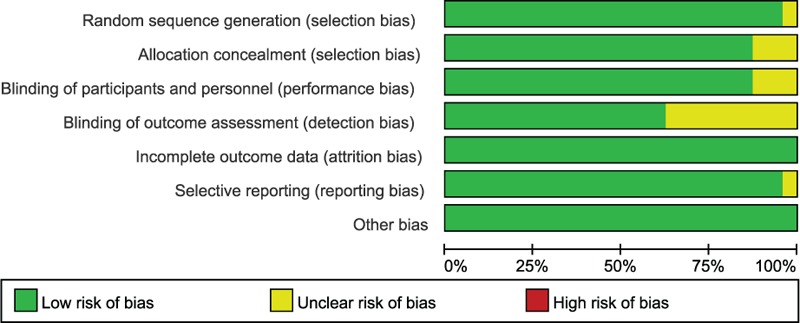
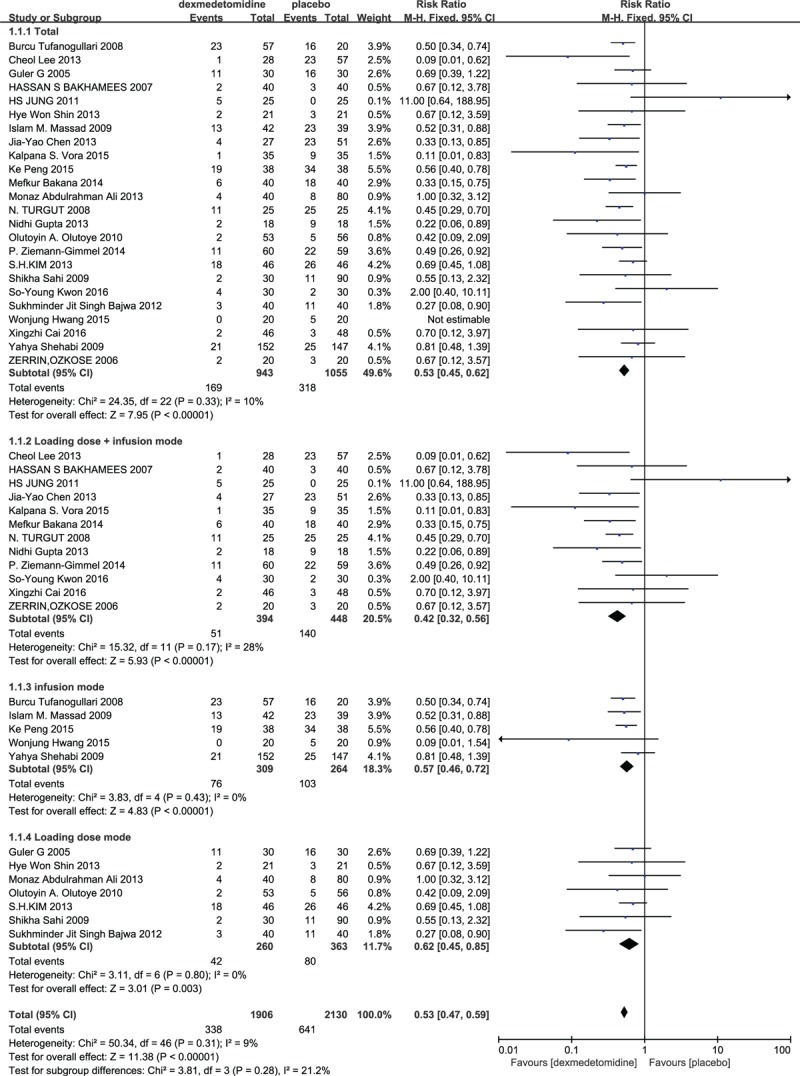
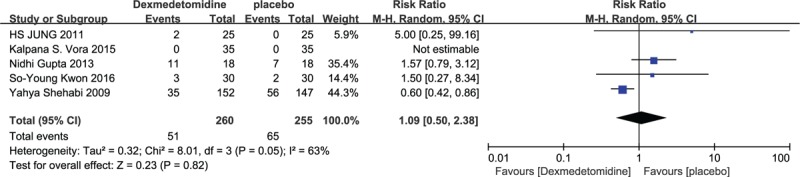
RevMan 5.3 software was applied for performing statistic analysis. Twenty-four trials with 2046 patients were included.
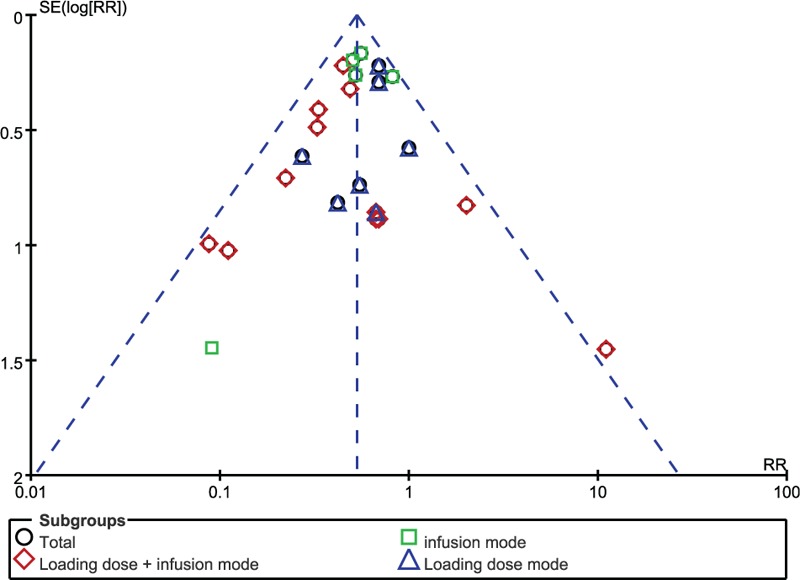
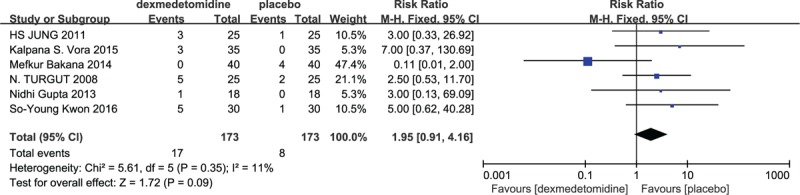
The PONV of the dexmedetomidine group was significantly lower compared with the placebo group (0.56, 95% CI: 0.46, 0.69). Subgroup analysis further confirmed the effect of dexmedetomidine (irrespective of administration mode) (P < 0.00001). Perioperative fentanyl consumption in dexmedetomidine group were also reduced significantly (P < 0.00001). Whereas, side effects such as bradycardia, hypotension increased in dexmedetomidine group (especially in loading dose mode and loading dose plus continuous infusion mode).
Dexmedetomidine administrated in continuous infusion mode has the advantage to prevent PONV as well as reduce side effects such as bradycardia and hypotension.
术后恶心呕吐(PONV)是术后常见的并发症。本文旨在评估右美托咪定对PONV的影响。
应用RevMan 5.3软件进行统计分析。纳入24项试验,共2046例患者。
与安慰剂组相比,右美托咪定组的PONV显著降低(0.56,95%置信区间:0.46,0.69)。亚组分析进一步证实了右美托咪定的效果(无论给药方式如何)(P<0.00001)。右美托咪定组围手术期芬太尼消耗量也显著降低(P<0.00001)。然而,右美托咪定组心动过缓、低血压等副作用增加(尤其是负荷剂量模式和负荷剂量加持续输注模式)。
持续输注模式下给予右美托咪定具有预防PONV以及减少心动过缓和低血压等副作用的优势。