Takasaki Keiko, Babazono Tetsuya, Ishizawa Kaya, Miura Junnosuke, Uchigata Yasuko
Department of Medicine , Diabetes Center, Tokyo Women's Medical University School of Medicine , Shinjuku-ku , Japan.
BMJ Open Diabetes Res Care. 2016 Dec 15;4(1):e000310. doi: 10.1136/bmjdrc-2016-000310. eCollection 2016.
We conducted this cross-sectional study to investigate the relationship between stage of diabetic nephropathy and likelihood or severity of depression in patients with diabetes.
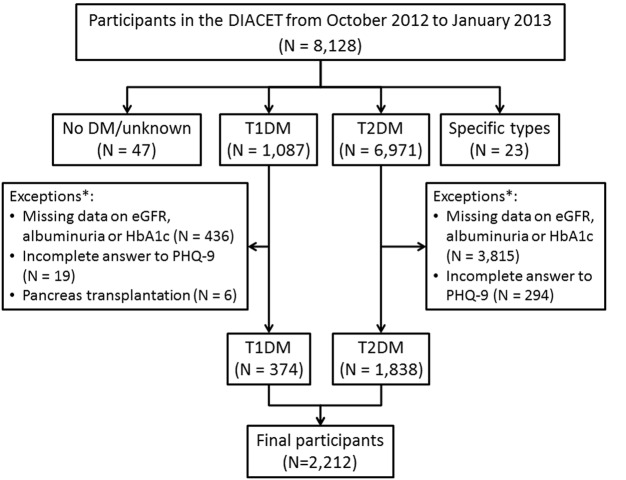
We studied 2212 patients with diabetes (mean age 60.9 years; 928 women; 1838 patients with type 2 diabetes). Presence and severity of depression was examined using the Patient Health Questionnaire-9 (PHQ-9). Patients were classified into 5 stages of nephropathy, according to albuminuria and estimated glomerular filtration rate (eGFR); patients in stage 5 undergoing dialysis and kidney transplantation were analyzed separately (stages 5D and 5T). The relationship between stage of nephropathy and depression was examined using analysis of covariance and multivariate logistic regression analysis.
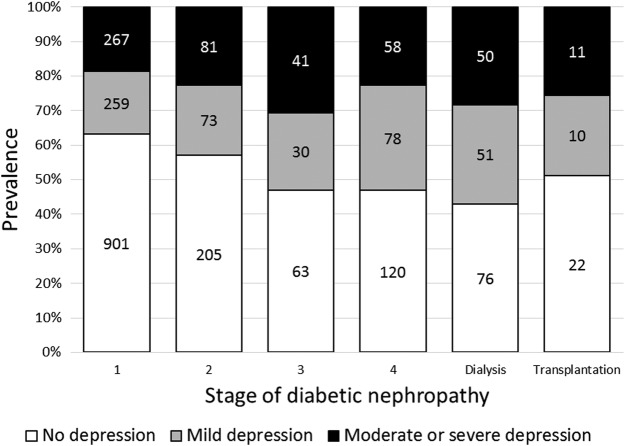
Both least square mean PHQ-9 scores and prevalence of patients with PHQ-9 scores ≥5 points (mild depression) and ≥10 points (moderate or severe depression) increased from stage 1 to 5D, and then declined in stage 5T. Multivariate ORs for mild or greater depression increased in patients in stages 3, 4, and 5D in reference to those in stage 1, which declined in patients in stage 5T. Albuminuria was significantly, but eGFR was not, associated with higher PHQ-9 scores and the PHQ-9 scores ≥5 or ≥10 after adjustment for clinical findings.
In patients with diabetes, progression of nephropathy is likely to be associated with increased risk and severity of depression, which may be reduced after successful kidney transplantation. Albuminuria may be more strongly associated with depression than eGFR.
我们开展这项横断面研究,以调查糖尿病肾病分期与糖尿病患者抑郁发生可能性或严重程度之间的关系。
我们研究了2212例糖尿病患者(平均年龄60.9岁;928例女性;1838例2型糖尿病患者)。使用患者健康问卷9项(PHQ-9)检查抑郁的存在情况及严重程度。根据蛋白尿和估算肾小球滤过率(eGFR)将患者分为5期肾病;对接受透析和肾移植的5期患者(5D期和5T期)进行单独分析。使用协方差分析和多因素逻辑回归分析来研究肾病分期与抑郁之间的关系。
从1期到5D期,最小二乘均值PHQ-9评分以及PHQ-9评分≥5分(轻度抑郁)和≥10分(中度或重度抑郁)的患者患病率均升高,然后在5T期下降。与1期患者相比,3期、4期和5D期患者轻度或更严重抑郁的多因素比值比升高,而5T期患者的该比值比下降。校正临床指标后,蛋白尿与较高的PHQ-9评分以及PHQ-9评分≥5或≥10显著相关,但eGFR并非如此。
在糖尿病患者中,肾病进展可能与抑郁风险及严重程度增加相关,而在成功进行肾移植后这种情况可能会减轻。蛋白尿可能比eGFR与抑郁的关联更强。