Van Rossom Sam, Smith Colin Robert, Zevenbergen Lianne, Thelen Darryl Gerard, Vanwanseele Benedicte, Van Assche Dieter, Jonkers Ilse
Human movement biomechanics research group, Department of kinesiology, Katholieke Universiteit Leuven, Leuven, Belgium.
Department of mechanical engineering, University of Wisconsin-Madison, Madison, United States of America.
PLoS One. 2017 Jan 11;12(1):e0170002. doi: 10.1371/journal.pone.0170002. eCollection 2017.
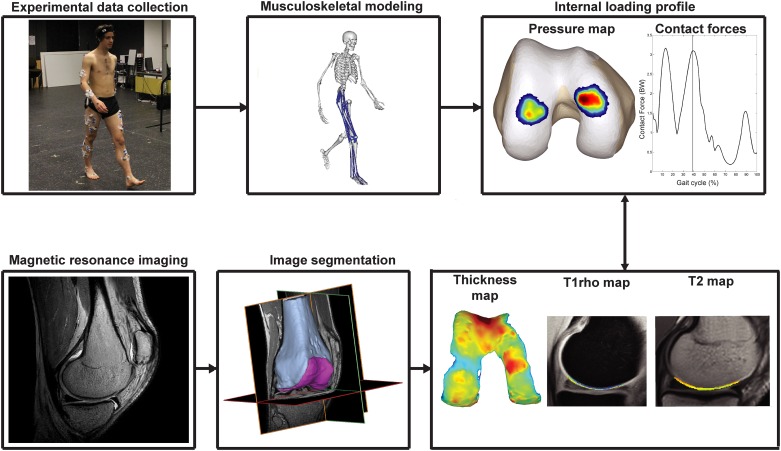
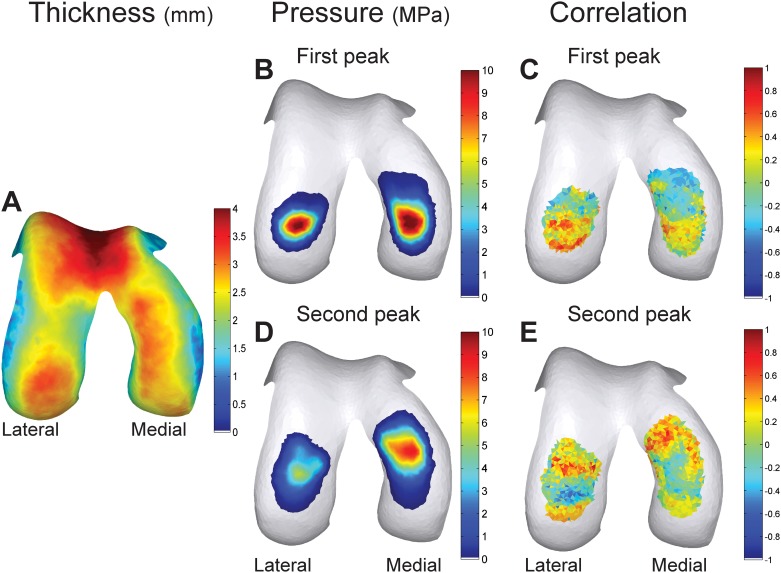
Cartilage is responsive to the loading imposed during cyclic routine activities. However, the local relation between cartilage in terms of thickness distribution and biochemical composition and the local contact pressure during walking has not been established. The objective of this study was to evaluate the relation between cartilage thickness, proteoglycan and collagen concentration in the knee joint and knee loading in terms of contact forces and pressure during walking. 3D gait analysis and MRI (3D-FSE, T1ρ relaxation time and T2 relaxation time sequence) of fifteen healthy subjects were acquired. Experimental gait data was processed using musculoskeletal modeling to calculate the contact forces, impulses and pressure distribution in the tibiofemoral joint. Correlates to local cartilage thickness and mean T1ρ and T2 relaxation times of the weight-bearing area of the femoral condyles were examined. Local thickness was significantly correlated with local pressure: medial thickness was correlated with medial condyle contact pressure and contact force, and lateral condyle thickness was correlated with lateral condyle contact pressure and contact force during stance. Furthermore, average T1ρ and T2 relaxation time correlated significantly with the peak contact forces and impulses. Increased T1ρ relaxation time correlated with increased shear loading, decreased T1ρ and T2 relaxation time correlated with increased compressive forces and pressures. Thicker cartilage was correlated with higher condylar loading during walking, suggesting that cartilage thickness is increased in those areas experiencing higher loading during a cyclic activity such as gait. Furthermore, the proteoglycan and collagen concentration and orientation derived from T1ρ and T2 relaxation measures were related to loading.
软骨对日常周期性活动中施加的负荷有反应。然而,软骨在厚度分布和生化组成方面的局部关系与行走过程中的局部接触压力尚未明确。本研究的目的是评估膝关节软骨厚度、蛋白聚糖和胶原蛋白浓度与行走过程中膝关节负荷(以接触力和压力表示)之间的关系。对15名健康受试者进行了三维步态分析和MRI检查(三维快速自旋回波序列、T1ρ弛豫时间和T2弛豫时间序列)。使用肌肉骨骼模型处理实验步态数据,以计算胫股关节的接触力、冲量和压力分布。研究了与股骨髁负重区域局部软骨厚度以及平均T1ρ和T2弛豫时间的相关性。局部厚度与局部压力显著相关:内侧厚度与内侧髁接触压力和接触力相关,外侧髁厚度与站立期外侧髁接触压力和接触力相关。此外,平均T1ρ和T2弛豫时间与峰值接触力和冲量显著相关。T1ρ弛豫时间增加与剪切负荷增加相关,T1ρ和T2弛豫时间减少与压缩力和压力增加相关。较厚的软骨与行走过程中较高的髁负荷相关,这表明在诸如步态等周期性活动中承受较高负荷的区域软骨厚度增加。此外,由T1ρ和T2弛豫测量得出的蛋白聚糖和胶原蛋白浓度及取向与负荷有关。