Decourtye Lyvianne, Mire Erik, Clemessy Maud, Heurtier Victor, Ledent Tatiana, Robinson Iain C, Mollard Patrice, Epelbaum Jacques, Meaney Michael J, Garel Sonia, Le Bouc Yves, Kappeler Laurent
Sorbonne Universités, UPMC Univ Paris 06, INSERM, UMRS 938, Centre de Recherche St-Antoine (CRSA), Paris, France.
MRC, National Institute for Medical Research, Division of Molecular Neuroendocrinology, London, United Kingdom.
PLoS One. 2017 Jan 11;12(1):e0170083. doi: 10.1371/journal.pone.0170083. eCollection 2017.
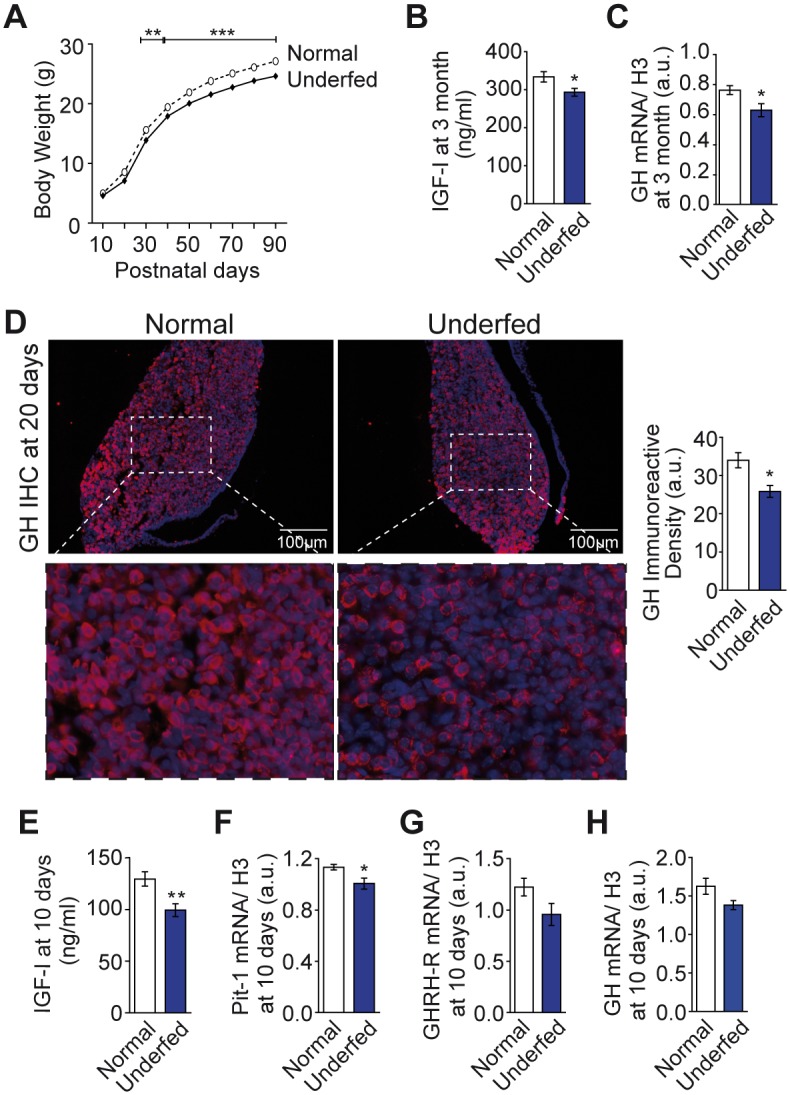
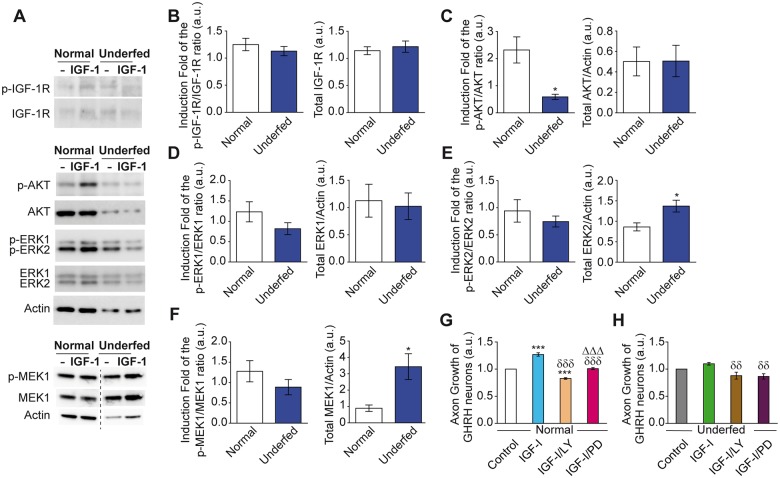
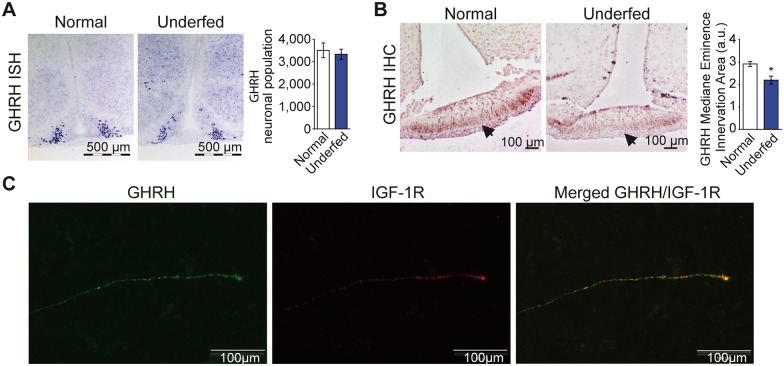
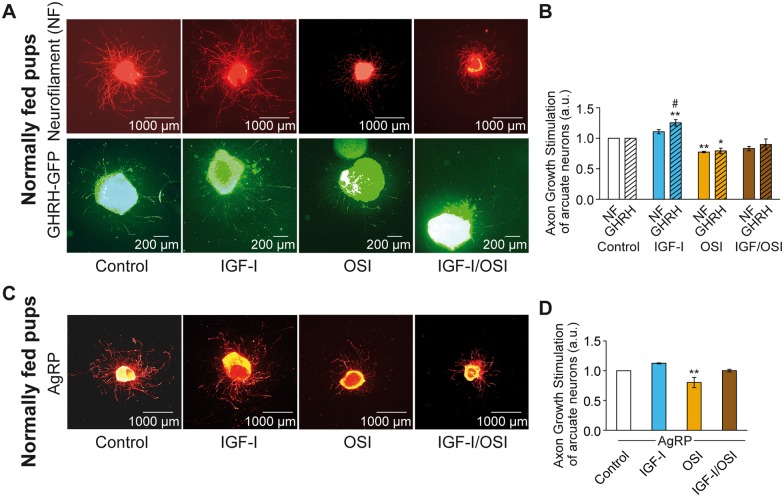
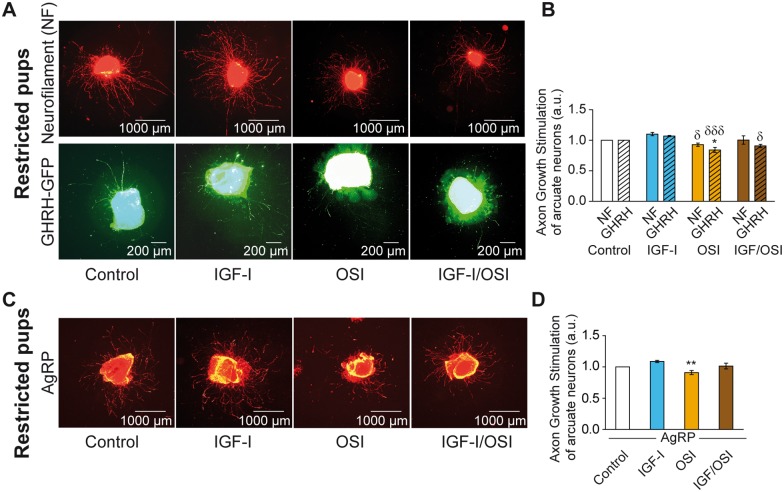
Nutrition during the perinatal period programs body growth. Growth hormone (GH) secretion from the pituitary regulates body growth and is controlled by Growth Hormone Releasing Hormone (GHRH) neurons located in the arcuate nucleus of the hypothalamus. We observed that dietary restriction during the early postnatal period (i.e. lactation) in mice influences postnatal growth by permanently altering the development of the somatotropic axis in the pituitary gland. This alteration may be due to a lack of GHRH signaling during this critical developmental period. Indeed, underfed pups showed decreased insulin-like growth factor I (IGF-I) plasma levels, which are associated with lower innervation of the median eminence by GHRH axons at 10 days of age relative to normally fed pups. IGF-I preferentially stimulated axon elongation of GHRH neurons in in vitro arcuate explant cultures from 7 day-old normally fed pups. This IGF-I stimulating effect was selective since other arcuate neurons visualized concomitantly by neurofilament labeling, or AgRP immunochemistry, did not significantly respond to IGF-I stimulation. Moreover, GHRH neurons in explants from age-matched underfed pups lost the capacity to respond to IGF-I stimulation. Molecular analyses indicated that nutritional restriction was associated with impaired activation of AKT. These results highlight a role for IGF-I in axon elongation that appears to be cell selective and participates in the complex cellular mechanisms that link underfeeding during the early postnatal period with programming of the growth trajectory.
围产期营养对身体生长具有编程作用。垂体分泌的生长激素(GH)调节身体生长,并受位于下丘脑弓状核的生长激素释放激素(GHRH)神经元控制。我们观察到,小鼠出生后早期(即哺乳期)的饮食限制会通过永久性改变垂体中生长激素轴的发育来影响出生后的生长。这种改变可能是由于在这个关键发育时期缺乏GHRH信号传导所致。事实上,与正常喂养的幼崽相比,喂养不足的幼崽在10日龄时胰岛素样生长因子I(IGF-I)血浆水平降低,这与GHRH轴突对正中隆起的神经支配减少有关。IGF-I优先刺激来自7日龄正常喂养幼崽的体外弓状核外植体培养物中GHRH神经元的轴突伸长。这种IGF-I刺激作用具有选择性,因为通过神经丝标记或AgRP免疫化学同时可视化的其他弓状核神经元对IGF-I刺激没有明显反应。此外,来自年龄匹配的喂养不足幼崽的外植体中的GHRH神经元失去了对IGF-I刺激的反应能力。分子分析表明,营养限制与AKT激活受损有关。这些结果突出了IGF-I在轴突伸长中的作用,这似乎具有细胞选择性,并参与了将出生后早期喂养不足与生长轨迹编程联系起来的复杂细胞机制。