Jové Mariona, Collado Ricardo, Quiles José Luís, Ramírez-Tortosa Mari-Carmen, Sol Joaquim, Ruiz-Sanjuan Maria, Fernandez Mónica, de la Torre Cabrera Capilla, Ramírez-Tortosa Cesar, Granados-Principal Sergio, Sánchez-Rovira Pedro, Pamplona Reinald
Department of Experimental Medicine, University of Lleida-Institute for Research in Biomedicine of Lleida (UdL-IRBLleida), Lleida, Spain.
Department of Oncology, Medical Oncology Unit, Hospital San Pedro de Alcántara, Cáceres, Official Postgraduate Programme in Nutrition and Food Technology, University of Granada, Spain.
Oncotarget. 2017 Mar 21;8(12):19522-19533. doi: 10.18632/oncotarget.14521.
Metabolomics is the comprehensive global study of metabolites in biological samples. In this retrospective pilot study we explored whether serum metabolomic profile can discriminate the presence of human breast cancer irrespective of the cancer subtype.
Plasma samples were analyzed from healthy women (n = 20) and patients with breast cancer after diagnosis (n = 91) using a liquid chromatography-mass spectrometry platform. Multivariate statistics and a Random Forest (RF) classifier were used to create a metabolomics panel for the diagnosis of human breast cancer.
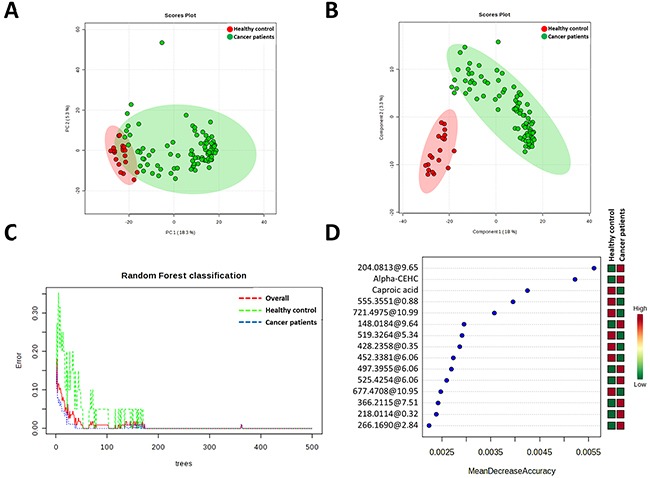
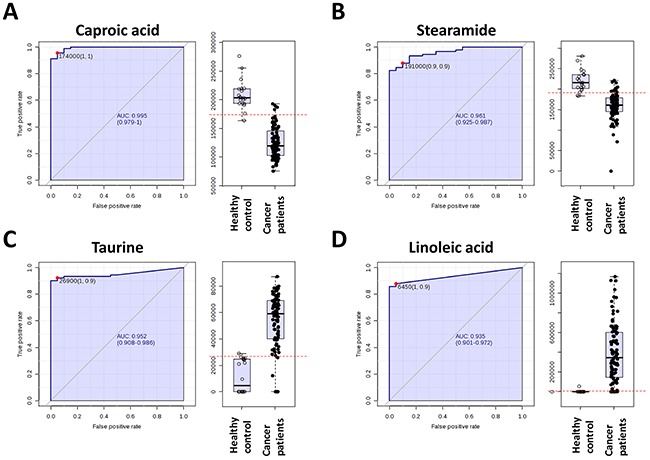
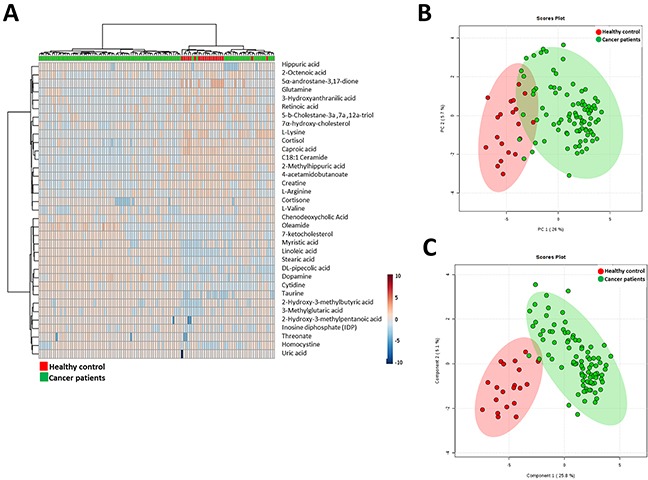
Metabolomics correctly distinguished between breast cancer patients and healthy control subjects. In the RF supervised class prediction analysis comparing breast cancer and healthy control groups, RF accurately classified 100% both samples of the breast cancer patients and healthy controls. So, the class error for both group in and the out-of-bag error were 0. We also found 1269 metabolites with different concentration in plasma from healthy controls and cancer patients; and basing on exact mass, retention time and isotopic distribution we identified 35 metabolites. These metabolites mostly support cell growth by providing energy and building stones for the synthesis of essential biomolecules, and function as signal transduction molecules. The collective results of RF, significance testing, and false discovery rate analysis identified several metabolites that were strongly associated with breast cancer.
In breast cancer a metabolomics signature of cancer exists and can be detected in patient plasma irrespectively of the breast cancer type.
代谢组学是对生物样本中代谢物进行的全面整体研究。在这项回顾性试点研究中,我们探讨了血清代谢组学特征是否能够区分人类乳腺癌的存在,而不考虑癌症亚型。
使用液相色谱 - 质谱平台对健康女性(n = 20)和确诊后的乳腺癌患者(n = 91)的血浆样本进行分析。采用多变量统计和随机森林(RF)分类器创建用于诊断人类乳腺癌的代谢组学面板。
代谢组学能够正确区分乳腺癌患者和健康对照者。在比较乳腺癌和健康对照组的RF监督分类预测分析中,RF对乳腺癌患者和健康对照的样本均准确分类100%。因此,两组的分类错误率和袋外错误率均为0。我们还发现健康对照者和癌症患者血浆中有1269种代谢物浓度不同;基于精确质量、保留时间和同位素分布,我们鉴定出35种代谢物。这些代谢物大多通过提供能量和构建合成必需生物分子的原料来支持细胞生长,并作为信号转导分子发挥作用。RF、显著性检验和错误发现率分析的综合结果确定了几种与乳腺癌密切相关的代谢物。
在乳腺癌中存在癌症的代谢组学特征,并且无论乳腺癌类型如何,均可在患者血浆中检测到。