Liang Xing-Xin, Li Fan, Gao Feng, Liu Yang, Qiao Xiao-Hui, Zhang Zheng, Du Lian-Fang
Department of Medical Ultrasound, Jiangwan Hospital, Hongkou District, Shanghai, China.
Department of Medical Ultrasound, Shanghai General Hospital, Shanghai Jiao Tong University School of Medicine, Shanghai, China.
Biomed Res Int. 2016;2016:6064526. doi: 10.1155/2016/6064526. Epub 2016 Dec 19.
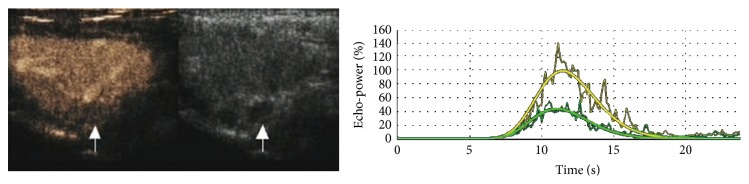
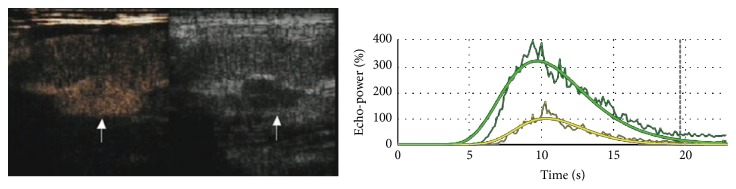
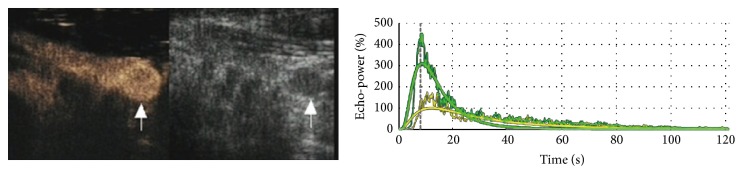
Using the model and quantitative parameters of contrast-enhanced ultrasound (CEUS) to assess the severity of secondary hyperparathyroidism (SHPT) was proposed. 42 SHPT patients who underwent CEUS examination were divided into three groups, light, moderate, and heavy as per parathyroid hormone (PTH). The process of CEUS was divided into two phases, wash-in phase and wash-out phase. The three groups were analyzed with their enhancing model in the two phases. The quantitative parameters of CEUS such as Arrival Time (AT), Time to Peak (TTP), Mean Transit Time (MTT), and Maximum Intensity (IMAX) were measured by time-intensity curve (TIC) and compared among the three groups. The enhancing model of light SHPT, moderate SHPT, and heavy SHPT showed statistical significance in wash-in phase and wash-out phase ( < 0.05). No difference was observed in AT and TTP among the three groups ( > 0.05) while MTT and IMAX showed statistical significance ( < 0.05). The CEUS of light SHPT was characterized by "slow-in, fast-out, and lower-enhancement" with short enhancement time; the CEUS of moderate SHPT was characterized by "fast-in, fast-out, and higher-enhancement" with slightly long enhancement time; the CEUS of heavy SHPT was characterized by "fast-in, slow-out, and higher-enhancement" with long enhancement time. Therefore, the model and quantitative parameters of CEUS can be benefit for the assessment of the severity of SHPT.
提出使用超声造影(CEUS)的模型和定量参数来评估继发性甲状旁腺功能亢进症(SHPT)的严重程度。42例接受CEUS检查的SHPT患者根据甲状旁腺激素(PTH)分为轻、中、重三组。CEUS过程分为两个阶段,即动脉相和延迟相。对三组在两个阶段的增强模式进行分析。通过时间强度曲线(TIC)测量CEUS的定量参数,如达峰时间(AT)、峰值时间(TTP)、平均通过时间(MTT)和最大强度(IMAX),并在三组之间进行比较。轻度SHPT、中度SHPT和重度SHPT的增强模式在动脉相和延迟相显示出统计学意义(<0.05)。三组之间的AT和TTP无差异(>0.05),而MTT和IMAX显示出统计学意义(<0.05)。轻度SHPT的CEUS表现为“慢进、快出、低增强”,增强时间短;中度SHPT的CEUS表现为“快进、快出、高增强”,增强时间稍长;重度SHPT的CEUS表现为“快进、慢出、高增强”,增强时间长。因此,CEUS的模型和定量参数有助于评估SHPT的严重程度。