Raj Towfique, Chibnik Lori B, McCabe Cristin, Wong Andus, Replogle Joseph M, Yu Lei, Gao Sujuan, Unverzagt Frederick W, Stranger Barbara, Murrell Jill, Barnes Lisa, Hendrie Hugh C, Foroud Tatiana, Krichevsky Anna, Bennett David A, Hall Kathleen S, Evans Denis A, De Jager Philip L
Program in Translational NeuroPsychiatric Genomics (T.R., L.B.C., J.M.R., P.L.D.J.), Institute for the Neurosciences, Departments of Neurology and Psychiatry, Center for Neurologic Disease (T.R., A.W., A.K., P.L.D.J.), Department of Neurology, and Division of Genetics (T.R., L.B.C., P.L.D.J.), Department of Medicine, Brigham and Women's Hospital, Boston, MA; Harvard Medical School (T.R., L.B.C., P.L.D.J.), Boston, MA; Program in Medical and Population genetics (T.R., L.B.C., C.M., J.M.R., P.L.D.J.), The Broad Institute, Cambridge, MA; Section of Genetic Medicine (B.S.), Department of Medicine, and Institute for Genomics and Systems Biology (B.S.), University of Chicago, IL; Indiana University Center for Aging Research (H.C.H.); Department of Psychiatry (F.W.U., H.C.H., K.S.H.), Department of Biostatistics (S.G.), Indiana University School of Medicine; Department of Medical and Molecular Genetics (J.M., T.F.), Indiana University, Indianapolis; Rush Institute for Healthy Aging (D.A.V.), Department of Internal Medicine, Department of Neurology (L.B., D.A.B.), and Rush Alzheimer's Disease Center (L.Y., L.B., D.A.B.), Rush University Medical Center, Chicago, IL. T.R. is currently affiliated with Ronald M. Loeb Center for Alzheimer's Disease, Departments of Neuroscience, and Genetics and Genomic Sciences, Mount Sinai School of Medicine, New York.
Neurol Genet. 2016 Dec 21;3(1):e125. doi: 10.1212/NXG.0000000000000125. eCollection 2017 Feb.
To identify genetic risk factors associated with susceptibility to age-related cognitive decline in African Americans (AAs).
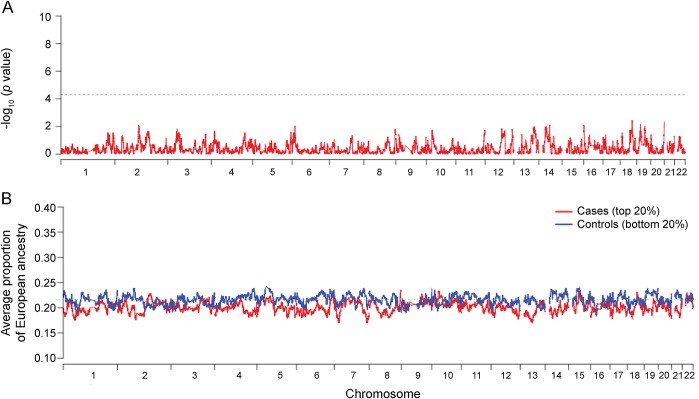
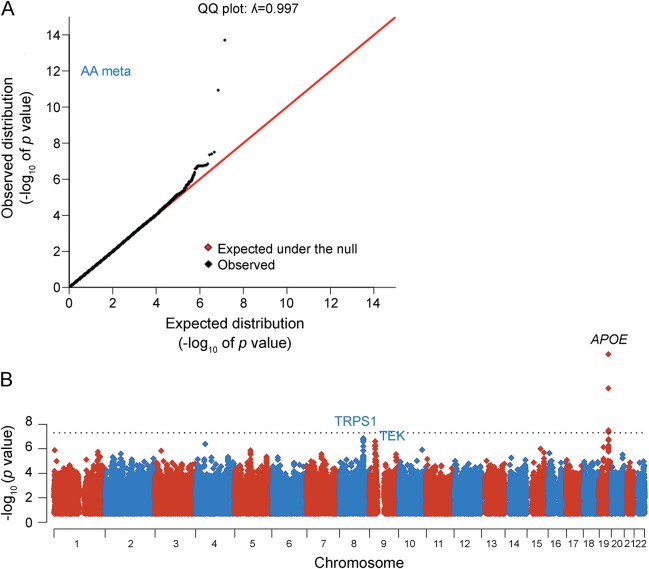
We performed a genome-wide association study (GWAS) and an admixture-mapping scan in 3,964 older AAs from 5 longitudinal cohorts; for each participant, we calculated a slope of an individual's global cognitive change from neuropsychological evaluations. We also performed a pathway-based analysis of the age-related cognitive decline GWAS.
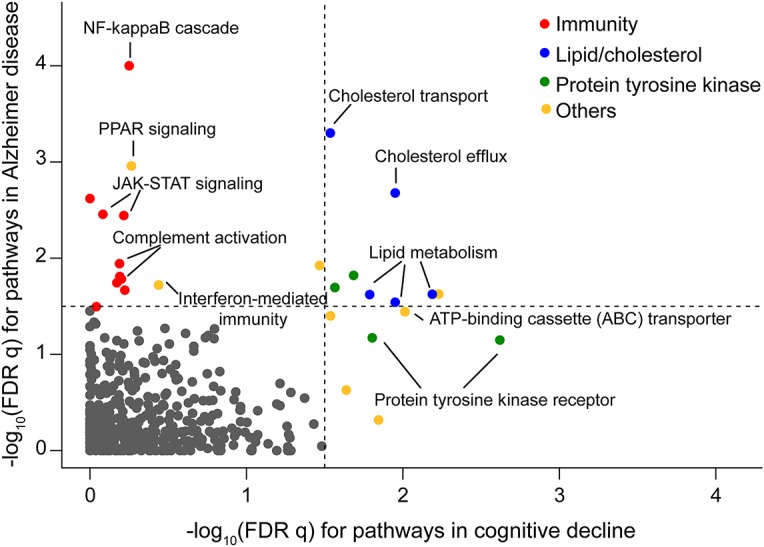
We found no evidence to support the existence of a genomic region which has a strongly different contribution to age-related cognitive decline in African and European genomes. Known Alzheimer disease (AD) susceptibility variants in the and loci do influence this trait in AAs. Of interest, our pathway-based analyses returned statistically significant results highlighting a shared risk from lipid/metabolism and protein tyrosine signaling pathways between cognitive decline and AD, but the role of inflammatory pathways is polarized, being limited to AD susceptibility.
The genetic architecture of aging-related cognitive in AA individuals is largely similar to that of individuals of European descent. In both populations, we note a surprising lack of enrichment for immune pathways in the genetic risk for cognitive decline, despite strong enrichment of these pathways among genetic risk factors for AD.
确定与非裔美国人(AA)年龄相关性认知衰退易感性相关的遗传风险因素。
我们对来自5个纵向队列的3964名老年非裔美国人进行了全基因组关联研究(GWAS)和混合映射扫描;对于每位参与者,我们根据神经心理学评估计算了个体整体认知变化的斜率。我们还对年龄相关性认知衰退GWAS进行了基于通路的分析。
我们没有发现证据支持存在一个在非洲人和欧洲人基因组中对年龄相关性认知衰退有显著不同贡献的基因组区域。已知的位于和位点的阿尔茨海默病(AD)易感变异确实会影响非裔美国人的这一特征。有趣的是,我们基于通路的分析得出了具有统计学意义的结果,突出了认知衰退和AD之间脂质/代谢和蛋白质酪氨酸信号通路的共同风险,但炎症通路的作用是两极分化的,仅限于AD易感性。
非裔美国人中与衰老相关认知的遗传结构在很大程度上与欧洲血统个体相似。在这两个人群中,我们注意到尽管这些通路在AD的遗传风险因素中高度富集,但在认知衰退的遗传风险中免疫通路令人惊讶地缺乏富集。