Lim Sher-Wei, Shiue Yow-Ling, Ho Chung-Han, Yu Shou-Chun, Kao Pei-Hsin, Wang Jhi-Joung, Kuo Jinn-Rung
Department of Neurosurgery, Chi-Mei Medical Center, Chiali, Tainan, Taiwan.
Institute of Biomedical Sciences, National Sun Yat-sen University, Kaohsiung, Taiwan.
PLoS One. 2017 Jan 12;12(1):e0169623. doi: 10.1371/journal.pone.0169623. eCollection 2017.
Traumatic spinal cord injury (tSCI) may involve new-onset anxiety and depression post-discharge. However, long-term population-based studies have lacked access to follow-up conditions in terms of new-onset anxiety and depression. The objective of this study was to estimate the long-term risk of new-onset anxiety and depression post-discharge.
The Longitudinal Health Insurance Database 2000 (LHID2000) from Taiwan's National Health Insurance Research Database was used in this study. Individuals with tSCI were identified using the International Classification of Diseases, Ninth Revision, Clinical Modification (ICD-9-CM) diagnostic codes of 806 and 952 from 1999-2008. The comparison cohort (other health conditions group) was randomly selected from the LHID2000 and was 1:1 matched by age, sex, index year, and comorbidities to reduce the selection bias. All study participants were retrospectively followed for a maximum of 3 years until the end of follow-up, death, or new-onset anxiety (ICD-9-CM: 309.2-309.4) or depression (ICD-9-CM: 296.2, 296.5, 296.82, 300.4, 309.0-309.1, and 311). Persons who were issued a catastrophic illness card for tSCI were categorized as having a severe level of SCI (Injury Severity Score [ISS] ≥16). Poisson regression was used to estimate the incidence rate ratios of anxiety or depression between patients with tSCI and other health conditions. The relative risk of anxiety or depression was estimated using a Cox regression analysis, which was adjusted for potential confounding factors.
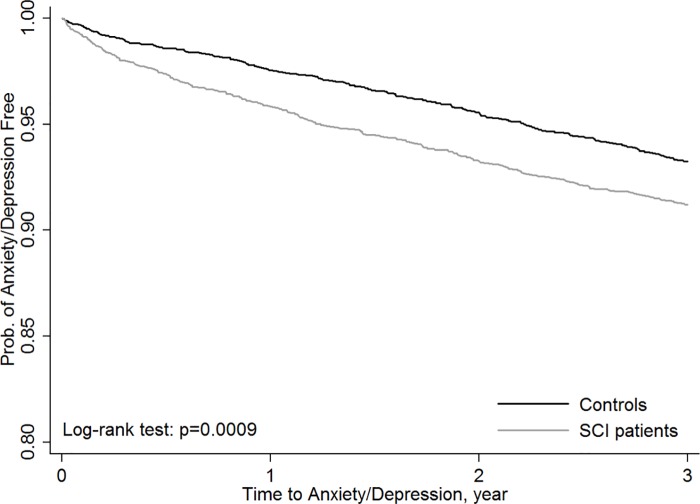
Univariate analyses showed that the tSCI patients (n = 3556) had a 1.33 times greater incidence of new-onset anxiety or depression (95% confidence interval [CI]: 1.12-1.57) compared to the other health conditions group (n = 3556). After adjusting for potential risk factors, the tSCI patients had a significant 1.29-fold increased risk of anxiety or depression compared to the group with other health conditions (95% CI: 1.09-1.53). Individuals with tSCI, including patients who were under the age of 35, patients who were males, patients who had a low income, and patients without a Charlson Comorbidity Index score, all had a higher long-term risk of anxiety or depression than the other health conditions group (IRRs: 1.84, 1.63, 1.29, and 1.39, respectively). For all tSCI patients, those with an Injury Severity Score (ISS) ≥16 had an almost 2-fold higher risk of anxiety or depression (adjusted Hazard Ratio: 1.85; 95% CI: 1.17-2.92) compared to those with ISS <16.
Our findings indicated that tSCI patients have a high risk of anxiety or depression post-discharge, especially among the younger tSCI patients (age <50 years), compared with the other health conditions group. This information could help physicians understand the long-term risk of new-onset anxiety or depression in tSCI patients post-discharge.
创伤性脊髓损伤(tSCI)可能在出院后引发新发焦虑和抑郁。然而,长期基于人群的研究缺乏关于新发焦虑和抑郁的随访情况。本研究的目的是评估出院后新发焦虑和抑郁的长期风险。
本研究使用了台湾国民健康保险研究数据库中的2000年纵向健康保险数据库(LHID2000)。通过1999 - 2008年国际疾病分类第九版临床修订本(ICD - 9 - CM)诊断编码806和952识别tSCI患者。对照队列(其他健康状况组)从LHID2000中随机选取,并按年龄、性别、索引年份和合并症进行1:1匹配,以减少选择偏倚。所有研究参与者进行了最长3年的回顾性随访,直至随访结束、死亡或出现新发焦虑(ICD - 9 - CM:309.2 - 309.4)或抑郁(ICD - 9 - CM:296.2、296.5、296.82、300.4、309.0 - 309.1和311)。因tSCI获得重大疾病卡的患者被归类为患有严重程度的脊髓损伤(损伤严重度评分[ISS]≥16)。使用泊松回归估计tSCI患者与其他健康状况患者之间焦虑或抑郁的发病率比。使用Cox回归分析估计焦虑或抑郁的相对风险,并对潜在混杂因素进行了调整。
单因素分析显示,与其他健康状况组(n = 3556)相比,tSCI患者(n = 3556)新发焦虑或抑郁的发生率高1.33倍(95%置信区间[CI]:1.12 - 1.57)。在对潜在风险因素进行调整后,与其他健康状况组相比,tSCI患者焦虑或抑郁的风险显著增加1.29倍(95% CI:1.09 - 1.53)。包括35岁以下患者、男性患者、低收入患者以及无查尔森合并症指数评分的患者在内的tSCI患者,其焦虑或抑郁的长期风险均高于其他健康状况组(发病率比分别为:1.84、1.63、1.29和1.39)。对于所有tSCI患者,损伤严重度评分(ISS)≥16的患者与ISS <16的患者相比,焦虑或抑郁的风险几乎高2倍(调整后风险比:1.85;95% CI:1.17 - 2.92)。
我们的研究结果表明,与其他健康状况组相比,tSCI患者出院后焦虑或抑郁的风险较高,尤其是在较年轻的tSCI患者(年龄<50岁)中。这些信息有助于医生了解tSCI患者出院后新发焦虑或抑郁的长期风险。
