Andersen Klaus Kaae, Duun-Henriksen Anne Katrine, Frederiksen Marie Hoffmann, Winther Jeanette Falck
Unit of Statistics, Danish Cancer Society Research Center, Strandboulevarden 49, Copenhagen 2100, Denmark.
Unit of Cancer Survivorship, Childhood Cancer Survivorship Research Group, Danish Cancer Society Research Center, Strandboulevarden 49, Copenhagen 2100, Denmark.
Br J Cancer. 2017 Jan;116(3):398-404. doi: 10.1038/bjc.2016.438. Epub 2017 Jan 12.
Childhood cancer survivors can experience learning problems resulting in lower-than-expected attained education as adults. It is unclear whether learning problems manifest already during adolescence.
We analysed nationwide Danish registries on school grades for Danish children during 2001-2014. Applying a matched design we compared grades of childhood cancer survivors to children without cancer at ninth grade. We estimated grade differences by subject and its correlation to cancer site and age at diagnosis. The available statistical precision allowed for an analysis of more rare cancer sites.
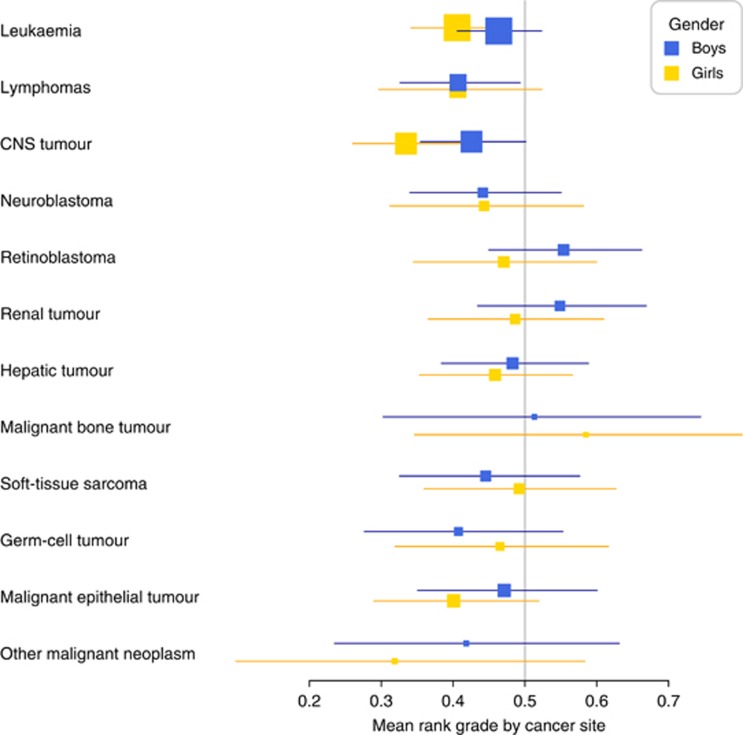
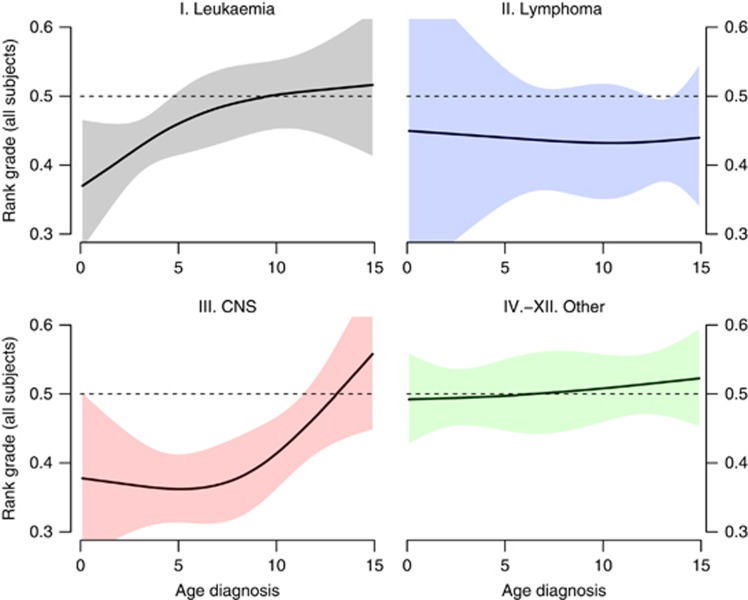
The total study population was 793 332 children (mean age 15.24 years and 49.7% girls), of whom 1320 were childhood cancer survivors. Lower rank grades were seen in children with cancer in all school subjects but differed substantially according to cancer site. Most affected were survivors of central nervous system (CNS) tumours, neuroblastoma, lymphoma, leukaemia, other malignant neoplasm and germ-cell tumours. Survivors from other cancer types did not obtain lower grades. Lower rank grades were associated with young age at diagnosis.
The effect of childhood cancer differed substantially between cancer sites. The largest effect was among survivors of CNS tumours and leukaemia diagnosed at a young age, suggesting an association with radiation therapy. However, the majority of cancer survivors fare well. Increasing awareness on children affected by cancer and special accommodations may help maximise the learning potential of those most affected.
儿童癌症幸存者可能会出现学习问题,导致成年后获得的教育程度低于预期。目前尚不清楚学习问题是否在青春期就已显现。
我们分析了丹麦全国范围内2001年至2014年丹麦儿童的学校成绩登记数据。采用匹配设计,我们将儿童癌症幸存者九年级时的成绩与无癌症儿童的成绩进行了比较。我们按学科估计了成绩差异及其与癌症部位和诊断时年龄的相关性。现有的统计精度允许对更罕见的癌症部位进行分析。
总研究人群为793332名儿童(平均年龄15.24岁,女孩占49.7%),其中1320名是儿童癌症幸存者。患癌症儿童在所有学科的成绩排名较低,但根据癌症部位有很大差异。受影响最大的是中枢神经系统(CNS)肿瘤、神经母细胞瘤、淋巴瘤、白血病、其他恶性肿瘤和生殖细胞肿瘤的幸存者。其他癌症类型的幸存者成绩没有更低。成绩排名较低与诊断时年龄较小有关。
儿童癌症的影响在不同癌症部位之间有很大差异。影响最大的是幼年时被诊断为中枢神经系统肿瘤和白血病的幸存者,这表明与放射治疗有关。然而,大多数癌症幸存者情况良好。提高对受癌症影响儿童的认识并提供特殊便利可能有助于最大限度地发挥受影响最大儿童的学习潜力。