Fidler Miranda M, Reulen Raoul C, Henson Katherine, Kelly Julie, Cutter David, Levitt Gill A, Frobisher Clare, Winter David L, Hawkins Michael M
From Centre for Childhood Cancer Survivor Studies, Institute of Applied Health Research, University of Birmingham, Birmingham, UK (M.M.F., R.C.R., K.H., J.K., C.F., D.L.W., M.M.H.); Nuffield Department of Population Health, University of Oxford, Oxford, UK (K.H., D.C.); Oxford Cancer and Haematology Centre, Oxford University Hospitals NHS Foundation Trust, Churchill Hospital, Headington, Oxford, UK (D.C.); and Great Ormond Street Hospital NHS Foundation Trust, London, UK (G.A.L.).
Circulation. 2017 Mar 7;135(10):951-963. doi: 10.1161/CIRCULATIONAHA.116.024811. Epub 2017 Jan 12.
Increased risks of cardiac morbidity and mortality among childhood cancer survivors have been described previously. However, little is known about the very long-term risks of cardiac mortality and whether the risk has decreased among those more recently diagnosed. We investigated the risk of long-term cardiac mortality among survivors within the recently extended British Childhood Cancer Survivor Study.
The British Childhood Cancer Survivor Study is a population-based cohort of 34 489 five-year survivors of childhood cancer diagnosed from 1940 to 2006 and followed up until February 28, 2014, and is the largest cohort to date to assess late cardiac mortality. Standardized mortality ratios and absolute excess risks were used to quantify cardiac mortality excess risk. Multivariable Poisson regression models were used to evaluate the simultaneous effect of risk factors. Likelihood ratio tests were used to test for heterogeneity and trends.
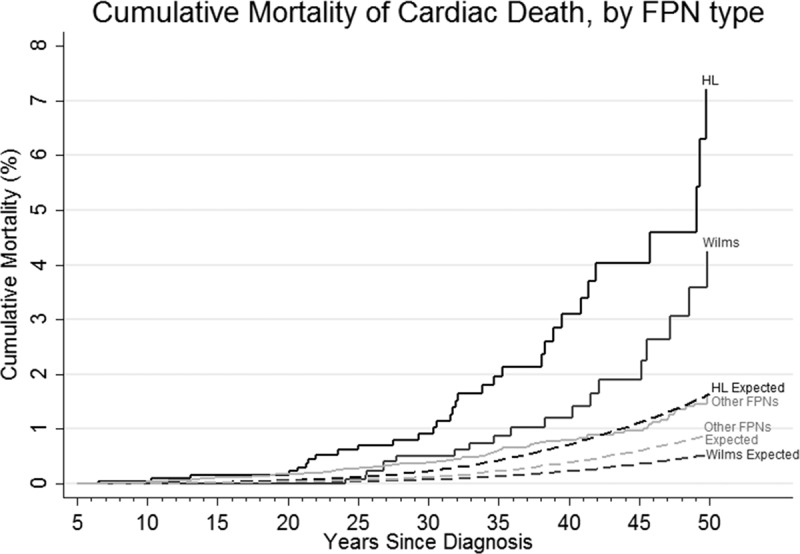
Overall, 181 cardiac deaths were observed, which was 3.4 times that expected. Survivors were 2.5 times and 5.9 times more at risk of ischemic heart disease and cardiomyopathy/heart failure death, respectively, than expected. Among those >60 years of age, subsequent primary neoplasms, cardiac disease, and other circulatory conditions accounted for 31%, 22%, and 15% of all excess deaths, respectively, providing clear focus for preventive interventions. The risk of both overall cardiac and cardiomyopathy/heart failure mortality was greatest among those diagnosed from 1980 to 1989. Specifically, for cardiomyopathy/heart failure deaths, survivors diagnosed from 1980 to 1989 had 28.9 times the excess number of deaths observed for survivors diagnosed either before 1970 or from 1990 on.
Excess cardiac mortality among 5-year survivors of childhood cancer remains increased beyond 50 years of age and has clear messages in terms of prevention strategies. However, the fact that the risk was greatest in those diagnosed from 1980 to 1989 suggests that initiatives to reduce cardiotoxicity among those treated more recently may be having a measurable impact.
此前已有研究表明儿童癌症幸存者患心脏病的发病率和死亡率风险增加。然而,对于心脏死亡的长期风险以及最近确诊的患者中该风险是否有所降低,我们知之甚少。我们在最近扩大的英国儿童癌症幸存者研究中调查了幸存者长期心脏死亡的风险。
英国儿童癌症幸存者研究是一项基于人群的队列研究,纳入了1940年至2006年期间确诊的34489名儿童癌症五年幸存者,并随访至2014年2月28日,是迄今为止评估晚期心脏死亡的最大队列。标准化死亡比和绝对超额风险用于量化心脏死亡的超额风险。多变量泊松回归模型用于评估风险因素的同时作用。似然比检验用于检验异质性和趋势。
总体而言,观察到181例心脏死亡,是预期死亡数的3.4倍。幸存者患缺血性心脏病和心肌病/心力衰竭死亡的风险分别比预期高2.5倍和5.9倍。在60岁以上的人群中,后续原发性肿瘤、心脏病和其他循环系统疾病分别占所有超额死亡的31%、22%和15%,为预防干预提供了明确重点。1980年至1989年确诊的患者中,总体心脏死亡和心肌病/心力衰竭死亡的风险最高。具体而言,对于心肌病/心力衰竭死亡,1980年至1989年确诊的幸存者的超额死亡人数是1970年以前或1990年以后确诊的幸存者的28.9倍。
儿童癌症五年幸存者的心脏死亡超额风险在50岁以后仍然增加,并且在预防策略方面有明确的信息。然而,1980年至1989年确诊的患者风险最高这一事实表明,降低近期接受治疗患者心脏毒性的举措可能正在产生可衡量的影响。