Logan C J, Kruuk L E B, Stanley R, Thompson A M, Clutton-Brock T H
Department of Zoology , University of Cambridge , Cambridge , UK.
Institute of Evolutionary Biology, University of Edinburgh, Edinburgh, UK; Division of Evolution, Ecology and Genetics, Research School of Biology, The Australian National University, Canberra, Australia.
R Soc Open Sci. 2016 Dec 14;3(12):160622. doi: 10.1098/rsos.160622. eCollection 2016 Dec.
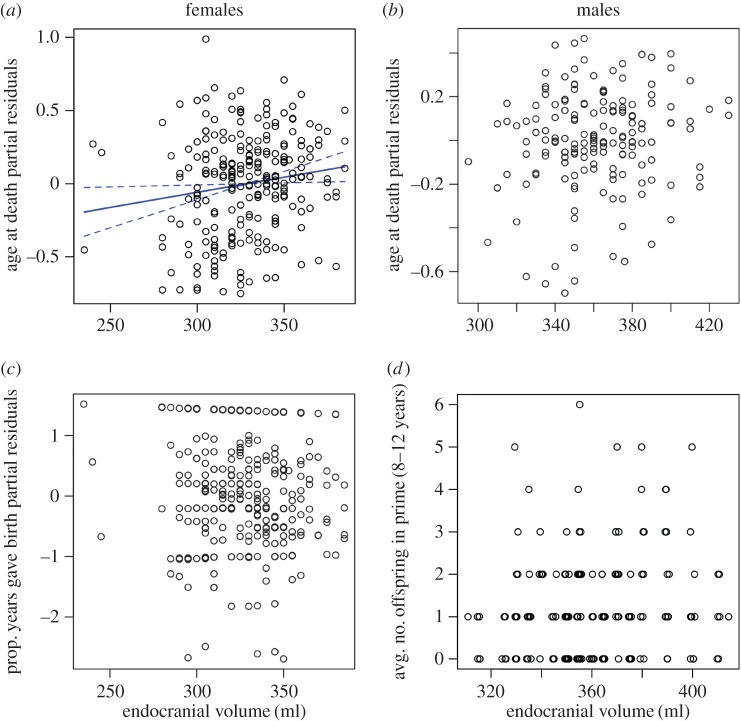
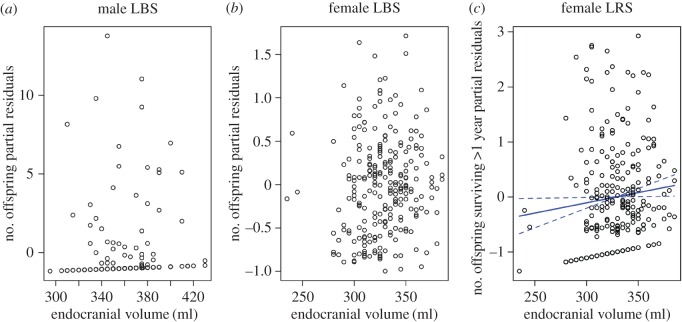
Research on relative brain size in mammals suggests that increases in brain size may generate benefits to survival and costs to fecundity: comparative studies of mammals have shown that interspecific differences in relative brain size are positively correlated with longevity and negatively with fecundity. However, as yet, no studies of mammals have investigated whether similar relationships exist within species, nor whether individual differences in brain size within a wild population are heritable. Here we show that, in a wild population of red deer (), relative endocranial volume was heritable ( = 63%; 95% credible intervals (CI) = 50-76%). In females, it was positively correlated with longevity and lifetime reproductive success, though there was no evidence that it was associated with fecundity. In males, endocranial volume was not related to longevity, lifetime breeding success or fecundity.
对哺乳动物相对脑容量的研究表明,脑容量的增加可能会给生存带来益处,但也会给繁殖力带来成本:对哺乳动物的比较研究表明,相对脑容量的种间差异与寿命呈正相关,与繁殖力呈负相关。然而,迄今为止,还没有对哺乳动物的研究调查过物种内部是否存在类似的关系,也没有研究过野生种群中个体脑容量的差异是否可遗传。在这里,我们表明,在一个野生马鹿种群中,相对颅内容积是可遗传的(遗传力=63%;95%可信区间(CI)=50-76%)。在雌性中,它与寿命和终生繁殖成功率呈正相关,尽管没有证据表明它与繁殖力有关。在雄性中,颅内容积与寿命、终生繁殖成功率或繁殖力无关。