Department of Oral Kinesiology, Academic Centre for Dentistry Amsterdam (ACTA), University of Amsterdam and VU University Amsterdam, MOVE Research Institute Amsterdam, Gustav Mahlerlaan 3004, 1081 LA, Amsterdam, The Netherlands.
Department of Oral and Maxillofacial Diseases, University of Helsinki, Helsinki, Finland.
Clin Oral Investig. 2017 Sep;21(7):2371-2378. doi: 10.1007/s00784-016-2045-3. Epub 2017 Jan 12.
The aim of this randomized placebo-controlled trail was to compare the effects of an objectively titrated mandibular advancement device (MAD) with those of nasal continuous positive airway pressure (nCPAP) and an intraoral placebo device on symptoms of psychological distress in OSA patients.
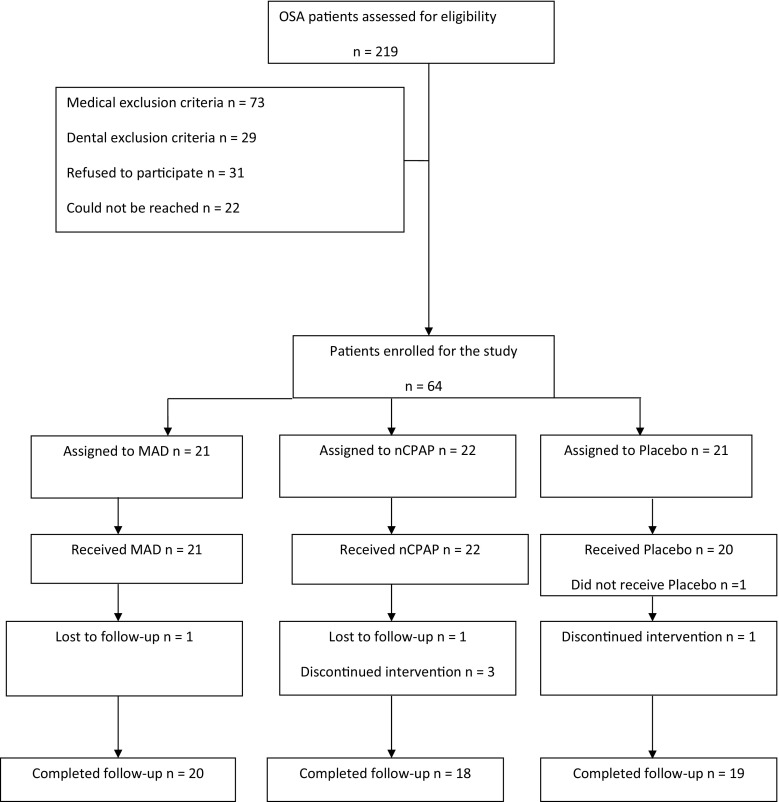
In a parallel design, 64 mild/moderate OSA patients (52.0 ± 9.6 years) were randomly assigned to an objectively titrated MAD, nCPAP, or an intraoral placebo appliance. All patients filled out the Symptom Checklist-90-Revised twice: one before treatment and one after 6 months of treatment. The Symptom Checklist-90-Revised is a multidimensional symptom inventory designed to measure symptomatic psychological distress over the past week. Linear mixed model analyses were performed to study differences between the therapy groups for the different dimensions of the Symptom Checklist-90-Revised over time.
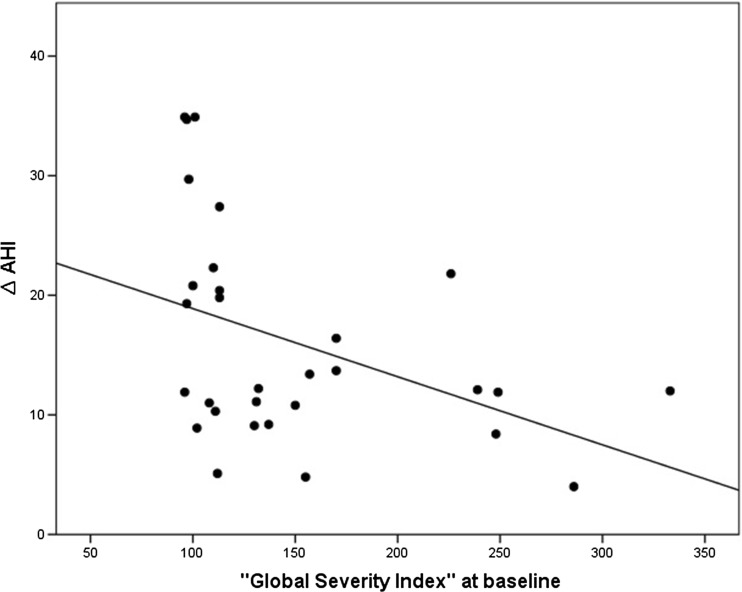
The MAD group showed significant improvements over time in the dimensions "somatization," "insufficiency of thinking and acting," "agoraphobia," "anxiety," "sleeping problems," and "global severity index" (F = 4.14-16.73, P = 0.048-0.000). These improvements in symptoms of psychological distress were, however, not significantly different from those observed in the nCPAP and placebo groups (P = 0.374-0.953).
There is no significant difference between MAD, nCPAP, and an intraoral placebo appliance in their beneficial effects on symptoms of psychological distress.
The improvement in psychological distress symptoms in mild/moderate OSA patients under MAD or nCPAP treatment may be explained by a placebo effect.
本随机安慰剂对照试验旨在比较客观滴定的下颌前伸装置(MAD)与持续气道正压通气(nCPAP)和口腔内安慰剂装置对 OSA 患者心理困扰症状的影响。
在平行设计中,64 例轻度/中度 OSA 患者(52.0±9.6 岁)被随机分配到客观滴定的 MAD、nCPAP 或口腔内安慰剂装置组。所有患者在治疗前和治疗 6 个月后两次填写症状清单 90 修订版。症状清单 90 修订版是一种多维症状清单,旨在衡量过去一周的症状性心理困扰。线性混合模型分析用于研究治疗组在症状清单 90 修订版不同维度上随时间的差异。
MAD 组在“躯体化”、“思维和行动不足”、“广场恐怖症”、“焦虑”、“睡眠问题”和“总体严重程度指数”等维度上随时间显著改善(F=4.14-16.73,P=0.048-0.000)。然而,这些心理困扰症状的改善与 nCPAP 和安慰剂组观察到的改善无显著差异(P=0.374-0.953)。
MAD、nCPAP 和口腔内安慰剂装置在改善心理困扰症状方面没有显著差异。
在 MAD 或 nCPAP 治疗下,轻度/中度 OSA 患者的心理困扰症状改善可能归因于安慰剂效应。