Ihn Hye Jung, Lee Taeho, Kim Ju Ang, Lee Doohyun, Kim Nam Doo, Shin Hong-In, Bae Yong Chul, Park Eui Kyun
Department of Oral Pathology and Regenerative Medicine, School of Dentistry, IHBR, Kyungpook National University, Daegu, Republic of Korea.
College of Pharmacy, Research Institute of Pharmaceutical Sciences, Kyungpook National University, Daegu, Republic of Korea.
PLoS One. 2017 Jan 13;12(1):e0170159. doi: 10.1371/journal.pone.0170159. eCollection 2017.
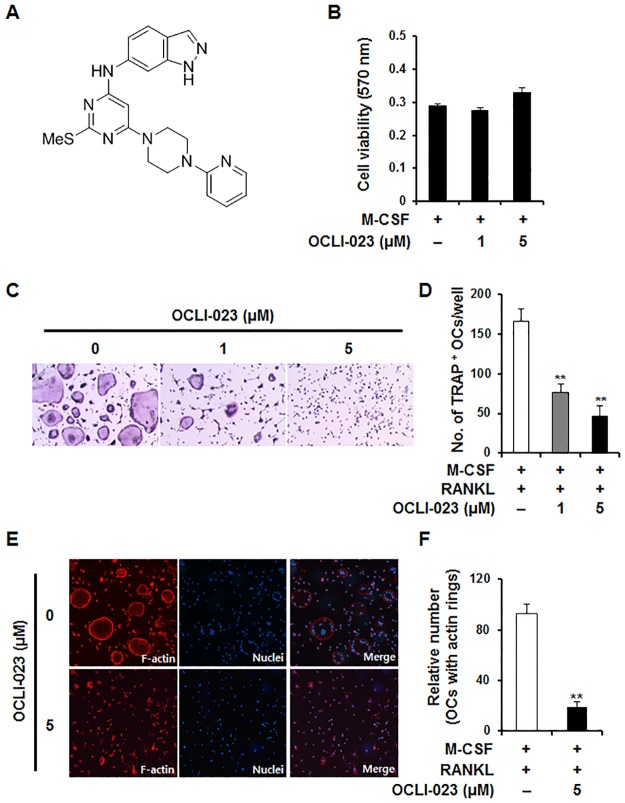
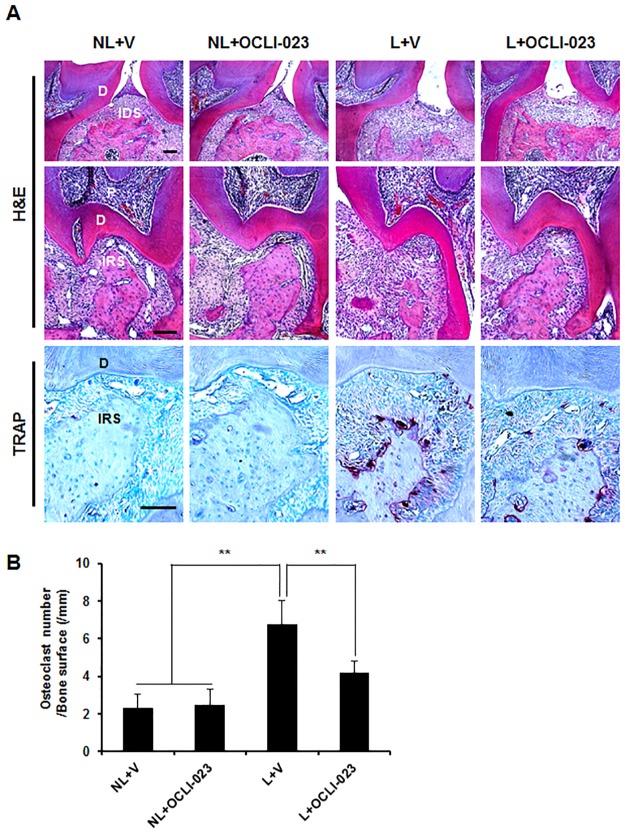
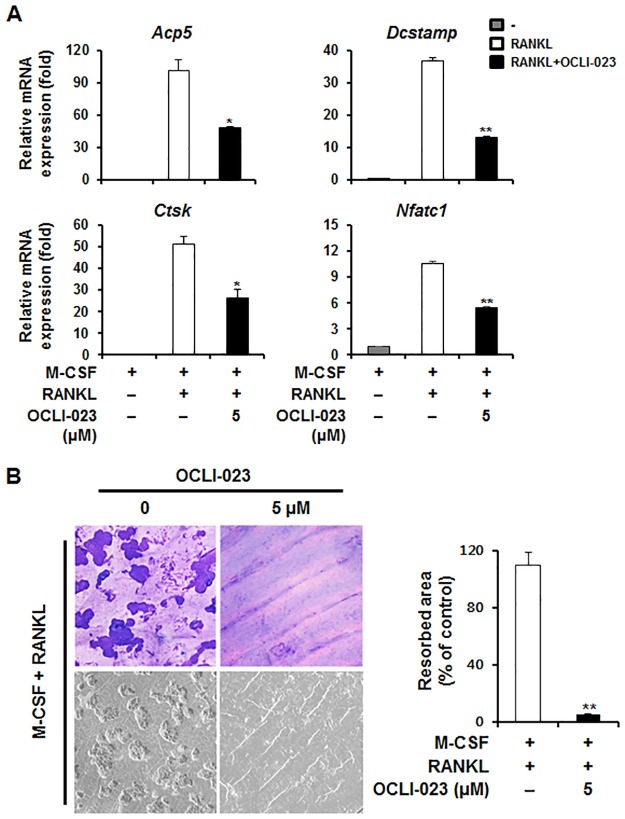
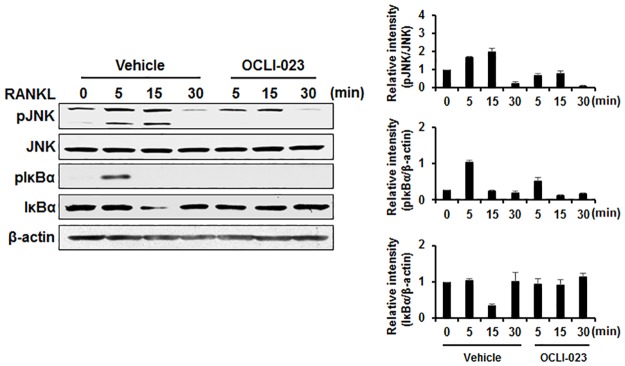
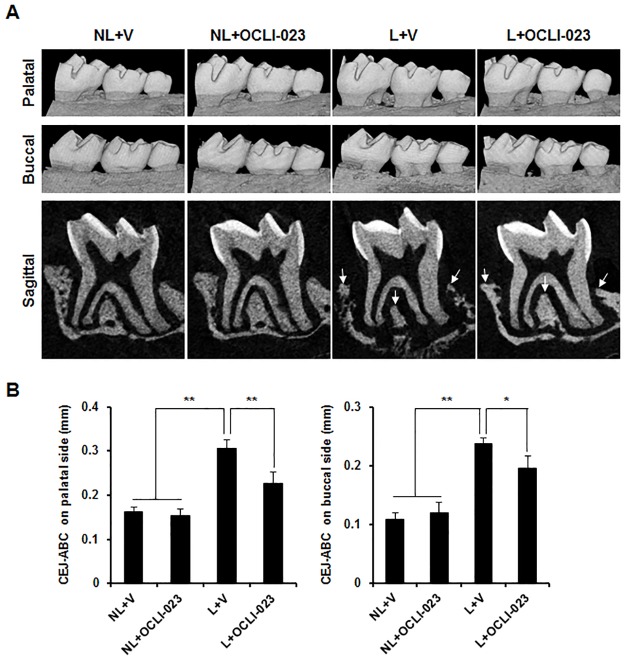
An abnormal increase in osteoclast differentiation and activation results in various bone-resorptive diseases, including periodontitis, rheumatoid arthritis, and osteoporosis. Chemical compounds containing pyrimidine ring have been shown to regulate a variety of biological processes. Therefore, in order to identify an antiresorptive agent, we synthesized a series of pyrimidine ring-containing chemical compounds, and found that OCLI-023 suppressed the differentiation and activation of osteoclasts in vitro. OCLI-023 directly inhibited receptor activator of nuclear factor-κB ligand (RANKL)-induced differentiation of bone marrow macrophages into osteoclasts, without a cytotoxic response. OCLI-023 also downregulated the RANKL-induced mRNA expression of osteoclast markers as well as inhibited the formation of actin rings and resorption pits. OCLI-023 attenuated the RANKL-induced activation of c-Jun N-terminal kinase and nuclear factor kappa-light-chain-enhancer of activated B cell signaling pathways. In a mouse model of periodontitis, ligature induced an increase of distance between cementoenamel junction (CEJ) and alveolar bone crest (ABC) in the second molar, and OCLI-023 significantly reduced it. Histological analysis showed ligature-induced increase of osteoclast numbers was also significantly reduced by OCLI-023. These data demonstrated the inhibitory effect of OCLI-023 on osteoclast differentiation and activity of osteoclasts in vitro, as well as on ligature-induced bone loss in vivo, and OCLI-023 can be proposed as a novel anti-resorptive compound.
破骨细胞分化和激活的异常增加会导致多种骨吸收性疾病,包括牙周炎、类风湿性关节炎和骨质疏松症。含嘧啶环的化合物已被证明可调节多种生物学过程。因此,为了鉴定一种抗吸收剂,我们合成了一系列含嘧啶环的化合物,并发现OCLI-023在体外可抑制破骨细胞的分化和激活。OCLI-023直接抑制核因子κB受体活化因子配体(RANKL)诱导的骨髓巨噬细胞分化为破骨细胞,且无细胞毒性反应。OCLI-023还下调了RANKL诱导的破骨细胞标志物的mRNA表达,并抑制了肌动蛋白环和吸收陷窝的形成。OCLI-023减弱了RANKL诱导的c-Jun氨基末端激酶和活化B细胞核因子κB轻链增强子信号通路的激活。在牙周炎小鼠模型中,结扎导致第二磨牙牙骨质釉质界(CEJ)与牙槽嵴顶(ABC)之间的距离增加,而OCLI-023显著减小了该距离。组织学分析表明,OCLI-023也显著减少了结扎诱导的破骨细胞数量增加。这些数据证明了OCLI-023在体外对破骨细胞分化和破骨细胞活性的抑制作用,以及在体内对结扎诱导的骨质流失的抑制作用,并且OCLI-023可被认为是一种新型抗吸收化合物。